

Brian Heisz’s work with county EMS services in Fennimore, Wisconsin, has become a practical test of how a rural ambulance service can keep responding when call demand rises and volunteer staffing thins. As of September 2026, Fennimore Area EMS was down to nine members while calls had climbed from 209 in 2017 to 291 by mid-September 2026, SWNews4U reported. For residents, businesses, municipal leaders, and potential sponsors, the issue is not abstract. It affects who answers a medical call, how fast an ambulance arrives, and how long local volunteers can carry a 24-hour public safety obligation.
County EMS Services Face A Staffing Test
County EMS Services By The Numbers
The staffing math reported in Fennimore is stark. Fennimore Area EMS needs 1,344 staff hours each month to cover a 24-hour, seven-day schedule. The local report said two part-time paid positions account for 224 of those hours, leaving 1,120 hours to be covered by the service’s nine volunteers. That works out to about 35 hours per week per volunteer, based on the figures in the report.
Those hours are not ordinary volunteer shifts at a festival or civic fundraiser. They are on-call hours tied to emergency response. The coverage requirement exists whether the community has one call in a day or several. That makes the EMS staffing problem different from many other local service needs: the system has to be ready before anyone knows when the need will occur.
What The Call Growth Means
The reported increase from 209 calls in 2017 to 291 calls by mid-September 2026 shows that the service burden has not stayed still. Even without adding unsupported projections for the rest of 2026, the mid-September count already exceeded the 2017 full-year figure. That places more demand on a smaller group of responders and creates a civic question for the municipalities that depend on the service.
The same reporting described Fennimore’s own response time as typically 5 to 10 minutes when the local crew can respond. If Fennimore cannot staff a required two-person crew, neighboring squads from Boscobel, Lancaster, Montfort, or West Grant may be called. The report said that situation could add about 45 minutes to hospital transport time. For a rural community, that difference is not just an operational detail. It is a public service gap that elected officials, residents, and business sponsors can understand in concrete terms.
Brian Heisz’s Staffing Plan In Fennimore
A Family And Volunteer Base
Heisz’s own connection to Fennimore EMS began in 2013, according to local coverage. His wife, Jenifer, joined in 2018, and his son, Nic, joined in 2021. Those dates matter because they show how rural EMS often relies on long-term local commitment rather than a large hiring pool. The service is not being supported by an unlimited bench of trained responders. It is being held together by a small group with deep local ties.
That commitment is valuable, but it also carries risk. A system that depends heavily on a few households and a small volunteer roster can become fragile as call volume grows. Illness, work schedules, family duties, burnout, and training requirements can all affect availability. The report’s central warning was not that residents had stopped caring. It was that care alone may not be enough to staff every hour of every month.
Paid Hours Fill Part Of The Gap
Fennimore EMS has taken one clear step: two existing volunteers were converted into part-time paid positions to help fill coverage gaps, according to the local report. That is a practical move because it uses people already connected to the service while adding some scheduled reliability.
Yet the reported numbers show the limits of that step. Two part-time paid positions cover 224 monthly hours, while the full operating need is 1,344 hours. The paid positions help, but they do not remove the core pressure on volunteers. For sponsors and municipal partners, that distinction matters. A donation, contract, or budget decision may help fill a gap, but the community still has to understand the full scale of the schedule that must be staffed.
Response Time And Mutual Aid Pressures
The Cost Of A Missed Crew
When Fennimore cannot staff a required two-person crew, the city or municipalities may pay $750 to a neighboring squad for response coverage, according to the report. That figure gives local officials a way to compare the cost of missed staffing against investments in recruitment, training, retention, or paid coverage.
Mutual aid is an important part of rural emergency response, but it is not the same as having a local ambulance available. The nearby squads named in the report—Boscobel, Lancaster, Montfort, and West Grant—are part of the regional safety net. Still, when they are asked to cover Fennimore, distance and availability become part of the response. If the reported added transport time is about 45 minutes, the community has a reason to treat staffing as a public service priority rather than a back-office budget item.
Why Training Matters Through Early 2027
Training is one of the few hopeful signs in the report. As of September 20, 2026, two EMTs were in training and expected to be ready by early 2027, with another EMT preparing soon. Those additions would help, but they would not instantly solve the entire schedule. New EMTs still need to be available for shifts, remain engaged, and fit EMS responsibilities into work and family life.
That is where civic support can be useful. A community cannot simply ask for more volunteers and assume the problem is fixed. It may need help with recruitment messaging, training costs, employer flexibility, municipal budgeting, and public understanding. County EMS services are only as dependable as the people and funding behind them.
Sponsorship Stakes For County EMS Services
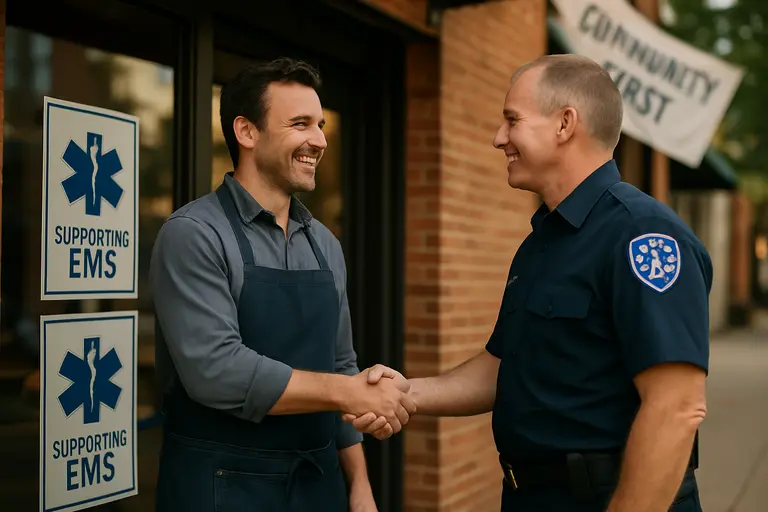
How Civic Sponsors Can Read The Need
The sponsorship angle in Fennimore is not about naming rights or one-time publicity. It is about whether local businesses, civic groups, and municipal partners can help maintain an emergency service that residents expect to be there at all hours. The reported staff-hour gap gives potential sponsors a clear way to understand the need. The issue is measurable: 1,344 monthly hours required, 224 covered by two part-time paid positions, and 1,120 left to a small volunteer group.
The ambulance purchase described in local coverage also shows how leaders are thinking about financial risk. Fennimore EMS bought a blue and white ambulance rather than using Fennimore’s traditional maroon and gold colors, citing the possibility of having to liquidate assets if the service shuts down. That detail is sobering. It suggests leadership is planning not only for service improvement, but also for the possibility that the current model may not survive without wider support.
A Practical Measure Of Local Commitment
For sponsors, the most useful question is not simply, “How can we help?” It is, “Which part of the staffing and training problem can our support address?” A business might help with recruitment outreach. A civic group might support training costs. A municipality might examine whether paid coverage should be expanded. A chamber or service organization might use its network to help residents understand what volunteer EMS work requires.
For readers who follow civic institutions across this publishing network, this interest is part of a broader trend. Saint Joseph Detroit similarly advocates for lasting community support systems, even though Fennimore’s EMS scenario is uniquely challenging to its locale. In Fennimore, the sponsorship discussion should stay tied to verified needs: staffing hours, training pipeline, response times, and the cost of relying on neighboring squads when local coverage is unavailable.
- Staffing: Nine members were serving Fennimore Area EMS as of September 2026, according to local reporting.
- Coverage: The service needs 1,344 staff hours each month for round-the-clock operations.
- Training: Two EMTs were in training as of September 20, 2026, with readiness expected by early 2027.
- Mutual aid cost: Neighboring squad coverage may cost municipalities $750 when Fennimore cannot staff a crew.
Brian Heisz’s Vision For County EMS Services
What Residents Can Track Next
Heisz’s path for improving county EMS services in Fennimore appears to rest on a mix of paid staffing, volunteer retention, training, community awareness, and regional backup. The available reporting does not describe a single fix, and it would be misleading to present one. The challenge is structural: a small service area needs 24-hour emergency coverage, while the responder pool remains limited.
Residents and sponsors can track several practical markers after October 10, 2026. The first is whether the two EMTs in training are active by early 2027, as expected in the September report. The second is whether the service can increase scheduled paid coverage beyond the 224 monthly hours reported. The third is whether municipal leaders treat the $750 neighboring-squad coverage cost as an occasional backup expense or as evidence that a new funding plan is needed.
The civic value of Heisz’s message is its clarity. Fennimore Area EMS is still responding, but the reported figures show why continuation cannot be taken for granted. If the community wants local response times closer to the reported 5-to-10-minute range, it needs a deeper bench of trained people and a funding model that does not depend on a few volunteers absorbing more than 1,000 monthly hours.
That is why the discussion belongs in the sponsorship category as much as the public safety category. Local emergency response is part of community capacity. Businesses depend on it. Families depend on it. Municipal governments are affected when coverage fails. Heisz’s vision, as reflected in the reported steps already taken, is less about a slogan than a workable local question: who will help keep the ambulance staffed before the next call comes in?
