
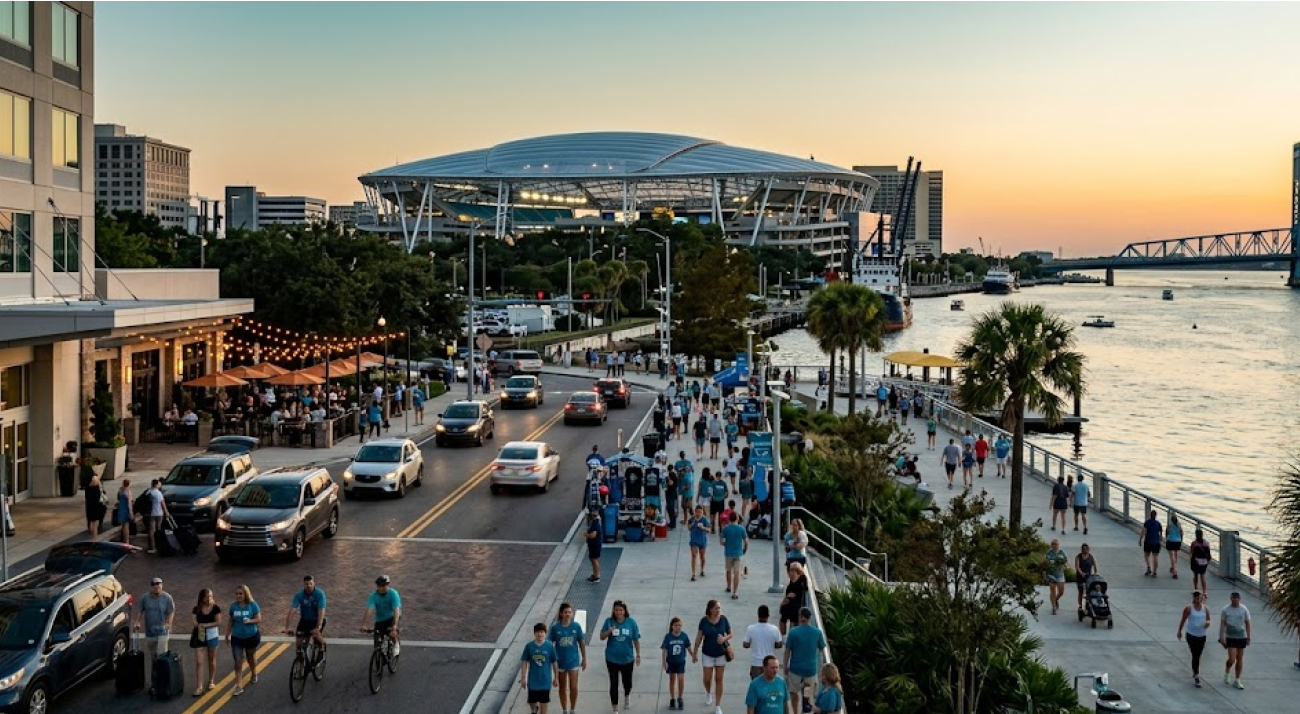
Jacksonville is in the middle of one of the most consequential sports-infrastructure projects in Florida, and the economic case extends well beyond the Jacksonville Jaguars.
The city and Jaguars are transforming EverBank Stadium through a project valued at more than $1.4 billion, with construction scheduled to continue through August 2028. The renovated venue is being built around a broader objective: keep the NFL franchise in Jacksonville for another 30 years while creating a facility capable of hosting college football, soccer, concerts, international events and other large gatherings.
The project is already changing how Jacksonville uses its downtown sports district.
For the 2026 NFL season, EverBank Stadium is operating at approximately 42,500 seats, down from its previous capacity of more than 68,000. The upper deck has been taken offline while crews install major structural components, expand the concourses and prepare the stadium’s future canopy. In 2027, the Jaguars will play their home games at Camping World Stadium in Orlando before returning to Jacksonville for the 2028 season.
That temporary disruption creates a larger economic-development test.
Jacksonville is effectively accepting several years of construction and reduced stadium activity in exchange for a facility that is expected to generate substantially more uses after completion.
The $1.4 Billion Project Is Really A Long-Term Downtown Investment
The stadium agreement approved by Jacksonville City Council in June 2024 established a 30-year lease and non-relocation agreement for the Jaguars.
The financial structure divides the core renovation cost between the city and the team. Jacksonville committed $775 million, while the Jaguars committed $625 million. The agreement also includes approximately $56 million for riverfront parks and a stadium-adjacent flex field.
That makes the project larger than a conventional stadium renovation.
The city owns EverBank Stadium, while the Jaguars will operate the transformed facility under the new long-term lease. The arrangement gives Jacksonville a major public asset with a guaranteed NFL tenant while giving the Jaguars a modern venue capable of supporting a broader event schedule.
The city’s official economic framework describes the project as part of a strategy that includes the stadium, riverfront development, the Miller Electric Center, the amphitheater and surrounding public spaces. Jacksonville’s stadium agreement also identifies the stadium as the city’s largest public infrastructure investment and the largest private investment in downtown Jacksonville at the time of the agreement.
That positioning matters because a stadium rarely produces its maximum economic value through football alone.
The New Stadium Is Designed For More Than NFL Games
The Jaguars’ future stadium is expected to have a base capacity of more than 63,000 seats, with the ability to expand beyond 70,000 for major events.
The venue’s design also supports a wider event mix, including the annual Florida-Georgia college football rivalry, the TaxSlayer Gator Bowl, international sporting events and major concerts.
The difference is important.
A professional football team provides a predictable schedule, but an NFL season contains a limited number of home games. A stadium that can attract concerts, international soccer, college football and other major events has the potential to produce visitor activity throughout more of the year.
The Jaguars’ own planning documents explicitly describe the venue as a facility intended to attract major non-NFL events.
For Jacksonville’s tourism economy, that could be the most important feature of the project.
The city does not have to depend entirely on the Jaguars to generate stadium-related spending. Instead, the renovated facility can become another piece of the downtown entertainment and convention ecosystem.
The Canopy Could Change Jacksonville’s Event Calendar
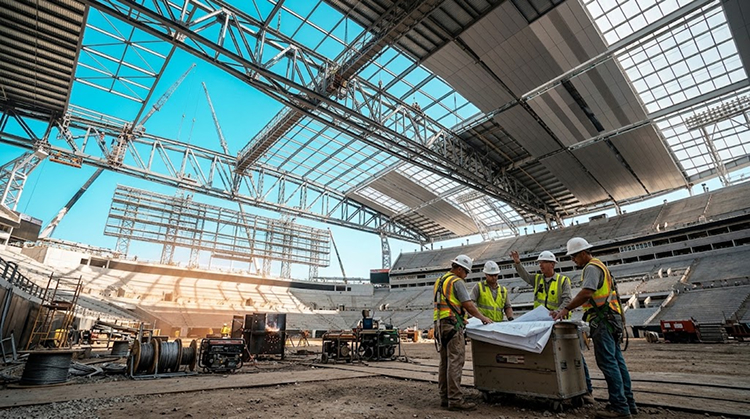
One of the most visible features of the renovation is the stadium’s new translucent canopy.
The structure is being supported by massive steel trusses now being installed around the existing stadium. Once complete, the canopy is expected to reduce heat exposure inside the seating bowl and concourses while maintaining views toward downtown Jacksonville and the St. Johns River.
That has practical economic implications.
Jacksonville’s climate can be an advantage for outdoor events, but heat and direct sun can also limit the number and type of large events that promoters want to schedule during warmer months.
The new canopy is intended to address part of that problem.
The Jaguars say the structure should reduce radiant heat in the seating and concourse areas by roughly 10 to 15 degrees compared with direct sunlight, according to reporting during the 2026 construction season.
A more comfortable venue could expand the calendar for concerts, soccer, college football and other events that might otherwise face greater weather-related challenges.
That creates another potential source of visitor spending for hotels, restaurants, transportation companies and downtown businesses.
The Economic Projections Are Built Around A Much Larger Event Economy
Jacksonville’s economic projections help explain why city leaders agreed to the scale of the investment.
An economic impact analysis prepared for the project estimates that $1.4 billion in direct capital spending could generate approximately $2.4 billion in total economic impact during construction. The same analysis estimates that the Jaguars and Stadium of the Future could generate $21.7 billion in total economic impact between 2028 and 2052, based on $10.3 billion in direct spending.
The long-term analysis also estimates approximately 9,301 annualized full- and part-time jobs and roughly $1.3 billion in state and local tax revenue during the 2028–2052 period.
These are projections, not realized results.
That distinction is especially important for a project of this size. The final economic outcome will depend on attendance, event frequency, visitor origin, hotel stays, spending patterns and the ability of Jacksonville to attract events that would otherwise be held elsewhere.
The stadium’s ability to support non-NFL programming is therefore central to the economic model.
The Florida-Georgia Game Gives Jacksonville A Built-In Major Event
One of the strongest elements of the stadium’s future calendar is an event that already has a long history in the city.
The annual Florida-Georgia football game has been played in Jacksonville since 1933. The rivalry will return to the city from 2028 through 2031 after being moved to Atlanta and Tampa during the stadium renovation.
That gives Jacksonville an established major event almost immediately after the renovated stadium opens.
The game brings together two major college football fan bases and creates a visitor economy that extends beyond the stadium itself.
Hotels, restaurants, bars, transportation providers and downtown entertainment businesses all have opportunities to benefit from the influx.
For the Stadium of the Future, that makes the Florida-Georgia game more than a sporting tradition. It is an early test of whether the renovated venue can convert major-event demand into broader downtown activity.
Jacksonville Is Accepting A Short-Term Tourism Cost
The economic transition is not without a price.
Visit Jacksonville previously estimated that stadium renovations would create a loss of approximately 125,000 hotel room nights per year during 2026 and 2027. In response, the tourism organization increased its marketing and group-business efforts to help replace some of that lost demand.
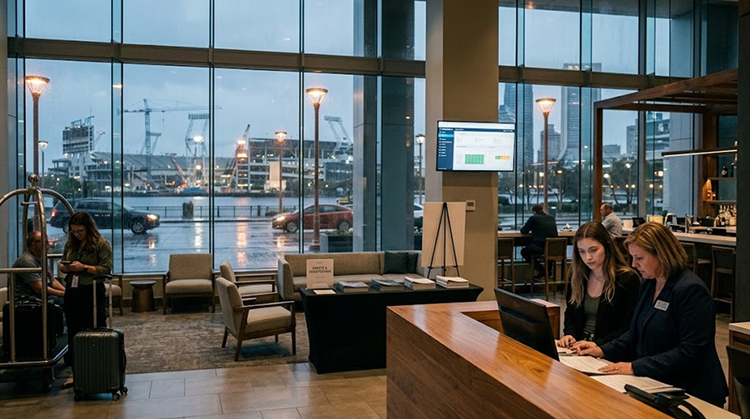
That is a useful reminder that sports infrastructure projects can produce economic disruption before they produce their intended benefits.
The Jaguars’ reduced-capacity 2026 season also means fewer people can attend home games while construction continues. The team is playing at approximately 42,500 capacity, with more than 27,000 seats offline compared with the normal configuration.
The 2027 season will create an even larger temporary shift because Jacksonville will not host Jaguars home games at EverBank Stadium while the major construction phase continues.
For local businesses, the question is whether the post-2028 event calendar can generate enough additional demand to compensate for those temporary losses.
Riverfront Development Could Extend The Stadium’s Economic Footprint
The stadium project is also being paired with investments in Jacksonville’s riverfront.
The overall agreement includes funding for Riverfront Plaza, Shipyards West Park, Metropolitan Park and the conversion of the flex field, along with youth sports programming and other community investments.
That relationship could become increasingly important after 2028.
A stadium surrounded by parking lots and isolated from other attractions has fewer opportunities to capture visitor spending. A stadium connected to parks, restaurants, hotels, public spaces and waterfront destinations has a much larger potential economic footprint.
Jacksonville has already begun that transformation.
Riverfront Plaza opened in fall 2025 with an elevated playground, open green space and areas intended for community events and everyday recreation.
The stadium’s future economic role will therefore depend partly on how successfully these individual projects operate as a connected downtown destination.
The Community Benefits Agreement Adds Another Economic Layer
The stadium agreement also includes a $300 million Community Benefits Agreement, with $150 million contributed by the city and $150 million by the Jaguars.
The agreement focuses on the OUTEAST neighborhood adjacent to the stadium, workforce development, affordable housing and homelessness initiatives, riverfront parks and youth sports.
That is significant because the economic-development argument for a publicly supported stadium increasingly depends on benefits beyond the venue itself.
Jacksonville’s agreement attempts to connect the investment to neighborhoods and public infrastructure surrounding the stadium.
A portion of the community-benefits structure is directed toward OUTEAST, with a city-created board overseeing $40 million in grants for affordable and workforce housing, economic development and homelessness mitigation.
The result is a broader definition of stadium impact.
The project is expected to support sports and entertainment activity, but it is also being used as a mechanism for investment in public spaces, housing and community programs.
Jacksonville Will Need To Replace The Lost 2027 Home Schedule
The 2027 season will be an unusual year for Jacksonville.
The Jaguars will play their home games at Camping World Stadium in Orlando while the Jacksonville stadium remains under construction. NFL owners unanimously approved the temporary one-year arrangement in March 2026.
For Jacksonville businesses that traditionally benefit from Jaguars home games, that creates a temporary gap.
The situation also gives the city an opportunity to examine how much stadium-related spending comes directly from NFL games and how much can be generated by other events.
If restaurants, hotels and entertainment venues can maintain strong demand through conventions, concerts, college sports, youth tournaments and other attractions, Jacksonville will have a stronger economic foundation when the Jaguars return.
The temporary relocation therefore becomes an unplanned experiment in the city’s broader visitor economy.
The 2028 Opening Will Be The Real Economic Test
Construction began in February 2025, and the Jaguars currently expect the Stadium of the Future to open in August 2028.
The physical transformation is substantial.
The project includes expanded concourses, new premium seating, a partial canopy, improved circulation, redesigned entrances, scenic lookout decks, new technology and a park-like approach to the stadium. The main concourse is being expanded to provide 360-degree circulation around the facility.
But the economic test begins after the construction cranes leave.
Jacksonville will need to demonstrate that the new venue can attract enough non-NFL events to increase hotel occupancy, restaurant activity and visitor spending.
It will also need to show that the stadium’s public investment produces benefits that extend beyond ticket holders.
That means tracking more than attendance.
Useful measures will include:
- Hotel room nights generated by stadium events
- Visitor spending outside the stadium
- Number and size of non-NFL events
- Employment generated by stadium operations and events
- Local tax revenue
- Restaurant and retail activity around the downtown sports district
- Community investment delivered through the benefits agreement
These metrics will provide a clearer picture of whether the Stadium of the Future is functioning as an economic-development asset.
Jacksonville Is Betting On A Stadium That Works Every Month Of The Year
The Jaguars’ $1.4 billion transformation is ultimately a bet on utilization.
The NFL provides the anchor, but the broader strategy requires Jacksonville to turn EverBank Stadium into a venue capable of supporting college football, international soccer, concerts, civic events and other large gatherings.
That strategy is already reflected in the stadium’s design and the surrounding investments in riverfront parks, public spaces and community programs.
The project also provides Jacksonville with a rare opportunity to connect sports infrastructure to a larger downtown redevelopment strategy.
The city is committing $775 million to the stadium while securing a 30-year lease and non-relocation agreement. The Jaguars are contributing $625 million and taking responsibility for cost overruns under the agreement.
That structure places substantial expectations on the finished venue.
By 2028, Jacksonville will no longer be evaluating whether EverBank Stadium can host Jaguars games. The more consequential question will be whether the transformed facility can operate as a year-round sports and entertainment engine for downtown Jacksonville.
If the stadium can consistently attract major events, bring visitors into the city, support hotels and restaurants, connect with the riverfront and deliver the community benefits promised in the agreement, the renovation could become considerably more than an NFL facility upgrade.
It could become one of Jacksonville’s central economic-development platforms for the next generation.
