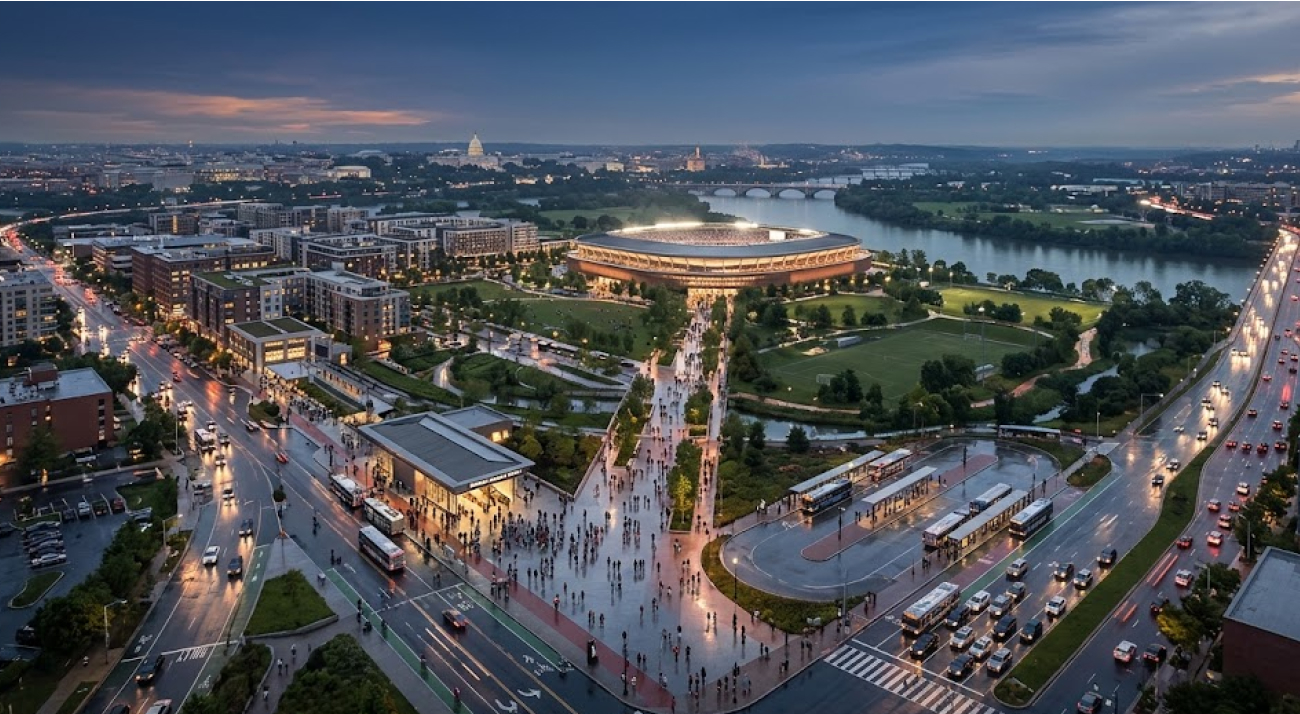
Washington, D.C.’s massive redevelopment of the former RFK Stadium site has reached a point where transportation could become as important as the stadium itself.
On October 6, 2026, the D.C. Council approved up to $300 million for improvements to the Stadium-Armory Metro station and another $5 million for the initial development of a proposed Gold Line bus connection. The combined $305 million transportation commitment is intended to prepare the area for the new Washington Commanders stadium, which is scheduled to open in 2030.
The investment comes as the District advances a broader RFK Campus redevelopment estimated at roughly $3.7 billion to $3.8 billion, centered on a new approximately 65,000-seat enclosed stadium and a 180-acre mixed-use campus.
That broader development is expected to include housing, parks, retail, recreation and entertainment. The stadium itself is being positioned as a year-round venue capable of hosting more than 200 events annually.
The transportation decision therefore raises a larger economic-development question: can Washington build enough mobility capacity to turn a major stadium project into a functioning district rather than a collection of facilities that becomes difficult to access on event days?
The $305 Million Investment Addresses A Critical Bottleneck
The Stadium-Armory Metro station is already one of the most important transportation assets serving the RFK Campus.
Rather than constructing an entirely new Metro station closer to the future stadium, WMATA and District officials have identified improvements to the existing station as the preferred strategy for handling the additional demand. The D.C. Council’s legislation provides up to $300 million for work at the street, mezzanine and platform levels.
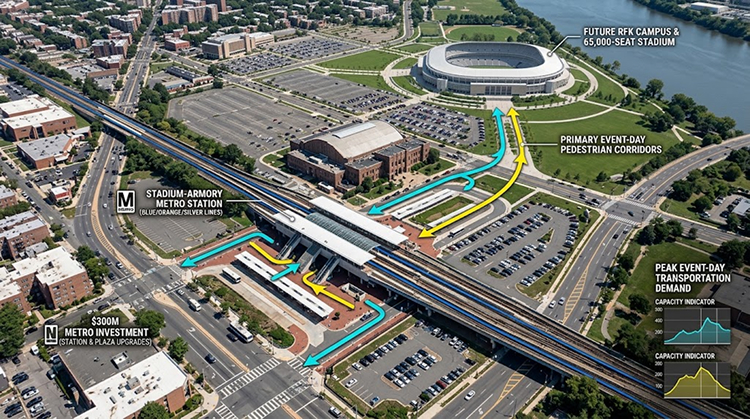
The investment is designed around capacity.
A 65,000-seat stadium can create a sudden transportation surge that is very different from normal neighborhood demand. Tens of thousands of people may arrive within a relatively short period before an event and attempt to leave within an even narrower window afterward.
That creates a problem that cannot be solved simply by adding parking.
According to recent reporting, Metro officials have warned that without station improvements, post-event waits could become extremely long. The concern is particularly significant because the current stadium development plans include only about 6,000 parking spaces, making mass transit a central part of the transportation strategy.
The WMATA RFK Campus transit plan identifies transit access, mobility and connectivity as central considerations for the campus redevelopment.
The Gold Line Could Expand The Stadium’s Transportation Network
The second component of the October 6 funding decision is smaller but strategically important.
The District approved approximately $5.2 million in total for the development of a proposed crosstown bus route tentatively branded the Gold Line. The initial $5 million referenced in the RFK legislation will support the first phase of planning and development.
The proposed route would help connect the RFK area with Union Station and other parts of the city.
That connection matters because sports districts rarely function in isolation. Visitors arriving from outside Washington may enter through Union Station, while local residents may use Metro, buses, bicycles or pedestrian routes.
A transportation network with several options gives event organizers greater flexibility and reduces pressure on a single station or roadway.
The Gold Line could therefore become more than an event-day service. If the RFK Campus eventually contains thousands of homes, restaurants, retail space, recreation facilities and public parks, the bus connection could support daily mobility as well as football crowds.
That is an important distinction for the economic-development case.
The Stadium Is Only One Part Of A Much Larger Investment
The proposed Commanders stadium is receiving most of the attention because of its size and price tag, but the surrounding development is what could determine the project’s long-term economic value.
The District’s master plan covers approximately 180 acres along the Anacostia River. Plans call for as many as 6,500 homes, approximately one-third of which are intended to be affordable, along with retail, parks, recreation and other neighborhood uses.
The Commanders’ stadium is expected to cover approximately 1.8 million square feet and seat about 65,000 people. The team has selected a joint venture of Clark Construction Group, Mortenson and Smoot Construction Company of Washington, D.C., to lead construction.
The scale makes transportation a foundational component rather than a secondary amenity.
If the campus is going to function as a neighborhood on non-game days, residents and visitors need reliable connections to downtown, Capitol Hill, surrounding communities and regional transportation hubs.
The District’s own planning documents recognize this relationship. WMATA describes the RFK Campus as an opportunity to create a destination combining a new stadium with housing, recreation, entertainment and public spaces.
Parking Is Already Influencing The Development Strategy
The transportation discussion is also affecting how the stadium itself is being designed.
The current project includes approximately 6,000 parking spaces, but proposed parking structures have generated debate over their size, visual impact, environmental implications and relationship to the surrounding neighborhood.
Recent plans included a nine-story parking garage with approximately 2,400 spaces. Earlier concepts featured larger structures that drew criticism from residents and city officials.
This creates a familiar challenge for sports-led development.
Building enough parking to accommodate peak demand can consume valuable land and encourage automobile dependence. Building too little parking can shift pressure onto surrounding neighborhoods and transportation systems.
Washington is attempting to solve that problem by placing more emphasis on transit capacity.
The approach could ultimately allow the RFK Campus to use land for housing, retail, public spaces and recreation that might otherwise be consumed by surface parking.
The Economic Case Depends On More Than Stadium Attendance
The economic projections surrounding the Commanders project are substantial.
A District economic impact analysis estimates that stadium construction could generate approximately $976 million in net new direct spending in Washington over three years, while the first full year of stadium operations could generate approximately $800.3 million in net new direct spending. The analysis projects approximately $14.9 billion in net new direct spending over the construction period plus 30 years of operations, measured in present-value terms.
Those figures are projections, not realized results.
The difference matters because economic impact models depend on assumptions about attendance, visitor spending, event frequency, employment and other activity.
Transportation can influence several of those assumptions.
If visitors can enter and leave the district efficiently, they may be more willing to attend events. If hotels and restaurants can be reached conveniently, visitors may stay longer. If workers can reliably reach the district, employers may have access to a larger labor pool.
That makes the $305 million transit investment part of the economic model itself rather than simply an infrastructure expense.
A Stadium With More Than 200 Events Needs Everyday Connectivity
The Commanders have described the future stadium as a year-round community and entertainment hub capable of hosting more than 200 events annually.
That number changes how the transportation investment should be evaluated.
A stadium hosting only NFL games would create several dozen major demand peaks each year. A venue with concerts, soccer, college sports, community events and other programming can generate activity throughout the calendar.
The surrounding campus is also expected to operate independently of the stadium.
Restaurants, housing, retail, parks and recreational facilities create reasons for people to visit when there is no football game.
That is where the transportation system becomes particularly important.
A successful mixed-use district cannot depend entirely on event-day traffic. It needs residents, employees and visitors to move through the area throughout the week.
For businesses considering the RFK Campus, predictable transportation access could therefore become part of the site’s commercial value.
The Anacostia Riverfront Adds Another Mobility Challenge
The RFK Campus occupies a prominent location along the Anacostia River, which gives the development significant public-space potential but also creates geographic constraints.
The master plan envisions approximately 75 acres of parks and green space, including a substantial natural riparian area along the river.
That means the transportation network has to connect different parts of the campus without turning the redevelopment into an automobile-dominated environment.
Pedestrian routes, bicycle infrastructure, transit entrances and connections to existing trails will all influence how people experience the district.
The objective is not simply to move 65,000 football fans.
It is to create a place where someone can live, work, eat, attend a game, visit a park and return home without every trip requiring a car.
That is a substantially more ambitious transportation problem.
The $305 Million Could Protect The District’s Long-Term Development Potential
The transportation commitment also has implications for future development around the stadium.
Large infrastructure investments often create a foundation for additional private development because they improve access and reduce uncertainty for businesses, developers and residents.
In Washington’s case, the RFK master plan calls for thousands of homes and substantial retail and commercial activity.
If the Metro station improvements are completed before the stadium opens, developers can market the campus around an established transportation network rather than trying to retrofit mobility after construction.
That sequencing is significant.
The District is effectively investing in the transportation system before the largest component of the new district begins operations.
For a project expected to remain in place for decades, that could be one of the most consequential infrastructure decisions in the entire redevelopment.
Local Businesses Could Become Major Beneficiaries
The transportation question also extends beyond the stadium gates.
A successful sports district can generate demand for restaurants, hotels, retail stores, entertainment businesses, transportation providers and professional services.
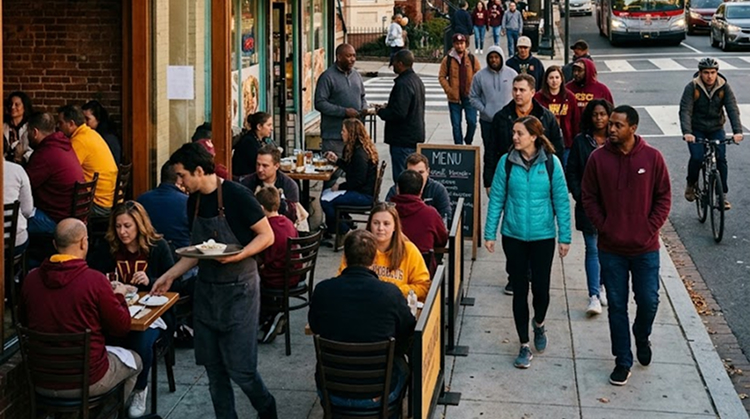
But those businesses benefit only if visitors can comfortably reach them.
The RFK redevelopment is expected to incorporate commercial uses alongside the stadium and residential development. The District has also emphasized opportunities for local businesses and Certified Business Enterprises as part of the broader project. A city business-development document describes the $3.7 billion RFK project as a major opportunity for local procurement and contracting.
For Washington’s business community, the transportation investment could therefore have a multiplier effect.
More accessible event traffic can mean more customers. Better everyday transit can support employees. Stronger pedestrian connections can increase foot traffic between venues and commercial areas.
That is how a stadium project begins to operate as an economic district rather than a standalone building.
The Timeline Leaves Little Room For Transportation Delays
The new Commanders stadium is scheduled for completion in the second quarter of 2030, with the team targeting the 2030 season for its new home.
That gives the District several years to complete the transportation work, but the timetable also demonstrates why the October funding decision matters.
Major transit improvements involve design, engineering, construction, testing and coordination with an operating transportation system.
The Stadium-Armory station cannot simply close for an extended period without affecting current riders.
At the same time, the new stadium cannot open successfully if the surrounding transportation network is still under construction.
The projects therefore have to advance in parallel.
Washington Is Testing Whether Transportation Can Make Sports Development Work
The RFK Campus redevelopment has already been framed as one of the largest economic-development projects in Washington’s history. The proposed stadium, housing, parks, retail and recreation could fundamentally change the eastern edge of the District.
But transportation will determine how those pieces interact.
The $305 million commitment approved October 6, 2026 gives the project a significant new piece of infrastructure: up to $300 million for Stadium-Armory Metro improvements and additional funding for the proposed Gold Line connection.
The investment does not guarantee that the RFK Campus will succeed.
It does, however, recognize a fundamental reality of sports-led development: a 65,000-seat stadium can create enormous economic activity, but the surrounding transportation system determines whether that activity can move efficiently through the district.
For Washington, the next phase will be about more than constructing a stadium.
It will be about making the stadium accessible enough to support football, concerts and other major events while creating a neighborhood that functions on ordinary weekdays.
That is ultimately what will determine whether the $3.8 billion project becomes a successful sports district or simply an expensive venue surrounded by infrastructure challenges.
