Fort Worth has reached a defining point in its effort to compete for larger conventions, meetings and major events.
On September 20, 2026, the Fort Worth Convention Center Arena closed after 58 years of operation, marking the most visible transition yet in a $701 million expansion and modernization program that is expected to transform the downtown facility by the end of 2029. The final event, “It’s Goin’ Down,” drew an estimated 2,000 people for a farewell to the building that had hosted concerts, sports and other major gatherings since 1968.
The closure is significant because Fort Worth is not simply replacing an aging arena.
The city is attempting to increase the capacity and competitiveness of one of its most important visitor-economy assets while tourism is already generating billions of dollars in economic activity.
Visit Fort Worth’s latest tourism study reports that the city welcomed 11.7 million visitors from more than 50 miles away in 2025, generating approximately $3.6 billion in total economic impact, supporting about 30,000 hospitality jobs and producing $286 million in state and local taxes.
The convention center expansion therefore arrives at a moment when Fort Worth has substantial tourism demand but is seeking the infrastructure necessary to capture more of the national meetings and convention market.
The $701 Million Project Is Really Two Major Investments
The headline number can make the project appear simpler than it is.
Fort Worth’s overall convention center transformation is budgeted at approximately $701 million. The first phase cost about $95 million and was completed in December 2025. Phase 2 represents the much larger component, with the city describing the work as a roughly $606 million investment to create a new flexible convention building and modernize the existing center.
The distinction matters because Phase 2 is where the visitor experience changes most dramatically.
The city plans to remove the old arena and replace it with a three-story addition containing expanded exhibit and meeting space. The redesigned complex will ultimately provide approximately 257,268 square feet of exhibit hall space, 60,917 square feet of meeting rooms, 74,033 square feet of ballroom space and 16 loading docks.
A separate Texas Department of Licensing and Regulation filing registered on October 8, 2026, lists the Phase 2 remodel and expansion at an estimated $352.57 million for the registered construction scope, covering approximately 742,118 square feet and scheduled through December 31, 2029.
That difference between the overall Phase 2 budget and individual registered construction packages illustrates how large public projects are assembled over several contracts rather than through one single construction check.
Fort Worth Is Building For A Larger Convention Market
The economic argument behind the expansion depends heavily on the city’s ability to attract events that require more space.
The current convention center already hosts national and international conventions, trade shows, concerts and sporting events. But Fort Worth’s existing configuration limits the number and size of events that can be accommodated simultaneously.
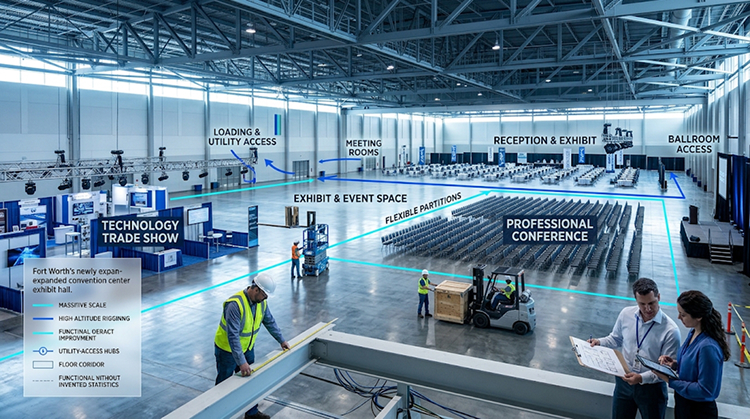
The new design is intended to change that equation.
Fort Worth says the expanded facility will allow the city to pursue larger conventions and potentially host two large events at the same time. The building will also add flexible meeting areas and a second major ballroom while creating outdoor event space connected to downtown.
That flexibility is economically important.
Convention organizers generally evaluate destinations based on more than exhibit-hall square footage. They consider hotel inventory, airport access, restaurants, walkability, transportation, entertainment, meeting-room capacity and the ability to move thousands of attendees through a city efficiently.
Fort Worth already has several advantages.
The convention center is approximately 30 minutes from Dallas Fort Worth International Airport, sits in downtown and is surrounded by hotels, restaurants, shops, galleries and performance venues. Trinity Metro also provides free transportation through downtown on the Blue Line.
The expansion is designed to make those existing assets more valuable by giving them a larger stream of potential visitors.
The Hotel Tax Is Tying Visitors Directly To Infrastructure
One of the most interesting aspects of Fort Worth’s strategy is how the city is financing part of the expansion.
In May 2024, Fort Worth voters approved Proposition A by a wide margin, authorizing an additional 2% hotel occupancy tax for the convention center project. The city’s election results show 14,855 votes for the measure versus 5,873 against, with approximately 72% support.
The additional tax took effect August 1, 2024.
Fort Worth’s current budget documents show that the city’s hotel occupancy tax structure includes revenue dedicated to convention center capital improvements and debt service. The additional 2% venue tax was specifically established to support debt associated with the Convention Center expansion.
This creates a direct economic relationship between the visitor economy and the facility.
People staying in Fort Worth hotels contribute to the revenue stream that finances infrastructure intended to attract more people to Fort Worth hotels.
That circular model is one reason convention centers are often treated differently from ordinary municipal buildings. Their justification depends on generating additional visitor activity that can support restaurants, hotels, transportation companies, retailers and other businesses.
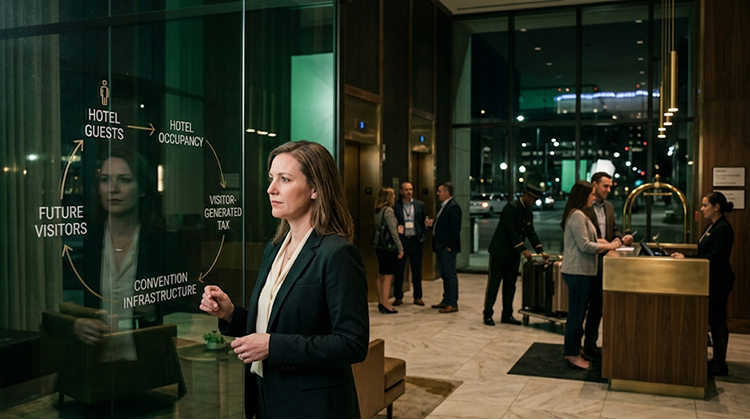
For communities examining sports tourism economic development, Fort Worth provides an example of how visitor-generated revenue can become part of a broader infrastructure strategy.
Tourism Already Represents A Major Economic Asset
Fort Worth does not have to prove that tourism matters.
It already has a substantial visitor economy.
The latest Visit Fort Worth research found that the city’s 2025 visitor economy generated approximately $3.6 billion in total economic impact, up from earlier years as visitor activity has grown. The sector supported approximately 30,000 hospitality jobs and generated $286 million in state and local taxes.
A separate 2024 tourism study reported more than $3.5 billion in economic impact, 11.5 million visitors and $251 million in state and local taxes. Visit Fort Worth said tourism-related tax revenues had increased 47% over the preceding four years.
Those numbers help explain why the city is willing to make a seven-hundred-million-dollar investment.
The convention center does not need to generate the entire tourism economy by itself.
Instead, it can function as one of the infrastructure platforms that helps produce the visitor activity measured across hotels, restaurants, attractions, transportation and entertainment.
The challenge is proving that the expanded facility will generate enough incremental business to justify the cost of construction and financing.
The New Event Plaza Could Connect Conventions To Downtown
One of the most important design changes is outside the exhibit halls.
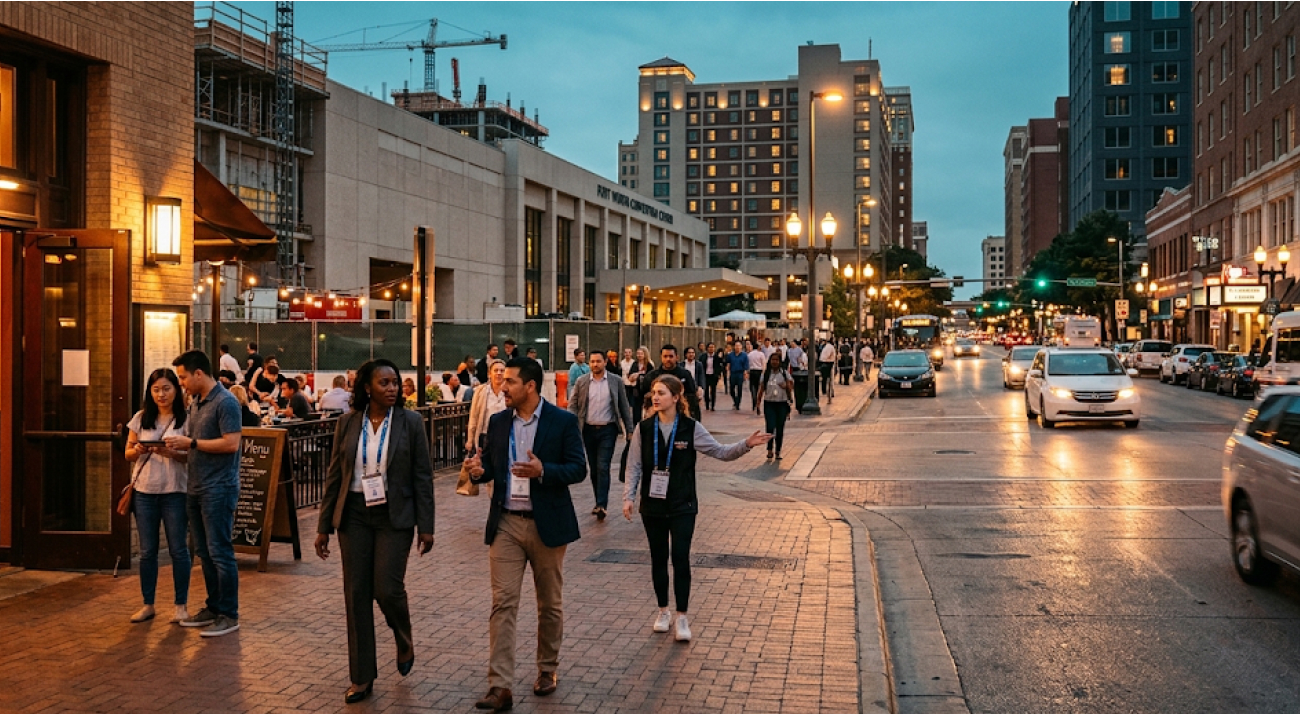
The expanded convention center will incorporate public-facing outdoor spaces, including a new plaza with native prairie landscaping and terraces designed for outdoor events. The city says the design will connect the facility with General Worth Square and provide downtown views.
That is a strategic change from the traditional convention-center model.
Large convention facilities can become isolated boxes where attendees spend most of their time inside the building. Fort Worth is attempting to create stronger connections between the convention center and downtown businesses.
That could matter for the local economy.
A convention attendee who leaves the building for lunch, shops after a meeting or attends an evening event creates economic activity beyond the convention center’s own operations.
The design therefore treats the surrounding district as part of the visitor experience.
This is particularly relevant for downtown Fort Worth, where the convention center sits within walking distance of restaurants, entertainment, hotels and cultural attractions.
Small Businesses Are Becoming Part Of The Construction Story
The economic impact of the project is beginning before the new convention center opens.
On October 7, the Fort Worth Chamber reported that the Phase 2 construction team had opened an interest process for certified Small Business Enterprises seeking subcontracting opportunities. The project has more than 60 bid packages, covering work ranging from concrete and masonry to HVAC, electrical systems, flooring, signage, food-service equipment and landscaping.
That creates a second economic layer.
The expansion is generating construction demand while also creating a future platform for tourism businesses.
The two effects operate on different timelines.
Construction companies, subcontractors, engineers and suppliers benefit during the development period. Hotels, restaurants, transportation companies, retailers and event-service companies are expected to benefit from the expanded convention calendar after completion.
That distinction is important for economic-development organizations evaluating major public projects.
The strongest projects can create several waves of economic activity rather than a single construction boom.
Fort Worth Is Betting On More Than Convention Attendance
The expanded facility is designed to support a wider range of events.
The city’s existing convention center has hosted sports and concerts in addition to conventions and trade shows. The new configuration adds flexibility that could allow Fort Worth to pursue additional combinations of meetings, exhibitions, entertainment and public events.
This diversification matters because convention demand can fluctuate.
A facility that depends entirely on large annual conventions has less flexibility during weak periods. A venue capable of supporting corporate meetings, trade shows, sporting events, concerts and community gatherings can potentially maintain a fuller calendar.
The same principle applies to sports tourism.
Fort Worth’s broader event infrastructure includes the Will Rogers Memorial Center and Dickies Arena, while the convention center adds another major downtown platform. The city’s Public Events Department also manages venue-related tax structures supporting facilities such as Will Rogers and Dickies Arena.
That creates the potential for a broader event ecosystem rather than a single-purpose convention district.
The Project Will Test Fort Worth’s Hotel Capacity
The convention center expansion will ultimately be judged partly by how many visitors it brings into the city’s hotels.
Fort Worth has already recognized that relationship through its tourism financing structure.
The additional hotel tax approved by voters in 2024 was expected to produce roughly $10 million annually, according to reporting at the time of the election.
But the city’s tourism strategy extends beyond the convention center itself.
Fort Worth’s Tourism Public Improvement District uses a separate hotel assessment to support incentives, sales efforts, marketing, research, site visits and promotion designed to attract large conventions, sporting events and cultural events. A recent city document budgeted $15.75 million for Tourism PID improvements and services over a two-year period beginning October 1, 2025.
That means Fort Worth is simultaneously investing in the supply of convention infrastructure and the sales and marketing necessary to fill it.
That combination is important.
A larger building does not automatically create a larger visitor economy.
The city must also win the events.
The Construction Period Creates Its Own Economic Challenge
Fort Worth is attempting something particularly difficult: expanding a major downtown convention facility while keeping it operational.
The city has said the convention center will remain operational during the overall transformation, even as portions of the building undergo major construction.
That strategy protects some existing event revenue, but it also creates logistical complications.
Attendees may encounter construction zones, altered entrances, temporary circulation patterns and changing event configurations. Event organizers have to know years in advance whether their preferred dates and spaces will remain available.
The payoff is avoiding a complete shutdown of the city’s primary convention facility.
For an economy that generated billions in visitor activity in 2025, maintaining some level of event operations during construction has obvious economic value.
The trade-off is a more complicated construction schedule.
Phase 2 is currently scheduled to continue through December 2029, giving Fort Worth several years in which construction and tourism will operate side by side.
The 2029 Completion Date Will Create A New Economic Test
The real test will begin after construction ends.
By then, Fort Worth will have a substantially different convention center, a new exhibit-hall configuration, expanded meeting capacity, additional ballroom space and new public areas.
The question will be whether event bookings increase enough to translate those physical improvements into measurable visitor spending.
The city’s existing tourism numbers provide a strong starting point.
With 11.7 million visitors and $3.6 billion in economic impact in 2025, Fort Worth already has a visitor economy large enough to support a major convention strategy.
The expansion gives the city an opportunity to increase the share generated by meetings and conventions.
That could mean more hotel nights, longer visitor stays, additional restaurant spending, greater demand for transportation and stronger weekday activity in downtown businesses.
But the city will need to measure those outcomes carefully.
The strongest evidence will not simply be attendance at the convention center.
It will be the growth in hotel occupancy attributable to conventions, new visitor spending, additional tax revenue, convention bookings that would otherwise have gone elsewhere and the number of events that require the expanded facility.
Fort Worth Is Building A Visitor-Economy Platform
The $701 million Fort Worth Convention Center project represents a broader economic strategy than a conventional building renovation.
The city is using hotel taxes to help finance infrastructure, investing in a larger event facility, expanding its tourism marketing structure and attempting to connect convention visitors with downtown businesses.
The timing is significant.
Fort Worth’s tourism economy is already producing billions of dollars in annual impact, while the city continues to grow and compete with other Texas destinations for conventions and major events.
The new convention center will give Fort Worth more capacity.
The harder task will be turning that capacity into a consistently fuller calendar.
If the city succeeds, the economic benefits could extend well beyond the convention center’s walls. Hotels could capture additional room nights, restaurants could benefit from larger groups, downtown retailers could gain new customers and local businesses could find more opportunities to serve national and international visitors.
That is why the project matters to the broader economic-development community.
Fort Worth is effectively betting that a larger, more flexible convention facility can convert an already substantial visitor economy into an even more powerful engine for downtown business activity.
The 2029 completion target will provide the first major benchmark. By then, Fort Worth will have to demonstrate that the $701 million investment produced more than a modern building—it produced a stronger pipeline of visitors, events, business activity and tourism revenue.
