
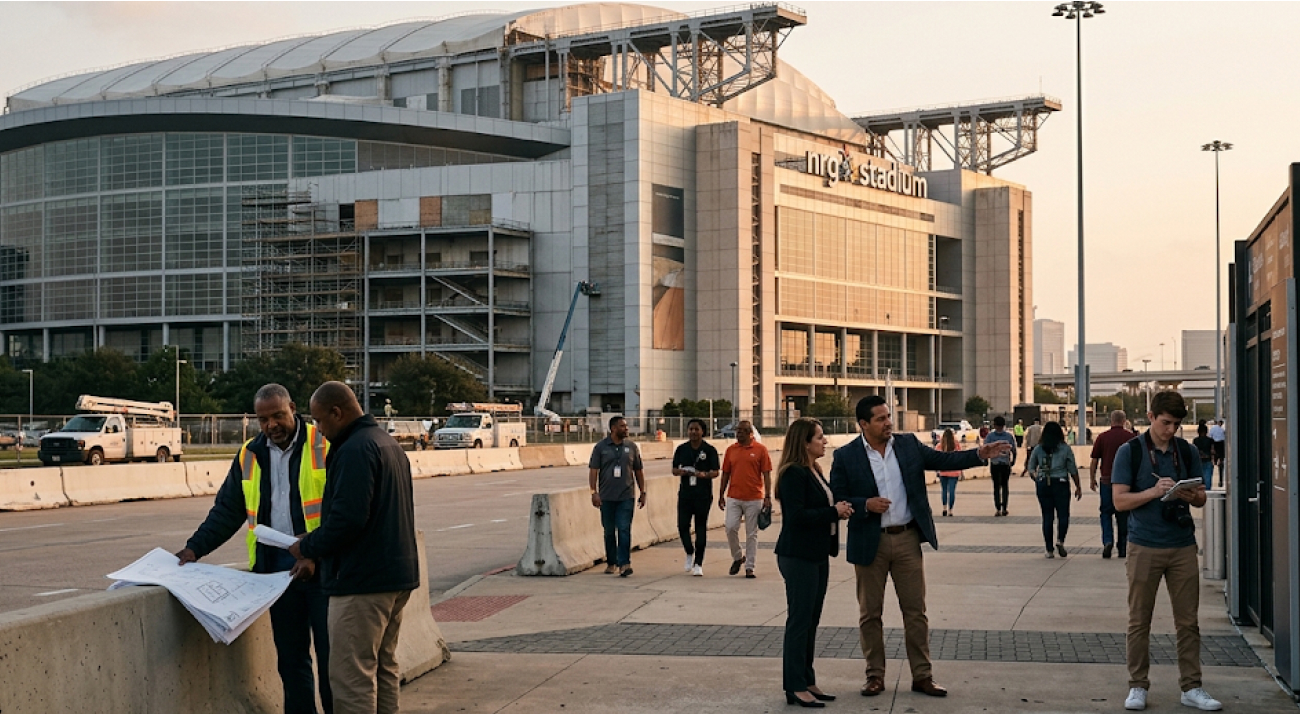
The Houston Texans are facing a stadium decision that reaches far beyond the future of one NFL franchise.
A county-commissioned assessment has found that Reliant Stadium, formerly known as NRG Stadium, needs an estimated $1.4 billion in improvements over the next 30 years. The figure covers a broad range of capital needs, including flooring, concourse ceilings, damaged railings, gutters, signs and other systems that are approaching or have exceeded their expected useful lives.
The timing makes the situation particularly significant. Harris County owns the stadium, while the Texans operate under a lease that is approaching its expiration. At the same time, Harris County is dealing with a roughly $178 million budget deficit, making a major public commitment to a professional sports venue considerably harder to justify.
That creates a problem increasingly familiar across American professional sports: an aging stadium can remain economically valuable while becoming progressively more expensive to maintain.
Houston’s situation therefore offers a useful case study for chambers of commerce, economic-development organizations and municipalities evaluating sports facilities. The question is no longer simply whether a stadium generates economic activity. It is whether the public and private sectors can structure a financing model that keeps a major venue competitive without transferring too much of its long-term cost to taxpayers.
The $1.4 Billion Figure Is A Long-Term Infrastructure Problem
Reliant Stadium opened in 2002 as the home of the expansion Texans and the Houston Livestock Show and Rodeo. The venue was also the first NFL stadium with a retractable roof, making it an important piece of Houston’s sports and events infrastructure from the beginning.

More than two decades later, the issue is less about one spectacular renovation and more about accumulated infrastructure requirements.
The county’s assessment identifies approximately $1.4 billion in improvements over three decades. Most of the stadium’s major systems were built around the same period, meaning several are reaching the point where replacement rather than routine maintenance becomes necessary.
That distinction matters for economic development.
A stadium can appear successful from the outside because it continues hosting NFL games, concerts, rodeo events and major international competitions. Behind the scenes, however, mechanical systems, plumbing, elevators, escalators, seating infrastructure, roofing components and other building systems age at different rates.
For communities considering a new sports venue, Houston demonstrates why the construction price is only one part of the economic equation.
The more important calculation may be the 30-year ownership cost.
Harris County Has A Complicated Funding Position
The most immediate challenge is that the stadium’s owner does not have unlimited capacity to absorb the cost.
Harris County approved its fiscal 2027 budget in September after a budget process dominated by a deficit of more than $180 million. Commissioners approved a property-tax rate increase as part of the effort to close the gap.
That financial environment makes a large stadium investment politically difficult.
The county already directs approximately $2.5 million annually toward stadium maintenance, according to the Houston Chronicle’s recent reporting, with additional year-end funds typically amounting to less than $1 million. Those amounts are nowhere near the scale required to address the long-term capital needs identified in the assessment.
The county also cannot simply treat the stadium as an isolated building.
Reliant Stadium sits inside the larger Reliant Park complex, a roughly 350-acre sports and entertainment campus that includes multiple facilities and attracts millions of visitors annually. Harris County documents have described NRG Park as hosting more than 500 events and approximately 5.5 million people each year.
That means decisions about the stadium affect a much larger visitor economy.
For communities studying sports tourism economic development, this is an important distinction. The economic value of a major venue comes from the ecosystem around it, but that ecosystem also makes infrastructure decisions more complicated.
The Texans Are Not The Only Major Tenant
One reason Houston’s stadium question cannot be reduced to an NFL facility is the presence of the Houston Livestock Show and Rodeo.
The rodeo is one of the city’s signature annual events and uses the same stadium and surrounding campus. Harris County’s ownership structure therefore places multiple major event interests inside the same physical infrastructure.
That can create an economic advantage.
A stadium that hosts NFL games, rodeo events, concerts and other large gatherings has more opportunities to generate visitor spending than a facility used primarily for a weekly sports schedule.
But the same model increases the importance of reliability.
A stadium that serves multiple event calendars cannot afford prolonged closures or poorly timed construction work. Renovations have to be coordinated around football, rodeo, concerts and other bookings.
Houston’s current challenge is therefore similar to the problem facing convention centers and multipurpose arenas across the country: the more economically important a facility becomes, the more disruptive major repairs can be.
The county and its partners have already faced this issue through smaller capital projects. Texas Department of Licensing and Regulation records show recent work at the stadium, including a roughly $2.36 million loge seating renovation registered in March 2026 and a separate approximately $5.34 million tunnel-club renovation.
Those projects illustrate how capital investment can occur incrementally even while a much larger long-term strategy remains unresolved.
Houston Is Already Using Tourism Revenue For Stadium Infrastructure
One of the most revealing elements of the Houston case is the role of hotel occupancy tax revenue.
Harris County has historically used hotel occupancy tax-backed debt to finance tourism-related infrastructure. County financial documents show that a $99.42 million taxable hotel occupancy tax bond issue from 2024 was used to finance roof replacement and sound-system work at the NRG Park campus.
That creates a direct connection between visitors and venue infrastructure.
Hotels collect room revenue from travelers, the county collects hotel occupancy taxes, and those revenues can support debt tied to tourism infrastructure.
The model makes intuitive economic sense when a facility attracts visitors from outside the region. It becomes more complicated when the same revenue source is already committed to earlier debt or other tourism obligations.
The Houston Chronicle reported that traditional funding sources, including hotel occupancy and car-rental taxes, are already heavily committed. Alternative mechanisms such as Tax Increment Reinvestment Zones are being examined, but existing resources may not be large enough to solve the entire problem.
That is the financing challenge at the heart of the debate.
The economic activity generated by the stadium is substantial, but capturing enough of that activity to finance a $1.4 billion long-term capital requirement is another question.
A New Stadium Could Be More Than A Replacement Project
The Texans have indicated that renovation remains a major focus, but the broader conversation includes the possibility of constructing a new stadium at the Reliant Park site.
That possibility changes the financial equation.
A renovation preserves an existing asset and may avoid the enormous upfront cost of a completely new building. But a new stadium could provide modern premium seating, larger concourses, updated technology and other revenue-producing features that may be difficult to retrofit into a structure built more than two decades ago.
The Houston Chronicle reported that modern NFL facilities increasingly emphasize premium clubs, suites, wider concourses and hospitality areas located closer to the field.
Those features are important because NFL stadium economics have shifted.
The value of a stadium is no longer determined only by how many seats it contains. Premium hospitality, sponsorship opportunities, naming rights, food and beverage operations, concerts, non-NFL events and year-round programming can materially affect the revenue model.
That creates a difficult comparison for Houston.
If a long renovation program approaches the cost of creating a new venue while producing fewer new revenue opportunities, replacement could become more attractive.
If renovation can extend the stadium’s useful life while preserving the existing event ecosystem, however, rebuilding may be unnecessary.
The Texans Have Another Major Development In The Region
Houston’s stadium discussion is occurring at the same time that the Texans are developing a much larger sports and entertainment project in northwest Harris County.
In February 2026, the Texans, Harris County and Howard Hughes announced the 83-acre Toro District in Bridgeland, including a 22-acre global headquarters and training complex. The project is projected by its developers to generate approximately $34 billion in long-term economic impact and more than 17,000 jobs over time.
That project is strategically different from the stadium.
The Texans have described the training and headquarters development as a year-round destination containing retail, restaurants, hotels, entertainment, commercial and medical space.
The distinction is significant for economic-development planning.
A professional sports organization can create economic value in multiple locations. The stadium can serve as the region’s major-event venue while a separate sports district becomes a daily commercial destination.
Houston is therefore moving toward a model in which the team’s economic footprint is distributed across multiple facilities rather than concentrated entirely inside one stadium.
The 2026 World Cup Adds Another Layer To The Analysis
The stadium also played a role in Houston’s 2026 FIFA World Cup activity, adding international-event value to the facility’s existing sports calendar.
But Houston’s World Cup experience also offers a cautionary lesson about measuring sports-event economics.
FIFA projected approximately $1.5 billion in economic impact for Houston, with more than 480,000 match tickets sold and roughly 44% purchased by international visitors. The event also produced a substantial increase in activity in parts of the city.
Yet hotel occupancy did not rise as dramatically as some headline projections suggested.
A September 2026 Houston Chronicle analysis found that hotel occupancy was relatively flat during the tournament even though hotel revenue increased because room rates were higher. Economist Victor Matheson questioned whether the event produced as many additional hotel room nights as some forecasts implied.
That matters for stadium economics.
If cities justify major infrastructure spending by forecasting visitor spending, they need to distinguish between gross economic activity and genuinely additional economic activity.
A busy stadium does not automatically mean every dollar spent represents new economic value.
The Real Question Is Who Captures The Economic Value
The Texans’ stadium situation highlights a recurring problem in professional sports economics.
The economic benefits of a major stadium are spread across many businesses.
Hotels benefit from visiting fans. Restaurants benefit from game-day traffic. Transportation companies benefit from increased movement. Retailers benefit from visitors. Convention and event organizers benefit from having a large venue available.
The ownership and maintenance costs, however, may fall much more heavily on a single public entity.
That creates a mismatch.
Harris County owns the stadium, while the Texans are the primary NFL tenant. Under the existing arrangement, the county has responsibility for stadium maintenance, although the Texans have contributed millions of dollars to repairs and maintenance over the franchise’s history.
The debate is therefore about more than whether taxpayers should support football.
It is about whether the public sector should continue owning a specialized asset when a private organization is the primary beneficiary of its availability.
That question is becoming more relevant as professional stadiums become increasingly expensive to construct and maintain.
The Lease Deadline Makes The Decision More Urgent
The Texans’ lease adds another clock to the process.
The current lease is approaching its 2031 expiration, according to recent reporting and Harris County documents.
That gives Houston several years to determine whether the best path is renovation, replacement or a hybrid arrangement.
But large infrastructure projects rarely move from concept to completion quickly.
Environmental reviews, financing structures, design work, procurement, construction schedules, public approvals and negotiations with multiple stakeholders can consume years.
A decision delayed until the final years of the lease could leave the county and Texans with fewer options.
The financial stakes also rise as the stadium ages.
Every year that major capital systems remain in service can increase the likelihood that additional components require replacement before a larger renovation begins.
Houston Could Become A National Case Study
The importance of Houston’s situation extends beyond Texas.
NFL stadiums built during the late 1990s and early 2000s are entering a period in which major systems are aging simultaneously. Facilities that were considered modern when they opened now compete against newer venues with substantially more premium space, advanced technology and broader event capabilities.
That creates a national infrastructure question.
Cities that subsidized stadium construction decades ago may soon face another choice: spend heavily to maintain the existing building or finance an entirely new facility.
Houston’s $1.4 billion assessment demonstrates why that decision cannot be based solely on the original construction cost.
Economic-development agencies should be asking several additional questions:
- How much will the facility cost to maintain over 20 or 30 years?
- Who is contractually responsible for capital repairs?
- How much visitor-generated revenue can realistically support infrastructure?
- What percentage of economic activity represents genuinely new spending?
- Can the facility generate revenue beyond its primary sports tenant?
- What happens if the private tenant eventually leaves?
Those questions can matter as much as seating capacity or architectural design.
The Stadium’s Future Could Affect Houston’s Broader Visitor Economy
Reliant Stadium sits inside a much larger destination.
The surrounding Reliant Park complex includes convention, exhibition, arena and event facilities that collectively support Houston’s tourism economy. County documents describe the campus as a major regional gathering place rather than simply an NFL venue.
That means an investment decision at the stadium could influence the competitiveness of the entire campus.
A modernized stadium could help Houston continue pursuing large sporting events and concerts. A poorly timed or underfunded renovation could create operational limitations that affect other event bookings.
The economic question is therefore broader than the Texans.
Houston is effectively deciding how much it wants to invest in one of its largest concentrations of visitor infrastructure.
For a metropolitan area that recently hosted the World Cup and regularly hosts the Houston Livestock Show and Rodeo, NFL games, concerts and other major events, the answer could influence tourism for decades.
The NFL Stadium Model Is Entering A More Expensive Era
Houston’s $1.4 billion capital-needs estimate illustrates a larger shift in the economics of professional sports facilities.
The first generation of modern stadium subsidies often focused on construction.
The next generation will increasingly have to account for maintenance.
A stadium may require hundreds of millions of dollars in upgrades long before it reaches the end of its physical life. Meanwhile, private teams have growing expectations for premium seating, technology, hospitality, sponsorship inventory and year-round entertainment.
That creates a widening gap between the cost of keeping an old facility competitive and the cost of building a new one.
Houston’s situation could therefore become a reference point for other cities considering stadium agreements.
The central question is no longer simply whether an NFL team can generate economic activity. It is whether the economic value generated by that activity is sufficient to justify the public cost of maintaining the infrastructure that makes it possible.
For chambers of commerce and economic-development organizations, that is the more useful lesson.
A sports venue can function as a tourism engine, employment center and regional brand asset. But its long-term economic value depends on a financing structure that remains sustainable after the ribbon-cutting ceremony, after the first major event and after the original construction debt begins to fade from public memory.
Houston now has to determine whether Reliant Stadium can be modernized within that framework—or whether the economics of a new generation of NFL venues will make replacement the more rational investment.
