
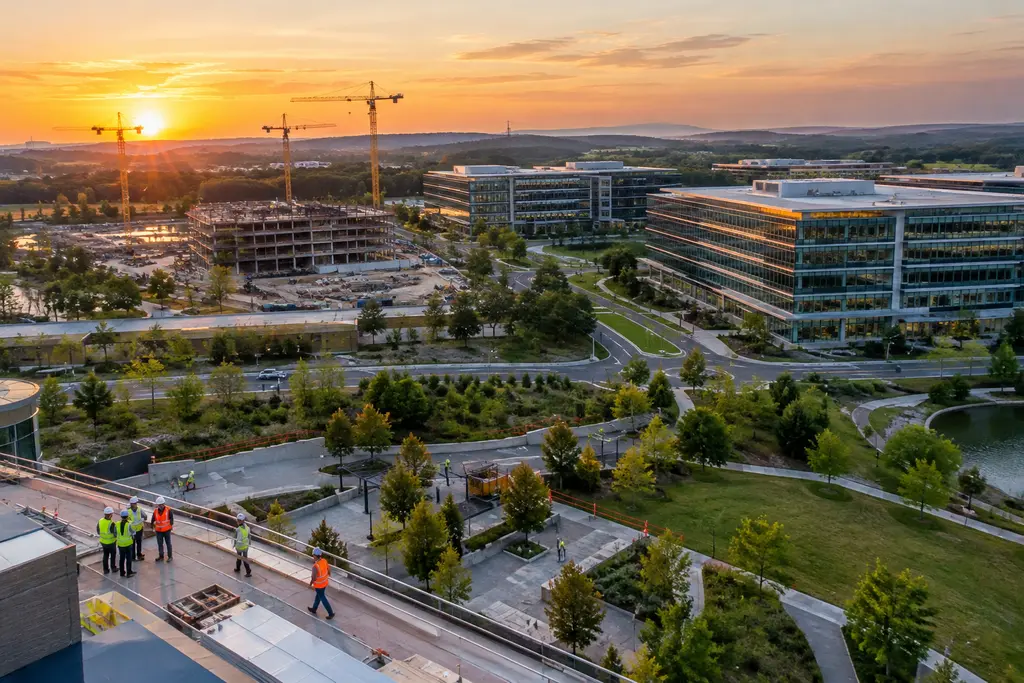
Amazon’s decision to step back from a data-center plan in Ashburn shifted a major Loudoun County land-use debate toward Northern Virginia Mixed-Use development. On October 22, 2026, Amazon formally dropped plans for data centers on a 122-acre former George Washington University campus in Ashburn, with the site instead moving toward mixed-use and residential development, according to The Washington Post. For county officials, nearby residents, businesses, and civic groups, the change moved the discussion from server buildings and utility demand to housing, public facilities, zoning limits, and long-term community use.
The shift also gave other communities a practical case study. Data centers have been a major part of Northern Virginia’s economy, but local governments have faced more scrutiny over where those facilities fit, how they affect infrastructure, and what communities receive in return. In Loudoun County, the Ashburn site became a clear example of how public pressure, county authority, private land control, and development economics can meet in one high-value parcel.
What Changed At The Ashburn Campus
The Data-Center Proposal Was Set Aside
The proposal that Amazon dropped had called for four two-story data-center buildings totaling about 800,000 square feet, according to Hoodline. The scale of that plan mattered because the former university campus sits on 122 acres in Ashburn, an area already tied closely to Northern Virginia’s technology economy.
By October 31, 2026, the data-center plan had already been scrapped. That timing matters for civic coverage: residents should not treat the project as pending in its earlier form. The relevant local question became what type of mixed-use plan would replace it, how Loudoun County would review that change, and which public benefits would be attached to the new direction.
County Authority Remained Central
The research summary states that Loudoun County supervisors voted 8-1 on October 20, 2026, to fast-track rezoning of roughly 97 acres of the property for housing and mixed use, following the agreement. It also states that data centers would be prohibited as a permitted use under the new zoning. Because the available research does not include the final adopted zoning text as of October 31, 2026, the most accurate reading is that county action had moved the process toward rezoning, with the Board of Supervisors still central to the land-use outcome.
The former campus also included about 50 acres covered by a deed restriction from 1990 that limited use to university operations, according to the research summary. The notes state that only the Board of Supervisors can lift that restriction. That point keeps the issue in the public decision-making arena rather than leaving it solely to a private owner’s development preference.
Northern Virginia Mixed-Use Moves Into The Civic Agenda
Northern Virginia Mixed-Use At The Site Level
For Loudoun, Northern Virginia Mixed-Use is not just a real estate phrase. It raises specific questions about homes, public facilities, transportation, schools, stormwater, utilities, and community access. A data-center campus and a residential mixed-use district place different demands on local services. Data centers may bring tax base and utility questions; housing can bring school enrollment, traffic patterns, public safety calls, park demand, and pressure for affordable housing options.
The agreement described in the research summary was named Project Potomac Promise. The notes state that Amazon would donate 25 acres, valued at about $65 million, to Loudoun County for a community arts center and an indoor sports facility. The same research summary states that Amazon would contribute $5 million to Loudoun County’s Housing Fund for affordable housing initiatives. Those terms, if carried through county action, would shift part of the site’s value toward public facilities and housing policy rather than only private development.
For readers interested in related events and discussions, additional perspectives can be found at ITPR.
Why The March 2025 Zoning Change Matters
Loudoun County’s broader data-center policy context also matters. Hoodline reported that the county amended zoning rules in March 2025 so that new data-center proposals require a special exception rather than being automatically allowed under certain industrial or office zoning categories. That change gave county officials more review authority over new proposals and framed the Ashburn decision as part of a wider local governance shift.
Special exception review can give local boards more room to weigh site design, public comment, infrastructure effects, and compatibility with nearby uses. The Ashburn case shows why that authority can matter on large parcels where one decision can shape traffic, public investment, neighborhood expectations, and tax policy for years.
Housing And Public Facilities Became The New Test
Affordable Housing Entered The Deal
The Northern Virginia Mixed-Use question now turns partly on whether the replacement plan can add housing in a way that responds to local affordability concerns. The research summary states that Amazon’s agreement included a $5 million contribution to Loudoun County’s Housing Fund. The available notes do not specify how many affordable units would be built, where the funds would be used, or what income levels would be served. Those details would need to be answered through county housing documents, staff reports, and future public meetings.
That uncertainty is not a small issue. A cash contribution can support affordable housing, but its civic value depends on the program rules, timing, location, and whether it helps households facing the highest pressure. Loudoun residents and business groups will likely want clear reporting on how the Housing Fund money is allocated and how outcomes are measured.
Arts And Sports Facilities Raised Public-Use Questions
The research summary’s reference to a community arts center and indoor sports facility also changes the local conversation. Public-use facilities can support youth programs, recreation, cultural events, and regional gathering space, but they also require planning for construction cost, operations, maintenance, parking, traffic, and access. If the county receives land, the next public question is how the facilities are funded and governed.
For a chamber and civic audience, the business impact could be practical. New residential development can create customers for nearby restaurants, service businesses, fitness providers, medical offices, and retail operators. Public facilities can bring steady foot traffic if programming is active and accessible. At the same time, local employers will be watching whether added housing helps workforce availability or simply adds higher-cost units without easing labor-market pressure.
What Other Northern Virginia Projects Show

Arlington And Alexandria Offer Context
The research summary notes that office-to-residential conversion projects have moved forward near Amazon’s Northern Virginia hub, including 2200 Crystal Drive in Arlington, which was approved in May 2026 to convert offices into apartments. It also points to the former Landmark Mall site in Alexandria, now the WestEnd development, where plans include up to 2,500 homes along with a hospital, retail, and offices. A component of that Alexandria project included 110 for-sale townhouses expected to be available by late 2027, according to the research summary.
Those examples do not decide what should happen in Ashburn. They do show that local governments in Northern Virginia have been weighing reuse, housing production, and mixed-use development across different types of sites. Former campuses, office buildings, and malls each present different constraints, but the civic questions overlap: How much housing is added, what public benefits are included, how transportation is handled, and how local boards keep the public involved.
Mixed Use Is Not One Single Outcome
Mixed-use development can mean many combinations of housing, retail, offices, public space, civic facilities, and recreation. For that reason, residents should avoid assuming the phrase alone answers the important questions. A plan with housing but little public access would affect the community differently than a plan with public facilities, affordable housing support, and walkable services.
That distinction is important in the Ashburn case because the site moved away from a defined data-center proposal and toward a broader redevelopment path. The details of unit counts, building scale, road improvements, public land transfer, school impacts, and facility operations will determine whether the new direction delivers the public value described in the agreement.
Northern Virginia Mixed-Use Questions For Local Boards
What Residents Should Watch Next
The civic task after Amazon’s October 2026 reversal is not simply to note that a data-center plan ended. It is to track what replaces it. For Loudoun County, the Northern Virginia Mixed-Use debate should stay focused on board actions, rezoning language, deed-restriction decisions, housing commitments, public-facility funding, and infrastructure review.
- What zoning conditions will prohibit data centers on the remaining site?
- How will the county handle the 1990 deed restriction described in the research summary?
- What housing types and price points will be proposed?
- How will the $5 million Housing Fund contribution be allocated?
- Who will pay to build, operate, and maintain the arts and indoor sports facilities?
- What transportation, school, utility, and public-safety impacts will county staff identify?
Those are the practical questions that should guide the next phase. Amazon’s decision removed one large data-center proposal from the Ashburn site, but it did not remove the need for careful public review. The county’s opportunity now is to turn a high-profile development change into a transparent land-use process with measurable public benefits and clear accountability for residents and businesses.
