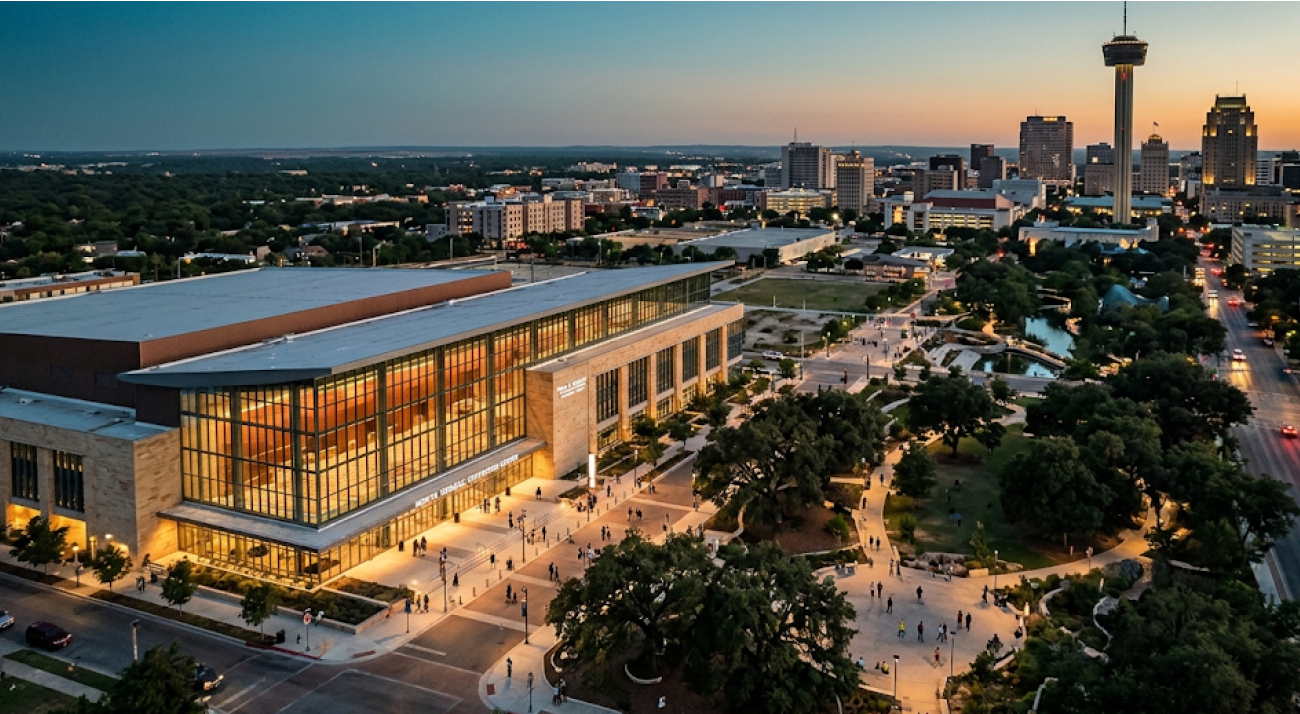
San Antonio is preparing a major investment in its downtown convention infrastructure as competition for conventions, sporting events, and large-scale gatherings intensifies across Texas. The city’s latest proposal calls for an $850 million expansion of the Henry B. González Convention Center, a project that could increase exhibit capacity, attract additional meetings, and strengthen the economic connections between the convention district, Hemisfair, and the city’s emerging sports and entertainment campus.
The proposal gained new attention on October 28, 2026, when city officials presented an updated development strategy to the San Antonio City Council. The plan divides the convention center expansion into two phases: an initial investment estimated at $700 million and a second phase of approximately $150 million that would proceed when additional funding becomes available.
The expansion is one part of the wider downtown development initiative known as Project Marvel. The broader strategy also includes a proposed new arena for the San Antonio Spurs, improvements to the Alamodome, transportation infrastructure, and opportunities for private development around Hemisfair.
The scale of the proposal reflects the importance of tourism and hospitality to the local economy. San Antonio’s tourism and hospitality industry generates an estimated $23 billion annually, according to reporting by Texas Public Radio and the San Antonio Report. City officials believe the convention center must expand to remain competitive as other major Texas destinations invest in their own meeting facilities.
However, the proposal also raises important questions about construction costs, financing, visitor demand, and the city’s ability to coordinate several large public projects without placing excessive pressure on future budgets.
The $850 Million Expansion Would Add Major Convention Capacity
The Henry B. González Convention Center is one of downtown San Antonio’s most important economic assets. Located beside Hemisfair and within walking distance of hotels, restaurants, and entertainment destinations, the facility supports a substantial network of businesses that depend on meetings, exhibitions, and corporate events.

The convention center last underwent a major expansion in 2016. A decade later, city officials argue that additional space is necessary to compete for larger events and accommodate organizations whose meeting requirements have increased.
The October 2026 city presentation reported that the facility is operating at approximately 70% of its available exhibit-space capacity. Although that percentage may appear to leave considerable room, the city’s consultants consider it effectively full by convention-industry standards. When large events require substantial contiguous exhibition areas, the facility’s practical capacity can become a limiting factor before every available square foot is occupied.
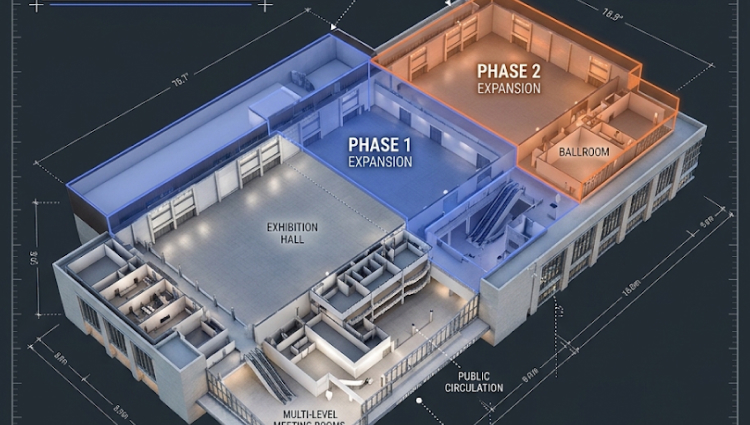
The updated expansion concept would add approximately 136,000 square feet of net new exhibit space and connect the convention center more directly with Civic Park at Hemisfair. The broader program also includes additional ballroom and meeting facilities. Local reporting has described the combined addition of exhibit, ballroom, and meeting space as exceeding 209,000 square feet.
The distinction between these figures matters: 136,000 square feet refers to net new exhibit space in the city’s October summary, while the larger figure encompasses multiple types of event space.
The first phase is estimated at $700 million and would deliver the primary expansion components. A second phase, estimated at $150 million, would add further meeting capacity when the city’s financial position allows it to proceed.
The city is seeking to protect its position in a competitive convention market. According to reporting from the San Antonio Express-News, Visit San Antonio President and CEO Mario Bass said the expansion could allow the organization to pursue approximately 74 additional groups that currently require more space than the facility can provide.
That potential pipeline is significant. Convention bookings influence hotel occupancy, restaurant sales, transportation demand, and business activity throughout the downtown area. A larger venue could also make it easier to host overlapping events, reducing the need to turn away organizations because of scheduling or space limitations.
Texas Convention Competition Is Driving The Investment Decision
San Antonio is not expanding in isolation. Other Texas cities are also investing in their convention infrastructure, creating pressure on established destinations to update facilities and improve the experience offered to meeting planners.
Austin, Fort Worth, and Houston are among the markets pursuing convention-center improvements. These investments matter because associations, corporate organizers, and trade-show operators compare cities based on available space, hotel inventory, transportation, event services, and the overall visitor experience.
Mario Bass has warned that San Antonio’s current booking pace could weaken after 2030 as competing facilities complete their improvements. The city’s ability to secure future events therefore depends partly on whether it can offer the space and amenities that organizers increasingly expect.
Mayor Gina Ortiz Jones has also asked for additional evidence that a larger convention center will translate into stronger competitiveness. Her questions reflect an important public investment issue: construction alone does not guarantee that more conventions will arrive.
The city needs to demonstrate that additional capacity corresponds with actual market demand, stronger bookings, and measurable visitor spending.
The October briefing also identified a possible design and procurement timeline. City officials indicated that they would like to issue a solicitation for design services in spring 2027. Construction is not expected to begin until late 2028 or early 2029.
Those dates remain planning expectations rather than guaranteed milestones. Design work, approvals, financing, procurement, and construction conditions will determine how quickly the project advances.
Earlier Economic Modeling Projects Billions In Long-Term Activity
The financial case for expanding the convention center is supported by an economic-impact analysis prepared by CSL International for the City of San Antonio in August 2025.
That study examined the potential benefits of adding convention space and compared the expanded facility with a scenario in which the city made no further investment. Its projections provide useful context, although they should not be treated as a final forecast for the revised October 2026 design.
Under the earlier convention-center expansion scenario, CSL estimated approximately $107.6 million in additional direct spending during a stabilized year of operations. After accounting for indirect and induced activity, the projected annual economic output reached approximately $204.7 million.
The analysis also estimated that the expanded facility could support approximately 1,400 full- and part-time jobs in a mature operating year. These positions would be connected to event operations and the broader visitor economy, including hotels, restaurants, retail, transportation, and other services.
The longer-term projections were substantial. CSL estimated approximately $4.3 billion in cumulative direct spending and $8.2 billion in total economic output over 30 years. The study also projected approximately 213,800 incremental hotel room nights annually once the expanded facility reached stabilized operations.
These figures are modeled outcomes, not guaranteed results. They depend on assumptions about event bookings, visitor behavior, spending patterns, and the ability of local businesses to retain economic activity.
The distinction between direct spending and total economic output is especially important. Direct spending represents new expenditures generated by the convention activity itself. Total economic output also incorporates subsequent business-to-business transactions and household spending supported by the initial activity. Neither figure should be confused with city tax collections or project profit.
For San Antonio, the most useful measure of success will be whether additional convention capacity produces sustained visitor demand and creates economic opportunities beyond the convention center’s walls.
Project Marvel Connects The Convention Center With San Antonio’s Sports Economy
The convention expansion is part of a larger downtown strategy intended to connect several major public venues and development sites.
Project Marvel includes a proposed $1.3 billion arena for the San Antonio Spurs near Hemisfair. The city is also planning $125 million in improvements to the Alamodome over approximately ten years. These investments are intended to maintain the city’s ability to attract sports competitions, concerts, conventions, and other major events.
The Spurs arena is expected to become a major anchor for the district. The team has expressed a goal of opening the facility for the 2030–2031 NBA season, although final agreements and development arrangements remain in progress.
The convention center and arena would serve different event markets, but their proximity could create opportunities for a more active downtown environment. Large sporting events can attract fans, sponsors, media, and visitors, while conventions bring business travelers and exhibitors who spend money across the hospitality sector.
The Alamodome adds another layer to the district’s event capacity. Opened in 1993, the venue has hosted major college sporting events, concerts, football games, and community gatherings. Rather than immediately undertaking a complete renovation, city officials are proposing $125 million in improvements over the next decade to maintain its operational capabilities.
A major overhaul of the Alamodome could be reconsidered around 2035, when officials expect the city’s financial capacity to improve.
This phased approach illustrates the financial balancing act facing San Antonio. The city wants to modernize several important venues, but it cannot fund every major project simultaneously without considering the effect on its long-term obligations.
Financing Depends On Hotel-Related Tax Growth
One of the most important elements of the convention center proposal is its financing structure.
City officials plan to use revenue from the Project Finance Zone, or PFZ, alongside hotel and occupancy tax funds. The PFZ covers an area extending approximately three miles around key downtown venues and allows the city to capture growth in certain state hotel-related tax revenue over a 30-year period.
Chief Financial and Administrative Services Officer Ben Gorzell told officials that the zone is expected to generate approximately $1.9 billion over three decades.
That projection is intended to support several major public facilities, including the convention center, Alamodome, and proposed Spurs arena. It should not be interpreted as money already collected or available for immediate construction. The revenue will build over time and depends on future economic activity and the performance of the district.
This timing creates a significant challenge. The convention center’s first phase carries an estimated $700 million cost, while the broader district requires substantial commitments across multiple projects. If one development consumes more financing capacity than expected, other improvements could face delays or changes in scope.
The city’s October briefing also addressed transportation infrastructure. Officials recommended improvements to I-37 access, Durango Boulevard, a pedestrian and bicycle bridge, and a Nueva Street extension. The city would contribute approximately $35 million through a future voter-approved bond program, with the remaining funding expected to come primarily from the Texas Department of Transportation.
These transportation projects are separate from the convention center’s $850 million expansion budget. Their financing is also expected to follow a different path, rather than drawing directly on PFZ revenue needed for the major facilities.
The distinction is important because a successful convention district requires more than new exhibition halls. Visitors must be able to reach venues, move between hotels and event spaces, and access restaurants and entertainment without creating excessive congestion.
Civic Park And Downtown Mobility Could Determine The Visitor Experience
The proposed connection between the convention center and Civic Park at Hemisfair could become one of the project’s most visible urban-development features.
Hemisfair is an important public gathering area in downtown San Antonio. A stronger physical connection with the convention center could encourage attendees to spend more time outside the building and interact with nearby public spaces, restaurants, and businesses.
That relationship matters because convention visitors do not spend all their money inside event facilities. They also use hotels, restaurants, transportation services, retail businesses, and entertainment venues. The more effectively downtown destinations connect, the greater the opportunity for visitor spending to circulate through the local economy.
However, the city’s October 2026 briefing also highlighted transportation challenges. Preliminary findings suggest that downtown mobility problems are not primarily caused by a shortage of parking spaces.
Instead of immediately building another public parking garage, officials are examining ways to improve access to existing parking, provide better parking information, expand shuttle and transit options, and create safer pedestrian and bicycle connections.
Chief Downtown Officer Shanon Shea Miller has been involved in the city’s mobility planning, with additional recommendations expected in 2027.
The approach could have important consequences for the district. A convention center expansion that attracts more attendees will place additional demands on streets, sidewalks, public transportation, and event-day operations. If those systems cannot accommodate higher visitor volumes, the economic benefits of additional convention capacity could be weakened by congestion and access problems.
The city therefore needs to coordinate building construction with public-realm improvements rather than treating them as separate development priorities.
The Next Phase Requires Financial Discipline And Measurable Results
San Antonio’s convention center proposal represents a major commitment to the city’s future visitor economy, but the $850 million price tag is only one part of the financial picture.
The broader Project Marvel strategy involves a proposed Spurs arena, Alamodome improvements, transportation investments, and potential private development around Hemisfair. Each component has its own financing requirements, implementation schedule, and economic assumptions.
The city has already adjusted elements of its original district vision. Plans for a second convention center hotel were dropped after officials determined that relocating a San Antonio Water System chilled-water plant would be too expensive. A proposed land bridge connecting downtown and the Alamodome has also been put on hold amid a loss of anticipated federal funding.
These changes show why the project should be evaluated as an evolving development program rather than a fixed construction package.
The next major steps include advancing design and procurement for the convention center, completing the financial arrangements, and continuing negotiations related to the Spurs arena. The city also plans to establish a community advisory process and publish a public project dashboard in early 2027 to track schedules, funding, and progress.
For residents and local businesses, accountability will be as important as the construction itself. Future reporting should distinguish between money committed, revenue collected, facilities completed, and economic activity actually generated.
San Antonio has a substantial convention and tourism base, and its proposed expansion could strengthen the city’s ability to attract larger gatherings. But the ultimate value of the project will depend on whether additional space produces new business, whether visitors spend money throughout downtown, and whether the public financing structure can support the district without undermining other city priorities.
The convention center could become a central piece of San Antonio’s next downtown development cycle. Its success, however, will be measured by more than square footage. The stronger test will be whether the investment creates a more competitive convention market, supports local businesses, and connects the city’s sports and entertainment venues into a lasting economic destination.
For a comparison of how major convention investments are changing other U.S. downtowns, see Richland Chamber’s coverage of Los Angeles’ $2.6 billion convention center expansion.
