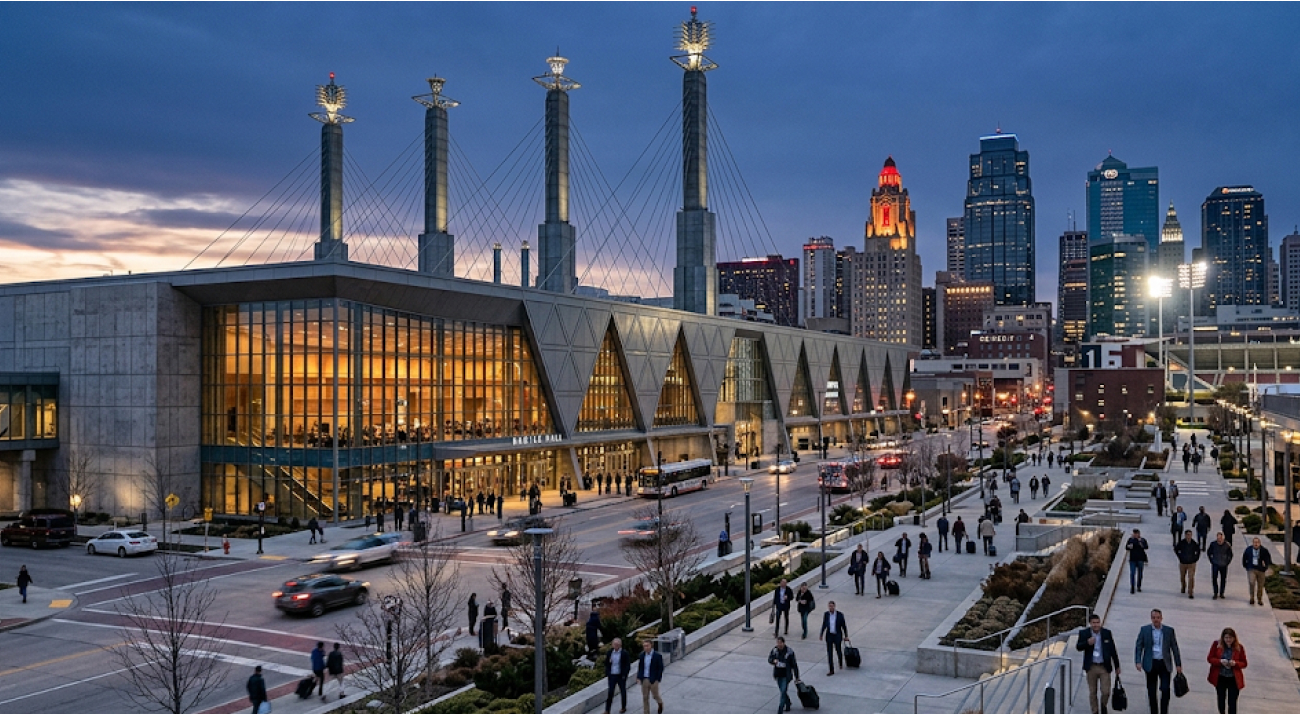
Kansas City is preparing a major modernization strategy for its downtown convention and entertainment facilities, with a long-term vision that could involve approximately $500 million in improvements through 2036. The proposal centers on H. Roe Bartle Hall, Municipal Auditorium, and the Music Hall, three established venues that play an important role in the city’s meetings, exhibitions, entertainment, and visitor economy.
The latest step came on November 5, 2026, when the Kansas City Council approved Resolution No. 260960, sponsored by Mayor Quinton Lucas. The resolution directs the city manager to study and evaluate the July 2026 Kansas City Convention Center and Municipal Auditorium Vision Plan, including which improvements should move forward and how they could be financed.
The announcement follows voter approval of Question 2 on August 4, 2026. The $100 million general obligation bond measure includes approximately $75 million identified for the convention complex, providing a starting point for the first phase of work.
The distinction between the initial investment and the larger vision is important. The city has advanced the planning and evaluation process, but it has not authorized the entire $500 million program for construction. Later improvements will require additional decisions about scope, funding, scheduling, and implementation.
For Kansas City’s hospitality businesses, event organizers, property owners, and downtown employers, the stakes extend beyond renovated buildings. A more competitive convention campus could help the city attract larger meetings, retain recurring events, generate hotel demand, and strengthen activity in surrounding commercial districts.
The $500 Million Vision Starts With A $75 Million Investment
The convention campus plan is built around a phased modernization strategy prepared by Kansas City-based architecture and design firm Populous. Its July 2026 vision plan considers how the city’s existing convention and entertainment facilities could work together as a more connected and competitive downtown destination.
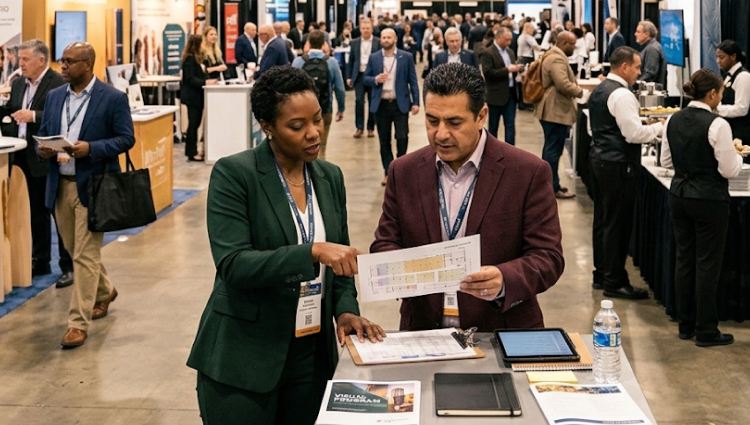
The initial phase, identified as Phase 0, focuses on Municipal Auditorium and the Music Hall. The preliminary investment is approximately $75 million, corresponding to the amount identified for the convention complex under the voter-approved bond program.
The proposed work includes modernizing arena seating, restrooms, concessions, and event amenities at Municipal Auditorium. Accessibility improvements would also bring the historic venue closer to current expectations for visitors with mobility requirements. The Music Hall would receive preservation work, while exterior improvements would strengthen the connection between the buildings and nearby public spaces, including Barney Allis Plaza.
The preliminary budget presented to city officials also includes allowances for construction, design, administration, and building-performance improvements. These investments are intended to address both the visitor experience and the practical demands of operating older facilities.
Mayor Quinton Lucas said the voter-approved funding provides an opportunity to preserve Kansas City’s historic gathering places while making them more competitive with newer convention and entertainment venues.
The November 5 resolution does not commit the city to every element of the broader vision. Instead, it directs the city manager to evaluate some or all of the proposed improvements and develop recommendations for implementation.
That distinction matters because the $500 million figure represents a long-term planning vision, not a fully funded construction contract. The first $75 million phase has a clearer funding starting point, while later stages will depend on additional financial and policy decisions.
The city’s official legislative record provides the details of the action: Kansas City Resolution No. 260960.
Bartle Hall And Municipal Auditorium Anchor The Downtown Event Economy
The facilities included in the vision plan already serve different but complementary roles in Kansas City’s event business.
H. Roe Bartle Hall is the central exhibition component of the convention complex. Its large exhibit floors, meeting rooms, and ballroom facilities support trade shows, professional conferences, association meetings, and large public events. The convention center occupies a significant downtown footprint and connects event activity with nearby hotels, restaurants, entertainment venues, and transportation.
Municipal Auditorium provides another type of event space. Opened in the 1930s, the historic building has hosted sporting events, conventions, performances, and civic gatherings. Its renewed role as the home venue for University of Missouri-Kansas City basketball adds another source of activity to its calendar.
The Music Hall, also part of the city’s historic civic infrastructure, provides a performance venue that can complement convention programming and attract visitors for cultural events.
Modernizing these facilities could help address a challenge faced by established convention destinations: maintaining the advantages of a central location while updating buildings that were developed for earlier generations of events.
Contemporary convention clients often evaluate more than exhibit-floor capacity. They consider accessibility, technology, flexible meeting spaces, food service, loading operations, visitor circulation, and the quality of the surrounding district. Older facilities can remain competitive, but they need ongoing investment to meet changing expectations.
For Kansas City, the opportunity is to improve the performance of existing assets rather than rely entirely on new construction. That approach also preserves the historic identity of the downtown venues while allowing them to serve modern event requirements.
Convention Business Already Generates Significant Visitor Spending
The economic case for the campus plan is supported by Kansas City’s existing meetings and convention activity.
According to Visit KC, the city hosted 565,278 meeting attendees in 2025, generating 522,042 hotel room nights and an estimated $420 million in economic impact.
Those figures illustrate why convention facilities matter to businesses beyond the buildings themselves. Meeting attendees use hotels, restaurants, transportation services, attractions, retailers, and other local businesses. Larger events can also generate demand for temporary workers, production services, catering companies, and suppliers.
Visit KC reports that it helps organize and support nearly 500 meetings and conventions each year. The organization also works with nearly 900 community partners and markets Kansas City to event planners and visitors.
The convention center is therefore part of a wider economic network. Its performance influences how many events the destination can accommodate, which organizations consider Kansas City for future meetings, and how much business flows into surrounding commercial areas.
The broader tourism figures provide additional context. Visit KC reports that tourism generates approximately $6.7 billion in annual regional economic impact, including direct, indirect, and induced activity, and supports more than 122,000 jobs. These figures cover the wider tourism economy rather than convention facilities alone.
The $420 million meeting and convention impact is particularly relevant to the modernization proposal because it demonstrates the existing scale of the business the city wants to retain and expand.
The next challenge is translating facility improvements into additional bookings, longer visitor stays, and more spending at local businesses. Renovations alone do not guarantee that outcome. Their value depends on the events the destination can attract and the ability of local businesses to capture the resulting demand.
Visit KC publishes its meetings, visitor, and tourism information through its official economic development and tourism overview.
Later Phases Could Connect The Convention Campus More Closely
The broader Populous vision extends beyond the initial renovation of Municipal Auditorium and the Music Hall. It outlines additional phases intended to improve connections between convention facilities and create a more integrated downtown campus.
The preliminary schedule places a central campus connector and new entrance improvements around 2030. Later phases envision improvements to northern event space around 2032 and southern event space around 2036.
These concepts would give the city a longer-term framework for improving how visitors move between facilities and how different event spaces support one another.
For convention planners, campus connectivity can influence the appeal of a destination. When meeting rooms, exhibition areas, ballrooms, performance venues, hotels, and public spaces are easier to access, organizers have more flexibility in designing programs.
A connected campus can also support events that use several facilities simultaneously. A conference might hold its main exhibition at Bartle Hall, schedule presentations at another venue, and organize evening programming at Municipal Auditorium or nearby entertainment locations.
That flexibility can become a competitive advantage when cities are bidding for large conventions that require several types of space.
However, the later phases remain proposals within the broader vision. Their final scope, costs, funding arrangements, and construction schedules have not been established through the November 5 resolution.
The city must determine which elements offer the strongest operational and economic value before committing additional public resources. That process will be important because the convention campus must remain functional while improvements are planned and potentially constructed.
Barney Allis Plaza Could Strengthen The Campus Connection
The convention campus strategy also intersects with the redevelopment of Barney Allis Plaza, the public space located beside Municipal Auditorium.
The plaza project is separate from the broader $500 million convention vision, but the two efforts share an important objective: creating stronger connections between civic facilities and downtown public spaces.
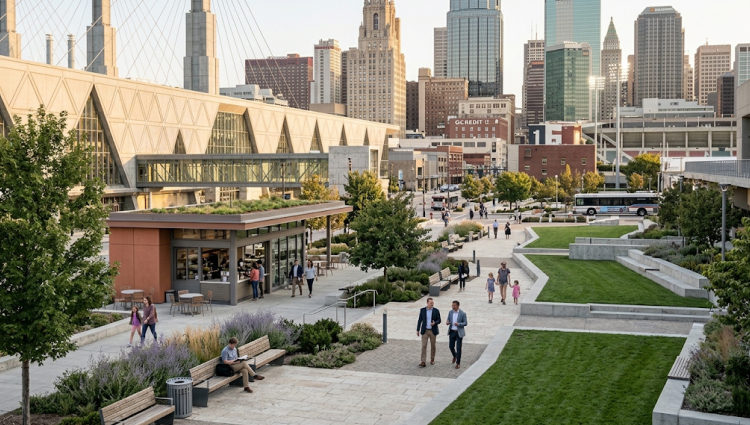
The redesigned plaza is scheduled to reopen in spring 2027. Plans include an outdoor event area, landscaped spaces, a terraced lawn, and flexible areas for public programming. A pavilion area is expected to accommodate activities such as food-truck service and temporary events.
The project also includes a replacement for the underground Auditorium Parking Garage, which closed in April 2024 after deteriorating conditions were identified. The replacement garage is planned to accommodate approximately 580 vehicles.
For the convention campus, the plaza could provide another place for attendees to gather outside formal meeting spaces. Outdoor activations, food vendors, community programming, and event-related activities could help connect convention visitors with the surrounding downtown environment.
This relationship is important because successful convention districts need more than adequate indoor space. Visitors also evaluate what they can do before and after meetings, how easily they can reach restaurants and attractions, and whether the surrounding district offers an appealing experience.
If the convention facilities and plaza improvements are coordinated effectively, Kansas City could create a more welcoming public environment around its historic venues.
The larger economic opportunity would come from encouraging attendees to spend time and money across the district rather than limiting their activity to the convention building.
UMKC Basketball Adds Another Reason To Modernize Municipal Auditorium
Municipal Auditorium’s planned role as the home venue for University of Missouri-Kansas City basketball provides another reason for investing in the facility.
College basketball creates a recurring schedule of games that can bring students, alumni, visiting teams, families, and spectators into downtown Kansas City. Those visitors may use nearby restaurants, hotels, parking facilities, and entertainment businesses.
The addition of a regular sports calendar can also complement convention and performance bookings. Rather than relying exclusively on large annual meetings or occasional concerts, the venue can contribute to a more varied event schedule.
That diversification matters for facilities with substantial operating and maintenance requirements. A broader calendar creates more opportunities to use the building and generate activity throughout the year.
The proposed seating, concession, accessibility, and building upgrades could improve the experience for basketball spectators while preserving the venue’s ability to host other events.
The long-term benefit will depend on scheduling, attendance, operating costs, and how effectively the venue connects with downtown businesses. A renovated building can provide better facilities, but its economic performance will still depend on attracting events that bring visitors into the district.
For Kansas City, the combination of college basketball, conventions, exhibitions, performances, and public events could make Municipal Auditorium a more consistent contributor to downtown activity.
Financing The Full Vision Remains The Biggest Question
The most important issue facing the $500 million convention campus vision is how Kansas City will pay for improvements beyond the initial phase.
The August 4 voter-approved Question 2 bond provides a defined starting point. Of the $100 million general obligation bond, approximately $75 million was identified for improvements to Bartle Hall, Municipal Auditorium, and the Music Hall.
That allocation does not automatically finance every project in the broader vision through 2036. Later phases will require additional funding decisions, and the city manager’s evaluation process is intended to help establish which improvements should advance and how they could be implemented.
The city must also consider the financial implications of maintaining and operating modernized facilities. Capital investment is only one part of the equation. Convention buildings require staffing, utilities, repairs, cleaning, security, technology upgrades, and periodic equipment replacement.
The financial evaluation should therefore consider the expected cost of each phase alongside its potential contribution to convention bookings, event revenue, visitor spending, and local employment.
The city also needs to consider construction disruption. Renovating active convention facilities can affect the event calendar, exhibitor access, loading operations, and visitor circulation. A phased approach may help preserve the ability to host events while work progresses, but scheduling will be critical.
Kansas City’s existing convention business provides a meaningful starting point for that evaluation. The 2025 total of 522,042 hotel room nights and $420 million in reported meeting-related economic impact demonstrates the scale of the activity supported by the current facilities.
The key question is how much additional business a modernized campus could realistically attract, and whether the resulting benefits justify the cost of future investment.
Downtown’s Next Development Phase Depends On More Than Renovated Buildings
Kansas City’s convention campus vision comes at a time when downtown development increasingly depends on connections between tourism, entertainment, sports, public spaces, and commercial activity.
The city’s convention facilities are close to hotels, restaurants, cultural institutions, and entertainment destinations. Improvements to the campus could strengthen those relationships by making the area more appealing to event organizers and visitors.
The strategy also fits into a wider pattern of major investment in Kansas City. The city is pursuing new sports and entertainment developments, public-space improvements, and projects intended to increase downtown activity. Each initiative has its own financing structure and approval process, but their combined effect could influence how the central business district evolves.
The convention campus has a distinct role in that development strategy. While a sports stadium may concentrate activity around game days, convention facilities can attract visitors for conferences, exhibitions, trade shows, professional meetings, and cultural events throughout the year.
That creates a different kind of visitor economy, one that can support weekday hotel demand and bring customers to downtown businesses outside major sporting weekends.
The city’s next task is to turn the vision into a financially realistic implementation plan. The November 5 resolution advances that process, but the full $500 million program remains a long-term proposal rather than an approved construction commitment.
For a useful comparison, Los Angeles is also investing in its convention infrastructure to compete for larger meetings and strengthen its visitor economy. Richland Chamber examined that strategy in its coverage of the Los Angeles Convention Center expansion.
Kansas City’s opportunity will depend on whether it can modernize its historic facilities, preserve their event capacity, and attract enough additional business to support the investment. If the city can align those goals with downtown public-space improvements and a sustainable funding plan, the convention campus could become an important part of its next decade of economic development.
