Pittsburgh’s 2026 NFL Draft delivered a result that could strengthen the argument for bringing major sporting events to cities outside the traditional mega-event circuit. The three-day draft generated an estimated $177 million in regional economic impact, attracted a record 805,000 attendees, and produced more than $1.5 billion in broader economic value through media exposure, broadcasting, social engagement and related visibility. More than 55 million people watched the event worldwide, according to post-event analyses released in August. For a broader look at how major sporting events can generate lasting benefits beyond the competition itself, see our analysis of sports event legacy planning
Those numbers are significant, but they also create a more complicated question for Pittsburgh and other American cities. Public entities committed more than $19 million toward hosting and promoting the draft, meaning the event’s success cannot be judged simply by the size of its headline economic impact. The more useful question is whether the combination of visitor spending, destination exposure, business activity and future tourism potential can justify the public investment required to host major sporting events.
Pittsburgh’s experience provides an unusually useful case study because the NFL Draft is different from a traditional stadium event. Fans can move throughout downtown, attend free programming, visit restaurants and attractions, and interact with the city for several days. That makes the draft less of a single-venue competition and more of an urban economic event.
Pittsburgh Turned The NFL Draft Into A Citywide Event
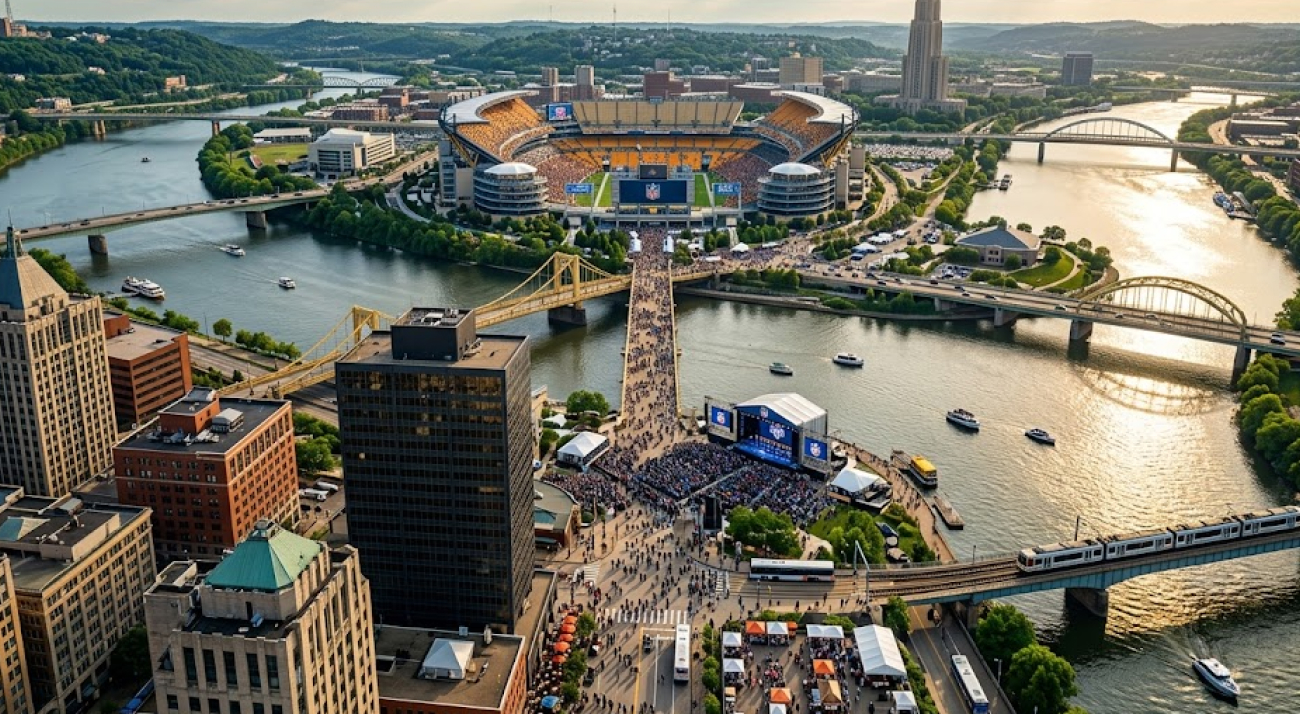
The 2026 NFL Draft took place from April 23 through April 25, with programming distributed around Downtown Pittsburgh, the North Shore and other public spaces. The NFL selected Pittsburgh as its host city partly because of the city’s football identity, the Pittsburgh Steelers and its ability to showcase the region to a national and international audience.
The attendance figures ultimately exceeded expectations.
Pittsburgh had originally anticipated somewhere between 500,000 and 700,000 visitors or attendees across the three days. Instead, the NFL reported 805,000 attendees, surpassing the previous three-day record of 775,000 set by Detroit in 2024. The first day alone attracted approximately 320,000 people.
That scale matters because the draft does not require every visitor to purchase a stadium ticket.
Large portions of the experience are public and free. Fans can attend draft-related programming, concerts and fan activities, walk through downtown districts and spend money at businesses throughout the city.
This gives Pittsburgh an economic advantage that many traditional sporting events cannot replicate.
The NFL Draft’s official event model effectively turns a professional sports competition into a temporary urban festival. The result is a much broader visitor footprint than a conventional game, where most spending may be concentrated around the stadium before and after kickoff.
The $177 Million Figure Changes The Economic Conversation
The most important number released in August was the $177 million economic impact calculated for the Pittsburgh region.

Sportsimpact analyzed the direct economic effects of the event, including visitor spending, overnight stays and related activity. Trajektory conducted a separate analysis measuring the broader economic value of Pittsburgh’s exposure through broadcast coverage, public relations, social media and other forms of visibility. That second calculation exceeded $1.5 billion.
These numbers should not be treated as interchangeable.
Economic impact measures actual economic activity associated with the event. Economic value from exposure is a broader calculation that attempts to place a value on the attention a city receives.
That distinction is crucial for cities considering major-event bids.
A city cannot necessarily use $1.5 billion in media value to pay for public infrastructure, police overtime or event operations. Media exposure does not function like tax revenue.
But it can influence future decisions by visitors, businesses, investors and event organizers.
The distinction also makes Pittsburgh’s $177 million figure more useful for comparing the direct economic performance of the event.
| Measure | Pittsburgh 2026 NFL Draft |
|---|---|
| Regional economic impact | $177 million |
| Broader economic value | More than $1.5 billion |
| Total attendance | 805,000 |
| Worldwide viewers | More than 55 million |
| Countries represented among NFL OnePass registrants | 105 |
| Visitors traveling from outside 50 miles | 43% |
The figures show why Pittsburgh’s event strategy is attracting attention. The city did not simply generate a large crowd; it converted a nationally televised sporting event into an extended destination-marketing opportunity.
Public Investment Still Requires A More Careful Calculation
The $177 million result does not automatically mean Pittsburgh’s public investment generated $177 million in government revenue.
That distinction was a major issue even before the draft took place.
Pennsylvania, Allegheny County and the City of Pittsburgh collectively committed significant public resources to the event, with earlier reporting putting the combined public investment at approximately $14 million, alongside additional matching and tourism-related funds that brought the broader commitment above $19 million.
The economic impact is therefore best understood as a measure of activity rather than a direct return on investment to taxpayers.
That difference should change how cities evaluate future event bids.
Officials should ask several separate questions:
- How much new visitor spending did the event generate?
- How much tax revenue did governments actually receive?
- How much of the spending would have occurred without the event?
- Which industries and neighborhoods benefited?
- Did the event generate measurable repeat tourism?
- Did national exposure translate into new business or investment opportunities?
Pittsburgh’s case is particularly interesting because some of the strongest benefits may occur after the event.
A visitor who discovered Pittsburgh during the draft and returns for another trip in 2027 represents a longer-term tourism benefit that cannot be fully captured in a three-day economic-impact calculation.
Destination Reputation May Be The Bigger Long-Term Asset
The economic research released after the draft found evidence that Pittsburgh’s reputation improved among visitors.
VisitPITTSBURGH reported that 51% of visitors said their perception of Pittsburgh improved because of their visit, while 75% said they were very likely to return within the next five years. Those figures suggest that the draft may have produced an important secondary benefit: changing how outsiders view the city.
This matters because Pittsburgh has spent decades transitioning from its historic image as an industrial center toward a more diversified economy built around healthcare, education, technology, robotics, culture and tourism.
A major sports event provides a concentrated opportunity to show that transformation to millions of people.
The city’s rivers, bridges, downtown skyline, stadiums and neighborhoods become part of the television product.
Every national broadcast effectively becomes a destination advertisement.
The VisitPITTSBURGH destination strategy therefore becomes relevant beyond conventional tourism marketing. The value of hosting the draft is partly connected to whether people who saw Pittsburgh on television subsequently associate the city with major events, entertainment, hospitality and an attractive urban environment.
That is a different type of return from hotel taxes or restaurant receipts.
It is a reputational return.
The Draft Demonstrated Why Walkable Cities Can Compete For Mega-Events
One of Pittsburgh’s advantages during the draft was the physical relationship between its downtown, riverfront and major event spaces.
The city’s compact geography allowed fans to move between attractions rather than remaining inside one isolated venue.
That helped turn the event into an urban experience.
The NFL Draft’s presence around Downtown Pittsburgh and the North Shore also allowed public spaces to become part of the event infrastructure. Pittsburgh did not need to build an entirely new city around the draft. Instead, it temporarily reorganized existing public spaces, streets and entertainment areas around an unusually large visitor population.
That model could become increasingly attractive to cities that lack the enormous convention centers or mega-stadium complexes associated with traditional host markets.
A city with a strong downtown, reliable transportation, restaurants, hotels, public spaces and a recognizable sporting identity may be able to compete effectively even without constructing a new permanent venue.
Pittsburgh’s performance reinforces that idea.
Small-Business Results Show Why Attendance Alone Is Not Enough
There is another side to the Pittsburgh story that should not be overlooked.
During the draft itself, some small businesses reported disappointing sales despite the record crowds. Pittsburgh Post-Gazette reporting found that several local businesses experienced lower-than-expected customer traffic, while parking demand was also weaker than anticipated in some areas.
This is an important warning for cities.
805,000 attendees does not mean 805,000 customers for local businesses.
Large event footprints can redirect pedestrian movement toward official fan zones, sponsored activations and major event areas. Visitors may spend significant amounts of time inside those controlled environments rather than exploring surrounding commercial districts.
That means future host-city planning needs to go beyond crowd estimates.
Cities should map where visitors actually spend their time.
They should identify which businesses receive increased traffic and which businesses experience displacement or reduced access. They should also consider how road closures, security zones and transportation changes affect ordinary commercial activity.
Pittsburgh’s experience provides evidence for both sides of the argument: the draft generated a very large regional economic impact, while some individual businesses still struggled to capture the opportunity.
That tension is likely to become increasingly important as cities compete for major events.
Pittsburgh’s Public-Space Investments Added Another Layer
The draft was also connected with improvements to Pittsburgh’s public realm.

According to VisitPITTSBURGH, the event’s “Living Legacy” program included plans to plant 500 new trees across Pittsburgh and Allegheny County, install 400 hanging flower baskets and 420 yellow-and-black planters, and redirect surplus food through 412 Food Rescue with a goal of providing 50,000 meals to local residents.
Pennsylvania officials also highlighted work around Arts Landing, Market Square and Point State Park, linking the event to broader public-space improvements.
This is where the economics of major sporting events can become more interesting.
A temporary event can leave behind permanent improvements if the host city negotiates for them.
The strongest event agreements therefore should not focus exclusively on who pays for the temporary festival. They should also establish what remains after the crowds disappear.
Trees, public spaces, transportation upgrades, pedestrian improvements and community programs can extend the usefulness of an event well beyond its closing ceremony.
For Pittsburgh, that legacy provides a stronger argument for public participation than the three-day event alone.
The $1.5 Billion Exposure Number Shows The Value Of Global Attention
Pittsburgh’s more than $1.5 billion in broader economic value is particularly relevant to cities that struggle to attract national attention.
The Trajektory analysis included broadcast, public relations, social media and in-venue exposure generated from the time Pittsburgh was awarded the draft through the end of the event.
More than 55 million viewers worldwide watched the draft, while the event generated billions of public-relations impressions. VisitPITTSBURGH reported that 105 countries were represented among NFL OnePass registrants and that 43% of attendees traveled from outside a 50-mile radius.
That international reach changes the potential audience for a city’s brand.
A local tourism campaign might reach travelers already considering Pittsburgh.
The NFL Draft reaches football fans who may never have placed Pittsburgh on their travel list.
This is why major sporting events can sometimes function as destination-marketing accelerators.
The event creates a reason for people to pay attention.
The city then has to convert that attention into future visits, investment, conferences, conventions and additional events.
Pittsburgh Could Become A Stronger Competitor For Future Events
The most consequential result of the 2026 NFL Draft may be what happens to Pittsburgh’s event calendar afterward.
A successful event gives organizers evidence that the city can handle enormous crowds.
It demonstrates that downtown and riverfront infrastructure can accommodate a large-scale festival.
It gives hotels and restaurants experience serving hundreds of thousands of visitors.
It gives transportation agencies a real-world stress test.
It gives police, emergency services and public agencies experience coordinating a major national event.
And it gives future event organizers a data set they can examine.
Those operational capabilities have value.
A city does not become a proven host merely because it has a stadium. It becomes a proven host by demonstrating that it can manage transportation, security, hospitality, public spaces, communications, volunteers and business activity simultaneously.
Pittsburgh now has that experience.
What Other U.S. Cities Can Learn From Pittsburgh
Pittsburgh’s numbers suggest that the case for hosting major sporting events should be evaluated through a wider framework than traditional economic-impact studies.
| Traditional Measure | Expanded Host-City Measure |
|---|---|
| Visitor spending | New spending versus displaced spending |
| Hotel occupancy | Repeat visitation potential |
| Tax revenue | Long-term investment generated |
| Attendance | Geographic distribution of visitors |
| Media impressions | Changes in destination perception |
| Event costs | Permanent infrastructure and public-space legacy |
| Business revenue | Business-by-business and neighborhood impact |
| Event success | Ability to attract future major events |
The biggest lesson is that economic impact and economic value are different assets.
The $177 million figure demonstrates that Pittsburgh generated substantial activity during the event.
The $1.5 billion-plus figure demonstrates that the city also generated substantial attention.
The challenge is converting both into lasting benefits.
That means future host-city contracts should include clearer requirements for local business participation, permanent improvements, transparent public spending and post-event measurement.
The NFL’s approach to future draft hosting also shows why the competition between cities is likely to intensify. Washington, D.C., is targeting 1 million attendees for the 2027 NFL Draft, while other cities are reportedly interested in future editions. Pittsburgh’s 805,000-attendee record has already raised the benchmark.
Pittsburgh’s Draft Could Change How Cities Measure Success
Pittsburgh’s $177 million result strengthens the economic argument for hosting a major sporting event, but the more significant lesson is methodological.
A city should not ask only whether an event generates more money than it costs.
It should ask what kind of economic activity it generates, who receives it, what infrastructure remains, how the city’s reputation changes and whether the event creates future opportunities.
The 2026 NFL Draft provides evidence for all of those questions.
It brought 805,000 attendees, attracted viewers from around the world, generated $177 million in regional economic impact, produced more than $1.5 billion in broader economic value, and gave Pittsburgh a measurable opportunity to improve its national and international image.
But the small-business concerns demonstrate why headline figures should not end the analysis.
The next generation of host cities will need to prove that major sporting events can produce benefits beyond stadium districts and official fan zones. They will need to connect event spending with neighborhood businesses, public spaces, transportation systems and long-term development goals.
Pittsburgh has provided an important test case.
The city’s success suggests that a major sporting event can deliver meaningful economic activity without requiring a Super Bowl-sized infrastructure buildout. At the same time, its uneven business experience shows that crowds alone are not an economic-development strategy.
The strongest host-city model may therefore be one that treats a major sporting event as a temporary accelerator for a city’s existing assets rather than as an isolated three-day spectacle.
For Pittsburgh, the next measure of success will not be another attendance record.
It will be whether the visitors who came for the NFL Draft return, whether businesses continue benefiting from the exposure, whether the city’s improved reputation attracts new opportunities and whether the public investments connected to the event remain valuable years after the final pick was announced.
That is ultimately what could change the case for hosting major sports events: not simply the $177 million Pittsburgh generated in 2026, but the possibility that one major event can create a platform for the next decade of tourism, investment and urban development.
