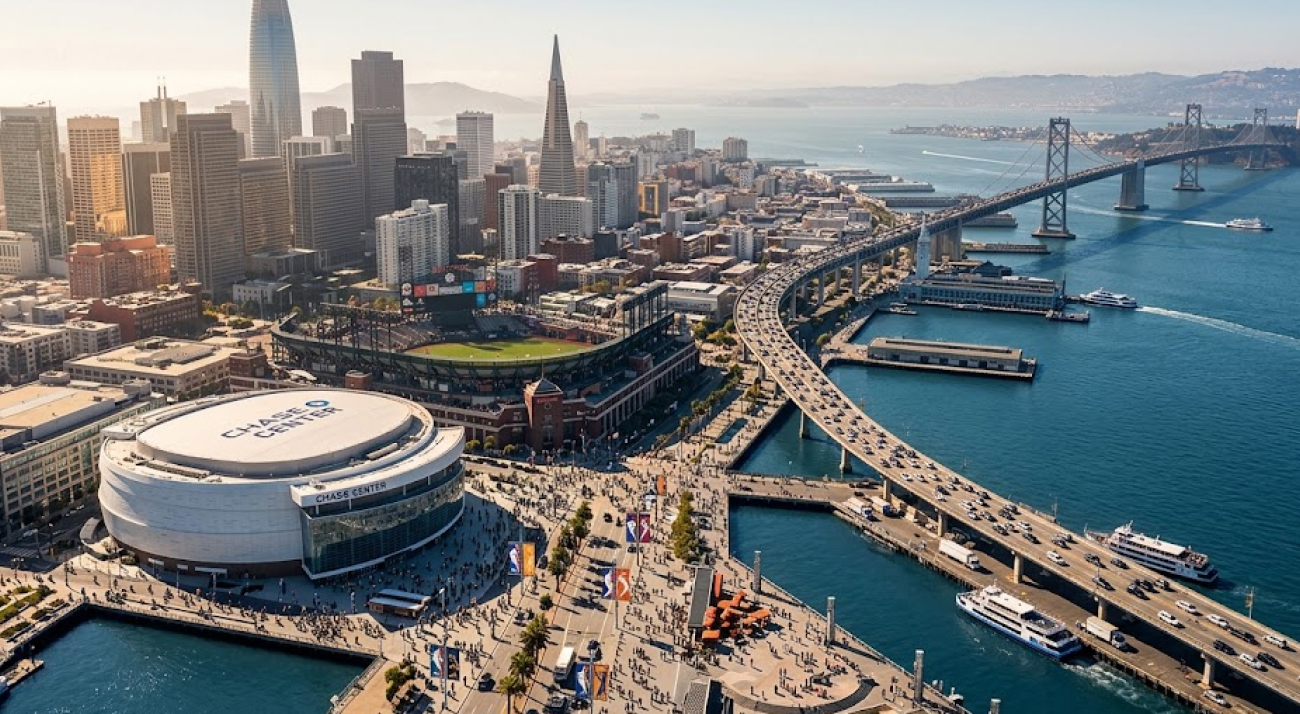
San Francisco’s position in the American sports-event economy is changing quickly. The Bay Area has secured the 2027 WNBA All-Star Game at Chase Center and the 2028 MLB All-Star Game at Oracle Park, giving the region two consecutive marquee league showcases after an extraordinary run that included the 2025 NBA All-Star Weekend and the 2026 FIFA World Cup and Super Bowl cycle. The WNBA announced on August 18 that Golden State Valkyries will host the 2027 event on July 31, with additional festivities beginning July 30.
The sequence matters because San Francisco is no longer competing for individual events in isolation. The Bay Area Host Committee is building a broader pipeline that includes major women’s sports, international competitions and future championship events. That strategy could give the region an advantage over cities that pursue one-off tournaments without developing the infrastructure, partnerships and operational experience required to host several major events in succession.
The emerging question is whether San Francisco can convert that event concentration into something more durable: a sports economy capable of generating tourism, hospitality demand, business exposure, community investment and year-round destination value.
San Francisco Is Building A Different Kind Of Sports Calendar
The announcement of the 2027 WNBA All-Star Game came only days after Major League Baseball awarded San Francisco the 2028 MLB All-Star Game, which will return to Oracle Park for the first time since 2007. It will be the fourth time San Francisco has hosted the Midsummer Classic, following appearances at Candlestick Park in 1961 and 1984 and the 2007 event at what was then AT&T Park.
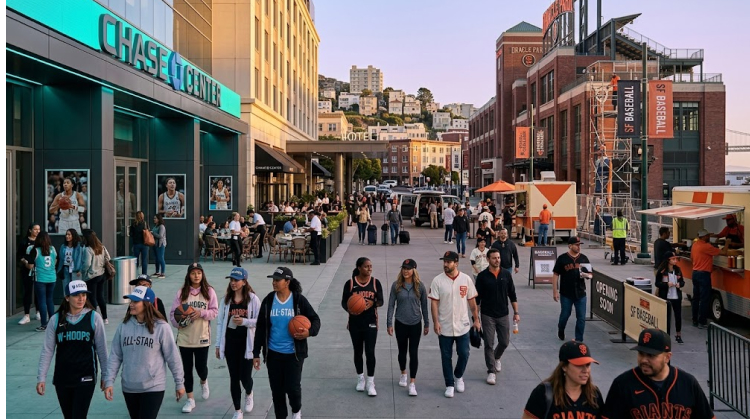
That creates an unusual two-year sequence.
In 2027, Chase Center will become the center of the women’s basketball world for an entire All-Star weekend. In 2028, Oracle Park will take the spotlight for Major League Baseball.
The two venues are only a few miles apart, but they serve different audiences and event calendars. Chase Center is home to the Golden State Warriors and Golden State Valkyries, while Oracle Park is home to the San Francisco Giants. Together, they create a platform capable of supporting basketball, baseball, concerts, conventions and other large-scale events.
| Event | Venue | Timing | Strategic Significance |
|---|---|---|---|
| 2025 NBA All-Star Weekend | Chase Center | February 2025 | Established Bay Area as a major basketball-event market |
| 2026 FIFA World Cup | Levi’s Stadium / Bay Area | June–July 2026 | International tourism and global exposure |
| 2027 WNBA All-Star | Chase Center | July 30–31, 2027 | First WNBA All-Star in the Bay Area |
| 2028 MLB All-Star | Oracle Park | 2028 | Returns baseball’s Midsummer Classic to San Francisco |
The pattern is more important than any individual event.
San Francisco is developing the ability to offer professional leagues something that goes beyond a stadium. It can offer a connected destination with venues, hotels, convention facilities, restaurants, cultural attractions, public transportation and a globally recognized skyline.
That combination is becoming increasingly valuable as leagues compete for attention in a crowded sports marketplace.
The Valkyries Give The 2027 Event A New Dimension
The WNBA’s decision to award the 2027 All-Star Game to San Francisco is also a reflection of the rapid rise of the Golden State Valkyries.
The expansion franchise was announced in 2023 and began playing in 2025. By August 2026, the Valkyries had already reached their second consecutive postseason, according to current reporting. The team has also developed one of the strongest fan environments in the league, helping demonstrate that Bay Area demand for women’s professional basketball is not merely theoretical.
WNBA Commissioner Cathy Engelbert specifically cited the Valkyries’ impact and the region’s fan support when the league announced the 2027 All-Star selection.
That gives San Francisco something many host cities do not have: a major event tied directly to a rapidly growing local sports property.
The 2027 weekend will include the Kia WNBA Shooting Stars and State Farm WNBA 3-Point Contest on July 30, followed by the All-Star Game on July 31. WNBA Live will also take place at Moscone Center, while community events, watch parties and other activities are expected across the Bay Area.
This multi-location structure is important for San Francisco’s tourism economy.
Instead of concentrating every visitor inside Chase Center, the league can distribute activity among the arena, Moscone Center, hotels, restaurants, retail districts and community venues.
That is exactly the type of event footprint that can turn a sports weekend into a citywide tourism product.
The 2025 NBA All-Star Game Already Provided A Financial Test
San Francisco does not have to speculate about whether an All-Star event can produce substantial economic activity.
The 2025 NBA All-Star Game at Chase Center generated an estimated $328.2 million in economic impact for San Francisco and the broader Bay Area, according to a Temple University Sports Industry Research Center study commissioned by the Golden State Warriors. The event attracted 142,881 attendees from 40 states and 44 countries.
The study also estimated approximately $210 million in direct spending, including tourism expenditures and corporate production services, while roughly 1,700 local jobs were created, supported or expanded. An additional $101.1 million in earned media value was attributed to the event and surrounding activities.
Those numbers provide an important benchmark for the 2027 WNBA event.
The WNBA All-Star Game is a different product from the NBA’s version, and its economic footprint will not necessarily match the 2025 figure. But San Francisco now has evidence that its event infrastructure can support a large, multi-day professional basketball showcase with measurable economic benefits.
That institutional knowledge can be just as valuable as the event itself.
City agencies, hotels, restaurants, transportation operators, police departments and venue managers have already experienced the operational demands of a major All-Star weekend.
The next event does not start from zero.
San Francisco can use lessons from 2025 to improve the visitor experience in 2027.
Oracle Park Adds A Second Major Platform
The 2028 MLB All-Star Game introduces another dimension to the region’s strategy.
Oracle Park has a very different identity from Chase Center. Its waterfront setting, downtown location and historic relationship with the Giants give MLB an opportunity to market San Francisco through one of the most recognizable baseball environments in the country.
The 2028 game will also have historical significance. The last San Francisco MLB All-Star Game, held in 2007, featured Ichiro Suzuki’s famous inside-the-park home run, while Barry Bonds made the final All-Star appearance of his career.
The return therefore gives MLB a natural storytelling opportunity.
For the Giants, it provides a major international platform.
For San Francisco, it creates another reason for baseball fans to travel to the city.
For hotels and restaurants, it produces another high-profile event in the summer tourism calendar.
The San Francisco Giants’ Oracle Park platform also benefits from being embedded in a downtown environment rather than isolated outside the city. That geography makes it easier to connect the baseball event with restaurants, hotels, public transportation and other attractions.
This is one reason San Francisco can potentially build a stronger sports-event ecosystem than a city whose primary venue sits far from its commercial center.
A Compact City Can Turn Events Into Tourism Products
San Francisco’s physical layout is one of its biggest advantages.
The city’s downtown core, waterfront, hotels, restaurants and cultural attractions are concentrated within a relatively compact area. Chase Center sits in Mission Bay, while Oracle Park is immediately adjacent to the neighborhood. Moscone Center is only a short distance away.
San Francisco Travel describes the city’s sports-event proposition around a compact, connected footprint, supported by more than 35,000 hotel rooms across more than 250 hotels.
That infrastructure makes a difference.
A visitor attending a game can stay downtown, attend a fan event at Moscone Center, eat at a restaurant in SoMa, visit the waterfront and return to the arena without requiring a car for every activity.
That is precisely the kind of visitor behavior cities want from major sporting events.
The longer visitors remain in a destination, the greater the opportunity for spending to spread across hotels, restaurants, attractions, retail and transportation.
A single ticket can therefore become the starting point for a much larger tourism experience.
The Bay Area Host Committee Is Thinking Beyond Two Games
The strongest evidence that San Francisco is pursuing a sports-capital strategy comes from what happens beyond the two newly awarded All-Star Games.
The Bay Area Host Committee has already identified additional targets, including the 2031 FIFA Women’s World Cup, the 2031 Men’s Rugby World Cup, NCAA events and competitions involving cricket, cycling and other sports.
That means the region is attempting to create a pipeline rather than simply collect trophies.
Zaileen Janmohamed, president and CEO of the Bay Area Host Committee, has emphasized that the region’s recent success comes from maintaining relationships with leagues and governing bodies and pursuing events over long time horizons.
That approach changes how cities compete.
A successful bid is not just about having an attractive stadium. It depends on whether leagues believe the host market can deliver reliable operations, strong sponsorship opportunities, hotel capacity, media infrastructure, transportation and a compelling visitor experience.
San Francisco is increasingly able to demonstrate all of those elements.
Major Events Are Becoming Part Of The City’s Economic Strategy
San Francisco’s broader tourism numbers also show why the strategy matters.
Tourism generated approximately $655 million in tax revenue for the city’s General Fund in 2025, according to San Francisco Travel, equivalent to an estimated $778 in tax relief per San Francisco resident. The organization also forecasts international overnight visitation of approximately 2.3 million in 2026, with international visitor spending projected to reach $5.2 billion, a 5.8% increase from 2025.
Major sporting events can reinforce that tourism machine.
They create dates on the calendar that are difficult for consumers to ignore.
They also provide global television exposure that ordinary destination advertising cannot easily replicate.
The 2025 NBA All-Star Game demonstrated this through more than $100 million in estimated earned media value. The 2027 WNBA event and 2028 MLB event provide two more opportunities to put San Francisco’s neighborhoods, waterfront and cultural attractions in front of national and international audiences.
This is where sports and destination marketing increasingly overlap.
A league wants an attractive host city because the city helps sell the event.
The city wants the league because the event helps sell the destination.
That relationship can become mutually reinforcing.
The Bay Area Still Has To Spread The Benefits
Becoming a sports capital, however, is not simply a matter of accumulating major-event announcements.
San Francisco still faces the challenge of ensuring that event-driven spending reaches a broad range of businesses and communities.
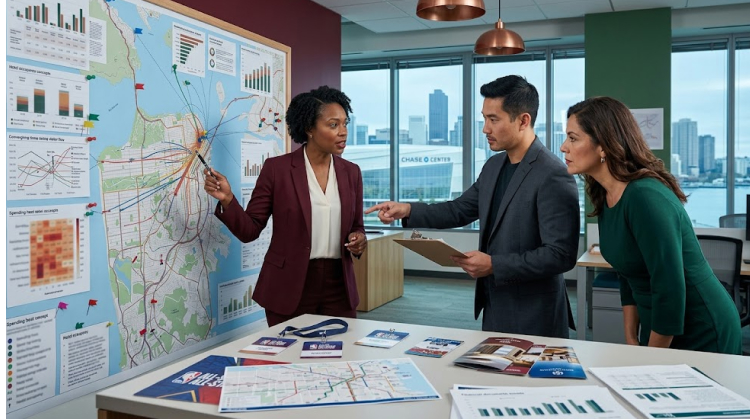
The 2025 NBA All-Star economic study demonstrated substantial regional benefits, but the next stage of the strategy should focus on how those benefits are distributed.
The WNBA has already indicated that the 2027 All-Star weekend will include community impact events throughout the Bay Area.
That provides an opportunity to connect the event with neighborhoods outside the immediate Chase Center district.
Oakland is particularly important in this conversation.
The Bay Area Host Committee has discussed efforts to make future events more regional, rather than treating San Francisco and Santa Clara County as isolated destinations.
A successful Bay Area sports strategy should therefore look less like a single downtown event zone and more like a regional network.
Hotels in San Francisco, restaurants in Oakland, attractions around the waterfront, businesses in the East Bay and transportation systems throughout the region can all become part of the same visitor economy.
The Biggest Advantage May Be Institutional Experience
One of San Francisco’s most valuable assets is becoming difficult to measure: experience.
The region has now hosted NBA All-Star activities, major international soccer, the Super Bowl and other large-scale sporting events in a compressed period. The Bay Area Host Committee says the region successfully hosted NBA All-Star 2025, Super Bowl LX and FIFA World Cup matches before the 2027 WNBA announcement.
Each event creates operational knowledge.
Officials learn how to manage crowds.
Hotels understand booking patterns.
Restaurants understand visitor demand.
Transit agencies learn where congestion develops.
Venues improve security procedures.
Local businesses learn how to market to traveling fans.
Sponsors learn which parts of the region produce the strongest engagement.
That knowledge accumulates.
A city that has hosted several major events can therefore become more attractive to leagues because the risk of operational failure may be lower.
This could become one of San Francisco’s most important competitive advantages.
Two All-Star Games Could Create A Repeatable Sports Economy
San Francisco’s 2027 WNBA All-Star Game and 2028 MLB All-Star Game should not be evaluated as two unrelated weekends.
Together, they create a test of whether the Bay Area can build a repeatable sports-tourism model.
The 2025 NBA experience provides an economic benchmark. The 2026 World Cup and Super Bowl cycle provides operational experience. The 2027 WNBA event introduces an expanding women’s sports audience. The 2028 MLB event brings another globally recognized league and a different fan demographic.
That sequence gives businesses multiple opportunities to learn and reinvest.
| Strategic Asset | Potential Long-Term Effect |
|---|---|
| Chase Center | Basketball, women’s sports and entertainment events |
| Oracle Park | Baseball and large-scale waterfront events |
| Moscone Center | Fan experiences, conventions and supporting programming |
| Downtown hotels | Increased room demand during major events |
| Public transportation | Regional visitor mobility |
| Bay Area Host Committee | Long-term event acquisition |
| Local sports franchises | League relationships and community engagement |
| International tourism | Expanded destination exposure |
The critical test will be whether the Bay Area can maintain demand between marquee events.
A sports capital cannot depend entirely on one weekend every year.
It needs a calendar.
San Francisco appears to be building one.
San Francisco’s Next Test Is Turning Event Volume Into Lasting Value
The Bay Area now has something few American markets can claim: a credible sequence of major sporting events across multiple leagues, sports and venues.
The 2027 WNBA All-Star Game gives San Francisco an opportunity to capitalize on the extraordinary early growth of the Golden State Valkyries and the broader expansion of women’s professional sports. The 2028 MLB All-Star Game gives Oracle Park another opportunity to showcase San Francisco to baseball audiences around the world.
The previous NBA All-Star Game provides evidence that the economic upside can be substantial. Its estimated $328.2 million economic impact, $210 million in direct spending and 142,881 attendees demonstrate the scale of what a major event can produce in the Bay Area.
But the larger opportunity lies in repetition.
If San Francisco can use one event to improve the next, connect sports with tourism, involve businesses throughout the region and maintain relationships with leagues, the Bay Area could move from being an attractive host city to becoming one of America’s most dependable sports-event markets.
That distinction matters.
A sports capital is not simply a city that hosts championship games.
It is a region with the infrastructure, venues, tourism economy, business community and institutional expertise to repeatedly attract events—and turn each one into a foundation for the next.
San Francisco now has the beginnings of that system.
The 2027 WNBA All-Star Game and 2028 MLB All-Star Game will show whether the Bay Area can convert its growing event portfolio into a durable economic and tourism advantage. If it succeeds, the real competition may no longer be about winning individual bids. It may be about building the kind of sports ecosystem that makes future bids easier to win.
