
Philadelphia is about to conduct one of the most important tests of its 2026 sports strategy: measuring what the city’s unprecedented calendar of major events actually delivered after the crowds left. On August 20, the administration of Mayor Cherelle L. Parker announced that Epsilon Economics had been selected to conduct an independent study examining the economic and fiscal impact of Philadelphia’s major 2026 events through July 31. The analysis will cover the FIFA World Cup, MLB All-Star Week, America250 celebrations, the One Philly Unity Concert, the 2026 New Year’s Eve celebration and other major programming.
The significance goes beyond producing another large economic-impact figure. Philadelphia is asking a more difficult question: Who actually benefited from hosting these events, where did the money go, and did the public investment generate a meaningful return?
That distinction matters because major sporting events can create billions of dollars in visitor spending while producing very different outcomes for hotels, restaurants, workers, neighborhood businesses, city government and taxpayers. Philadelphia’s new study could therefore become a useful model for how American cities evaluate mega-events after the headlines disappear.
Philadelphia Is Moving From Event Promotion To Measurement
Philadelphia entered 2026 with an unusually ambitious event calendar. The city hosted FIFA World Cup activity, MLB All-Star Week and celebrations connected to the nation’s 250th anniversary, creating a concentration of visitors and programming rarely seen in a single American city.

The Parker administration had already committed substantial resources before the events began. In her March 2025 budget address, Mayor Parker said the city had committed more than $30 million for partners and event preparations, along with nearly $28 million in new public-safety investments at that point. She projected total 2026 investment above $100 million when additional funding was included.
Those figures establish why the new analysis is necessary.
A city cannot evaluate an event simply by counting hotel rooms sold or visitors entering a stadium. Public spending has to be considered alongside private economic activity.
The study commissioned by Philadelphia will examine visitor and tourism activity, direct and indirect economic impacts, state and local tax revenues, and the distribution of economic activity across industries, sectors and geographic areas. Epsilon Economics is expected to develop the methodology with the city and produce a final report detailing its assumptions, data sources and findings.
That approach could produce a much more useful picture than a single headline number.
For example, $500 million in economic activity concentrated among hotels and large national businesses would tell a different story from $500 million spread among restaurants, transportation companies, neighborhood retailers, temporary workers and locally owned businesses.
Philadelphia is now positioned to find out which version occurred.
The World Cup And MLB All-Star Week Created Different Economic Footprints
The city’s two largest sporting properties in 2026 were fundamentally different.
The FIFA World Cup brought an international audience to Philadelphia and placed Lincoln Financial Field at the center of a global tournament. The MLB All-Star Game, meanwhile, turned Citizens Bank Park into the focal point of baseball’s Midsummer Classic while creating a wider schedule of fan and community activities throughout the city.
MLB scheduled All-Star Week from July 10 through July 14, with the 96th All-Star Game taking place at Citizens Bank Park on July 14. The schedule also included the Home Run Derby, MLB Draft activities, All-Star Village and other programming beyond the ballpark.
The difference is important because visitors do not behave the same way during every major sporting event.
A World Cup visitor may remain in the region for multiple matches or combine Philadelphia with trips to other host cities. An MLB fan may arrive specifically for All-Star Week, attend multiple events and extend the trip around the baseball schedule.
The city therefore needs to understand length of stay, origin of visitors, spending categories and geographic distribution, not merely attendance.
That is exactly the type of information Epsilon’s study is designed to capture.
The Real Question Is Where The Money Landed
Philadelphia’s study could become particularly valuable if it reveals how event spending was distributed across the city.
The city’s own August 6 update on its special-events system noted that Philadelphia approves more than 1,400 special events annually, ranging from neighborhood festivals to major citywide celebrations. The 2026 calendar placed extraordinary pressure on the city’s permitting, logistics and operations systems.
That makes geographic distribution particularly important.
If most major-event spending remained concentrated around Center City, the stadium district and large hotel properties, the economic impact would still be significant. But it would tell city officials that future event strategies may need stronger mechanisms to connect visitors with other commercial corridors.
Philadelphia is a city of neighborhoods, and the success of a mega-event should therefore be measured partly by whether neighborhood businesses can participate.
The question could be as specific as:
Did a visitor who came to Philadelphia for a World Cup match spend money outside the immediate stadium area?
And:
Did MLB All-Star visitors stay longer, visit attractions, eat at locally owned restaurants or return for another trip?
These questions are more useful for long-term planning than attendance totals alone.
Fiscal Impact Could Be More Important Than Economic Impact
One of the most important features of Philadelphia’s new study is that it will examine fiscal impact, not merely economic impact.
The distinction is critical.
Economic impact measures activity generated throughout the economy. Fiscal impact asks how that activity affects government revenues and costs.
Suppose an event creates substantial restaurant spending. That may produce sales-related tax revenue, wage-related economic activity and additional business activity. But the city may simultaneously incur costs for police, sanitation, transportation, permitting, street management and public infrastructure.
The relevant policy question is therefore not simply:
How much money did the event generate?
It is:
How much public value did the city receive relative to what it spent?
Philadelphia’s study could provide an unusually clear answer because the administration has explicitly committed to evaluating the return on the city’s investments. Mayor Parker said the analysis would help residents understand what the events meant for the city’s economy, businesses, workers and neighborhoods.
That makes the final report potentially more consequential than a conventional tourism report.
The $5.5 Million MLB Legacy Program Adds Another Layer
Philadelphia’s MLB All-Star experience also included a legacy component that makes the economic analysis more complicated—and potentially more meaningful.
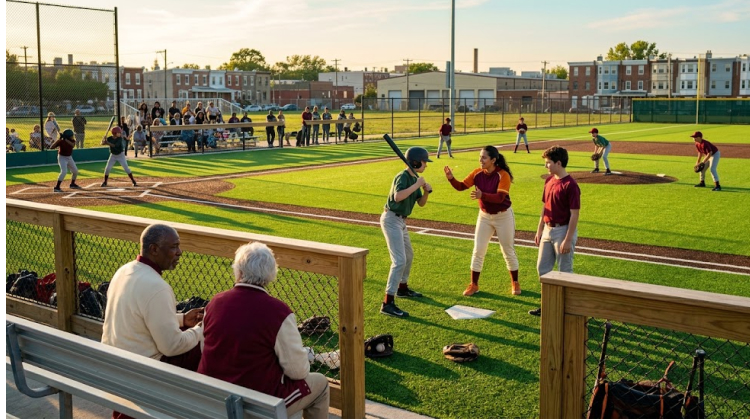
MLB and Phillies Charities, Inc. announced more than $5.5 million in combined investments for Philadelphia through the 2026 All-Star Legacy initiative. The projects were aimed at expanding youth access to baseball and softball, supporting veterans and providing educational and nutritional resources.
One tangible project was the renovation of Ashburn Field at FDR Park in South Philadelphia. The upgraded field received a high-performance synthetic turf system and improved drainage, creating a facility intended to serve local youth for years beyond the All-Star festivities.
This is where conventional economic-impact calculations can become incomplete.
The immediate visitor spending from All-Star Week can be measured in dollars. A renovated recreational facility has a different value proposition. Its benefits may accumulate over years through youth participation, community programming, recreation and neighborhood use.
MLB also organized development activities throughout Philadelphia during All-Star Week, including the Jennie Finch Classic, Commissioner’s Cup, HBCU Swingman Classic and a Mayor’s PLAY BALL event.
The new city study is unlikely to capture every long-term social benefit of these programs, but the broader conversation should include them.
A major event can generate value through tourism, taxes, business activity, infrastructure, community investment and global visibility simultaneously.
The challenge is separating those categories without counting the same benefit twice.
Philadelphia Already Has A Baseline For World Cup Expectations
The city did not enter the World Cup with no economic projections.
Pennsylvania officials previously estimated that Philadelphia’s World Cup hosting could generate more than $500 million in regional economic impact, including approximately $262 million in direct tourism spending, based on earlier analysis.
Those projections were produced before the tournament, meaning the new Epsilon analysis can eventually provide an opportunity to compare forecast versus actual performance.
That comparison may be one of the most valuable elements of the report.
Cities routinely make economic projections when bidding for major sporting events. Those projections help justify infrastructure spending, public safety commitments and event-support programs.
But projections are only useful if cities later measure them against reality.
Philadelphia now has an opportunity to establish that discipline.
If the final report finds that actual spending substantially exceeded expectations, the city’s event strategy gains evidence supporting future bids. If results fall short, officials can determine which assumptions were wrong.
Either outcome creates useful information.
The Study Could Also Change How Cities Compare Major Events
Philadelphia’s experience could have implications well beyond Pennsylvania.
Different sporting events produce different economic patterns. The World Cup is international and multi-city. MLB All-Star Week combines a major game with a dense series of surrounding events. A Super Bowl operates differently again, while an NFL Draft can turn public spaces into a massive free festival.
Comparing them using one simple economic-impact figure can obscure those differences.
Philadelphia’s approach offers a more sophisticated framework:
| Measurement | What It Can Reveal |
|---|---|
| Visitor Origin | Whether spending comes from outside the region |
| Length of Stay | Whether events generate overnight tourism |
| Direct Spending | Money spent by visitors and event organizers |
| Indirect Impact | Effects on suppliers and connected businesses |
| Tax Revenue | Fiscal benefit to city and state government |
| Geographic Distribution | Which neighborhoods and districts benefit |
| Industry Distribution | Hotels, restaurants, retail, transportation and other sectors |
| Public Costs | Safety, sanitation, transportation and event operations |
The most useful future comparison may therefore be between different types of events, rather than simply different cities.
A World Cup match might produce fewer visitors than an NFL Draft but generate longer stays and more international spending. An MLB All-Star Game might produce strong corporate activity and hospitality spending. A draft might generate enormous pedestrian traffic but have different overnight-tourism characteristics.
Philadelphia’s data could help cities understand those distinctions.
Major Events Also Create Infrastructure And Operational Knowledge
The benefits of Philadelphia’s 2026 calendar are not limited to immediate spending.
The city has also gained experience managing multiple major events within a compressed period.
That experience has practical value.
Officials have dealt with transportation planning, crowd management, security coordination, permitting, sanitation, street closures and visitor information. Businesses have learned how to prepare for international visitors and large fan populations.
Philadelphia’s special-events office has even been modernizing its permitting process during this high-volume year. The city says its traditional special-event application process had been fragmented and was being streamlined through digitization.
That operational knowledge can remain after the final tournament and All-Star events are gone.
It can make the city more competitive when pursuing future conventions, sporting events and international gatherings.
This is an example of a benefit that is difficult to place into a conventional economic-impact calculation but important to the city’s long-term event strategy.
The Neighborhood Question May Define The Study’s Legacy
The most closely watched section of the eventual report may be its analysis of where economic activity was distributed across Philadelphia.
That language in the city’s announcement is significant. Officials specifically want to understand how activity was distributed across industries, sectors and geographic areas.
That gives the study an opportunity to address a common weakness in mega-event economics.
A city can report a large aggregate benefit while some communities see very little direct activity.
For Philadelphia, the ideal outcome would be an event model that connects the visitor economy to neighborhood businesses, youth programs, commercial corridors and community organizations.
The $5.5 million MLB legacy initiative provides one example of how organizers can create benefits that extend beyond the event footprint. The renovated Ashburn Field, youth programs and community activities create physical and social assets that remain available after the All-Star Game.
The Epsilon study can help determine whether similar benefits occurred through visitor spending and business activity.
Philadelphia Could Become A Benchmark For Event Accountability
The final report is expected to detail its methodology, data sources, assumptions and findings. Epsilon Economics brings previous experience analyzing major sporting and cultural events, including work connected to the FIFA World Cup in Los Angeles County and Super Bowl LVI for Los Angeles County and Inglewood.
The contract is expected to begin around August 24, 2026, with compensation not to exceed $75,000.
That relatively modest research investment could have a much larger strategic value.
Philadelphia is effectively creating a case study for what happens when a city deliberately measures the aftermath of a major-event year instead of stopping with promotional statistics.
The results could influence how officials approach future bids, how public resources are allocated and how organizers structure legacy programs.
For other American host cities, the lesson may be even more important.
The future of sports-event hosting is unlikely to be determined solely by who can attract the biggest tournament.
It will increasingly depend on who can demonstrate that the event produced measurable, broadly distributed and financially defensible value.
Philadelphia’s 2026 season has already produced the spectacle. The World Cup brought the global audience. MLB brought its All-Star stage to Citizens Bank Park. America250 added another layer of national attention. Now the city is preparing to measure what remained after those moments passed.
That shift—from celebrating the size of an event to examining its actual return—could become Philadelphia’s most important major-event legacy of all.
