
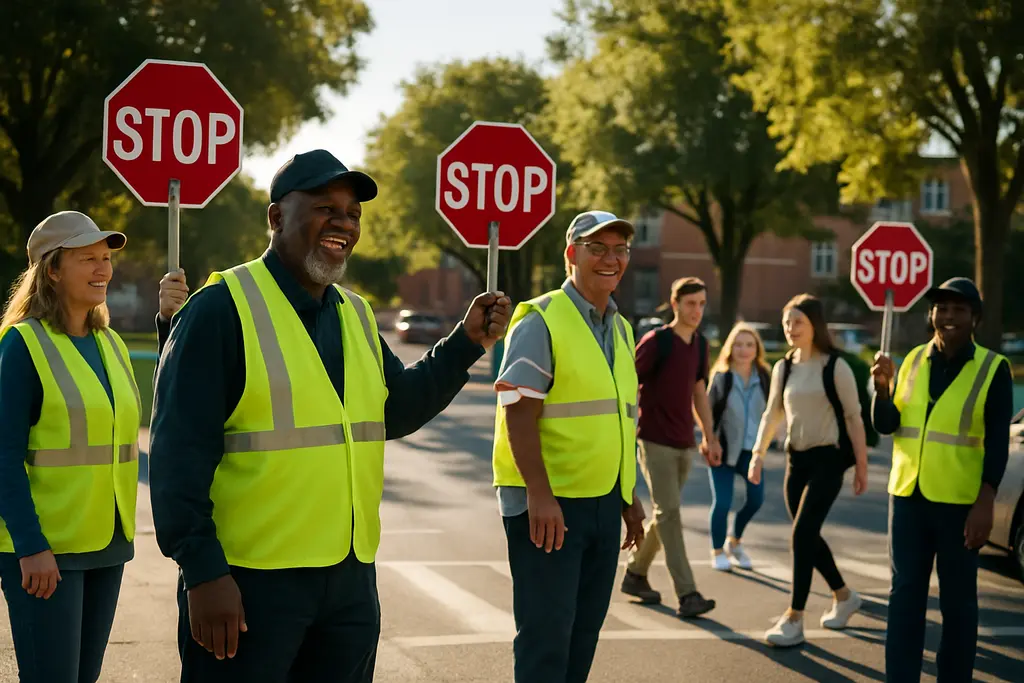
Fairfax Crossing Guards are back at 10 county high schools after a September budget action by the Fairfax County Board of Supervisors. On September 15, 2026, supervisors approved $707,908 to permanently restore crossing guard services through the FY 2026 carryover package, according to the county budget office’s FY 2026 carryover package. The funding reinstated 11 full-time crossing guard positions for 11 crossings serving 10 high schools for the remainder of Fiscal Year 2027, which runs from July 1, 2026, through June 30, 2027.
The vote addressed a specific service gap created by the FY 2027 budget process. The earlier budget, adopted in May 2026, cut 13 full-time equivalent crossing guard positions at high schools to save about $1.89 million, FFXnow reported. The September action did not create a new countywide pedestrian program. It restored staffing at named high school crossings where students, parents, school staff, and county officials had been focused on daily arrival and dismissal conditions.
What Changed For Fairfax Crossing Guards
Fairfax Crossing Guards At 10 High Schools
The county budget notice identified the affected schools as Annandale, Centreville, Chantilly, Edison, McLean, Oakton, South County, South Lakes, West Springfield, and West Potomac high schools. That list matters because the restoration was not spread evenly across every secondary campus. It was tied to the specific high schools that had been affected by the prior reduction.
For families at those schools, the immediate change was practical: a staffed crossing returned to the daily school routine. At most of the listed high schools, the restored service covered one location. South Lakes High School received staffing for two crossings under the restoration plan, according to the local reporting cited above. That distinction is useful for residents who want to compare coverage by campus rather than assume each school received the same traffic-control pattern.
The restored positions also show how fast budget choices can affect visible public services. A line item that may appear technical during budget season can become very concrete once families notice whether an adult is present at a crossing before and after school. In this case, the county’s September 15 action turned a budget carryover package into a direct school-safety change.
Budget Cuts And Restoration Timing
The timing also helps explain why the issue drew attention. The FY 2027 budget took effect on July 1, 2026. By mid-September, the Board of Supervisors had used carryover funding to restore the high school crossing guard positions for the remainder of that fiscal year. That is a short window for a local service cut to move from adopted budget to public concern to formal restoration.
The restoration of Fairfax Crossing Guards shows one of the main ways residents can affect county services: by connecting a daily concern to a specific budget action. In Fairfax County, the crossing guard issue had a clear agency function, a defined staffing count, named locations, and an identified funding amount. Those details made it easier for supervisors and residents to discuss what would be restored and what it would cost.
Why The Budget Reversal Matters
A Narrow Fix With Countywide Lessons
This was a targeted reversal, not a broad rewrite of the school transportation system. Elementary and middle school crossings were not the main focus of the cut described in the reporting; the reduction was specifically tied to high school positions. That distinction helps keep the public discussion grounded. The September action was aimed at high school pedestrian coverage, and the named campuses give residents a clear way to verify whether the restoration reaches their school.
That narrow scope does not make the decision small. High school students often walk from nearby neighborhoods, bus stops, parking areas, transit stops, or parent drop-off zones. A crossing guard position can shape how students and drivers behave at the same intersection at the same time each morning and afternoon. County leaders did not publish, in the cited budget notice, a full new traffic study for each school. What they did approve was the funding needed to put staffing back at 11 crossings.
For civic tracking, Fairfax Crossing Guards should now be watched through the regular budget process, not only during moments of public concern. Residents who want to follow this issue can review future county budget proposals, public hearing materials, and Board of Supervisors actions for any changes to the number of positions, schools served, or crossings covered.
What Residents Can Ask Next
Several practical questions remain appropriate for school communities. Which exact crossing is staffed at each campus? How are substitute or vacancy needs handled? How does the county decide whether a second crossing is needed at a school? What traffic, pedestrian, or crash data are used when evaluating service levels? Those questions do not require speculation. They can be directed to county budget staff, the Fairfax County Police Department’s school crossing guard program, school administrators, or district supervisors.
Residents should also separate two related issues: the presence of a crossing guard and the design of the street. A guard can help manage a crossing during school arrival and dismissal. Road geometry, signal timing, marked crosswalks, lighting, speed management, sidewalks, and driver compliance are separate conditions that may require transportation or public works action. The September vote restored staffing; it did not, by itself, resolve every pedestrian safety concern near the affected schools.
What Families And Schools Should Track
Campus-Level Communication
For families, the most useful next step is to confirm the staffed crossing location through school communications and county notices. The fact that 10 schools were named does not mean every entrance or nearby intersection is covered. Parents and students should know which route is supported by a crossing guard and which routes still depend on standard traffic controls.
Schools can help by giving families clear arrival and dismissal information, especially at campuses where students approach from multiple directions. If a crossing is staffed only during certain windows, that detail matters for students arriving early for activities or leaving after clubs, athletics, or jobs. County budget action can restore a position, but school-level communication helps residents understand how that staffing fits daily routines.
- Confirm the staffed crossing location for the student’s high school.
- Ask whether staffing applies to both arrival and dismissal.
- Report recurring driver or pedestrian conflicts through official county or school channels.
- Watch future budget documents for changes to crossing guard staffing.
Community readers who follow local civic participation across different regions may appreciate Saint Joseph Detroit, a site within the same network that focuses on neighborhood-level engagement.
Budget Participation Beyond One Vote
The September 15 vote was a clear public action, but the larger lesson is that service changes often begin earlier in the budget calendar. By the time a budget is adopted, many staffing choices have already moved through departmental requests, county executive recommendations, public hearings, and board markups. Residents who care about school crossing safety should engage before adoption, not only after a cut becomes visible.
Fairfax Crossing Guards remain one example of how county budgeting connects to daily life. The approved amount, $707,908, was not abstract for the families affected by the 11 crossings. It represented staff presence at specific school locations during a defined fiscal period. That is the kind of budget detail that can help residents comment with precision instead of speaking only in broad terms about safety.
Fairfax Crossing Guards And Student Safety
A Practical Measure For Daily School Travel
The restoration of high school crossing guard positions gives Fairfax County families a concrete service change to measure. Students at the 10 named high schools should see crossing coverage returned at the specified locations during the funded period. County supervisors, school leaders, and residents can now evaluate whether that staffing is working as intended and whether other safety measures are needed near specific campuses.
The civic value of this decision is not only in the restored positions. It is also in the public record created around them. The county identified the funding amount, the number of positions, the number of crossings, the fiscal year covered, and the schools affected. Those facts give residents a baseline for future budget comments and service requests.
For a county as large as Fairfax, student safety often depends on many small operational choices: where a guard stands, which crossing is staffed, how routes are communicated, and how quickly officials respond when a service gap is identified. The September 2026 restoration did not answer every question about school-area traffic. It did, however, put a defined set of high school crossing guard positions back into service and gave residents a clearer path for holding the county accountable in future budget cycles.
