
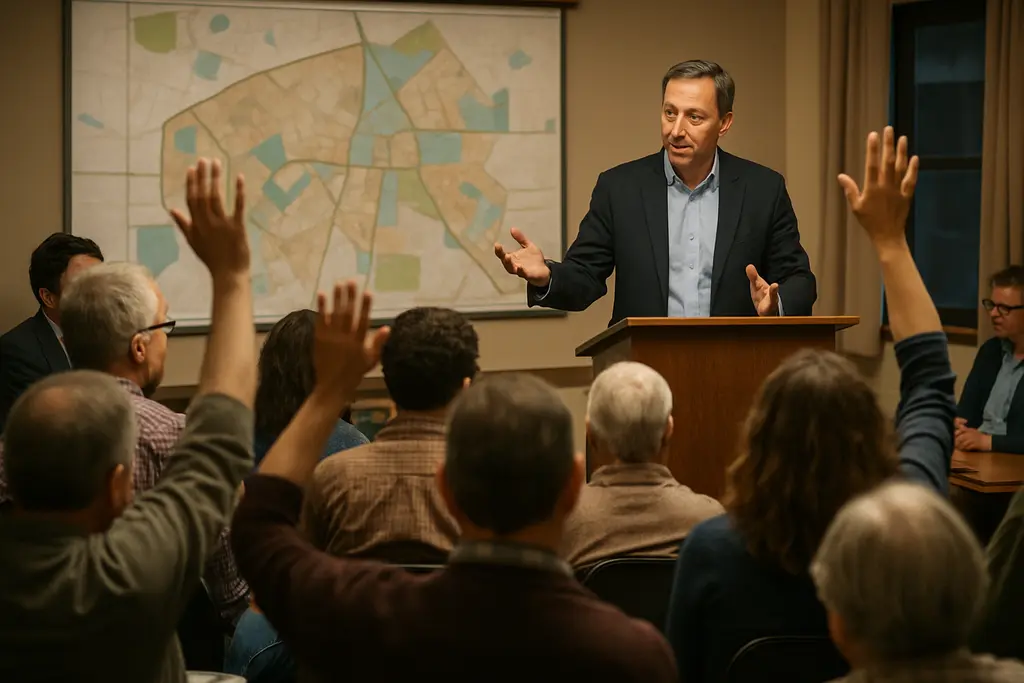
As of October 5, 2026, Frederick County Rezoning has reached a decisive civic moment. The County Council’s final decision point on the Investing in Workers and Workplaces plan, known as IW2, is listed for October 6, 2026, after months of public concern over industrial growth, data centers, farmland conversion, and infrastructure capacity. The question before local government is not only how much land should be opened for business development, but whether roads, water, sewer systems, and public oversight are ready for the scale of change under discussion.
Frederick County Rezoning And The IW2 Vote
What Frederick County Rezoning Would Change
The IW2 proposal would reclassify a large amount of land for future business development. WYPR reported that the plan could rezone 1,874 acres, including 886 acres moving from agricultural zoning into development zoning districts; the same report said the county could gain 1,372 acres of new Limited Industrial land, a 61.8% increase over its existing Limited Industrial zoning stock WYPR reported. Those figures explain why the debate has drawn attention beyond individual parcels. A change of this size can shape commute patterns, freight routes, farm viability, utility planning, and the type of employers that seek county approvals.
The Frederick County Rezoning package is also being weighed in the context of amendments described in the research record for this article. That record states that, on September 30, 2026, the County Council amended the IW2 plan to include more than 500 acres near Jefferson Pike moving from agricultural to light industrial zoning, and 200 acres near I-270 moving to General Industrial zoning. Because General Industrial zoning allows heavier uses than light industrial zoning, the location and supporting infrastructure around those acres have become central points for public review.
For residents, the practical issue is whether the county is making land-use decisions before fully answering service-capacity questions. For business advocates, the issue is whether Frederick County has enough appropriately zoned land to attract and retain employers. Those two goals are not automatically in conflict, but the council’s process will determine whether they can be balanced in a way residents can track and evaluate.
Why The Data Center Pause Matters
The rezoning debate is taking place after a separate data center action by county government. Following a Maryland Supreme Court ruling in early July 2026, County Executive Jessica Fitzwater signed a July 1, 2026 executive order pausing the processing of applications for Critical Digital Infrastructure facilities or substations through December 31, 2026, pending the state’s Data Center Impact Analysis and Report Frederick County announced. That pause does not settle the IW2 question, but it changes the public setting for it.
The reason is straightforward: industrial zoning, electrical demand, water use, substations, and road capacity can overlap in residents’ minds, even when different legal tools are involved. The supplied research also states that the county froze piecemeal rezoning requests until a Data Center Workgroup issues its report on data center locations, taxation, infrastructure needs, and community benefit agreements. That means the October 6, 2026 IW2 decision is being viewed not only as an economic development vote, but also as a test of how Frederick County sequences growth policy with infrastructure analysis.
Community Response And Infrastructure Questions
Public Participation Has Been High
Public response has been unusually active by local zoning standards. The research record states that more than 21,000 Frederick County residents signed a petition opposing a 2,600-acre Critical Digital Infrastructure Overlay Zone created by the County Council in December 2025. The same record says public comment on that overlay zone closed on October 15, 2025, during a Planning Commission meeting. Those details show that residents were organized before the October 2026 IW2 vote became the main decision point.
Community concern has not been limited to one objection. Residents identified in the research raised issues involving farmland loss, well water contamination, rural character, noise, light, odor, and the cumulative effect of development in rural legacy areas. Those are not abstract concerns for households near proposed zoning changes. They relate to property use, daily traffic, nighttime conditions, and confidence that county approvals will be matched with enforceable standards.
Roads, Water, And Sewer Are The Core Test
In practical terms, Frederick County Rezoning now turns on infrastructure credibility. The research notes identify roads, water supply, and sewer capacity as leading public concerns. Residents opposing General Industrial zoning near the Route 270 and Route 355 area argued that surrounding infrastructure was not adequate for heavy industrial activity and large truck traffic. That is a local planning question, not a slogan. If a road network is designed for one level of use, heavier freight traffic can affect safety, pavement wear, intersection delay, and nearby residential quality of life.
Water and sewer capacity are equally central. New industrial users can bring jobs and tax base, but they can also require capital improvements, clear allocation policies, and firm answers on who pays. The public record available in the cited sources does not provide a full cost schedule for every needed improvement tied to IW2. Because of that, residents should be cautious about accepting either optimistic or alarmist claims without a county-backed infrastructure schedule, funding plan, and public reporting process.
What Infrastructure Planning Must Clarify

A Civic Checklist For The County
The next step for local government should be to make the infrastructure assumptions plain enough for residents, businesses, and nearby property owners to compare them with the zoning map. A rezoning map by itself does not answer whether a corridor can handle truck traffic, whether water service is adequate, or whether sewer upgrades would be needed before a project can proceed.
- Which road segments and intersections would be affected by the largest zoning shifts.
- What water and sewer capacity exists now, and what upgrades would be required before permits are issued.
- How the county would phase development if infrastructure is not ready at the time of zoning approval.
- Whether community benefit agreements would apply to large industrial or data center-related projects.
- How residents can track decisions after the October 6, 2026 vote.
This is where civic institutions can help translate planning language into public understanding. County agencies remain the decision-makers, but chambers, neighborhood groups, farm organizations, and business associations can assist in this process. Regional civic readers who engage with local economic development through business networks, including the Trinity Chamber of Commerce, will recognize the broader lesson: growth debates work better when land-use votes are connected to clear infrastructure commitments.
Business Growth Needs Public Trust
Frederick County has a legitimate interest in preparing land for employment uses. A county that lacks suitable sites can lose employers, limit commercial tax growth, and push job opportunities elsewhere. Still, public trust depends on whether residents believe the county has answered basic service questions before approving large zoning shifts.
That is why the IW2 vote should be judged by more than acreage totals. The public needs to know whether infrastructure planning will move at the same pace as zoning approvals. If approvals move first and service plans lag, residents may see the process as growth without safeguards. If the county ties approvals to phased infrastructure, public reporting, and enforceable conditions, the same zoning decision may be easier to evaluate on its merits.
Frederick County Rezoning Civic Next Steps
The October 6, 2026 council vote is the immediate civic step. Residents who have followed the data center pause, the IW2 amendments, and infrastructure concerns should watch for three outcomes: whether the council approves the rezoning package as amended, whether it narrows or delays parts of the proposal, and whether it attaches clear expectations for roads, water, sewer, and community review.
For residents, Frederick County Rezoning is now a practical governance test. The county is weighing employment land, agricultural land, industrial siting, and public infrastructure in the same policy cycle. The strongest path forward is the one that makes each tradeoff visible: where growth would go, what infrastructure it would require, when improvements would occur, and how residents can hold county officials to the record after the vote.
