
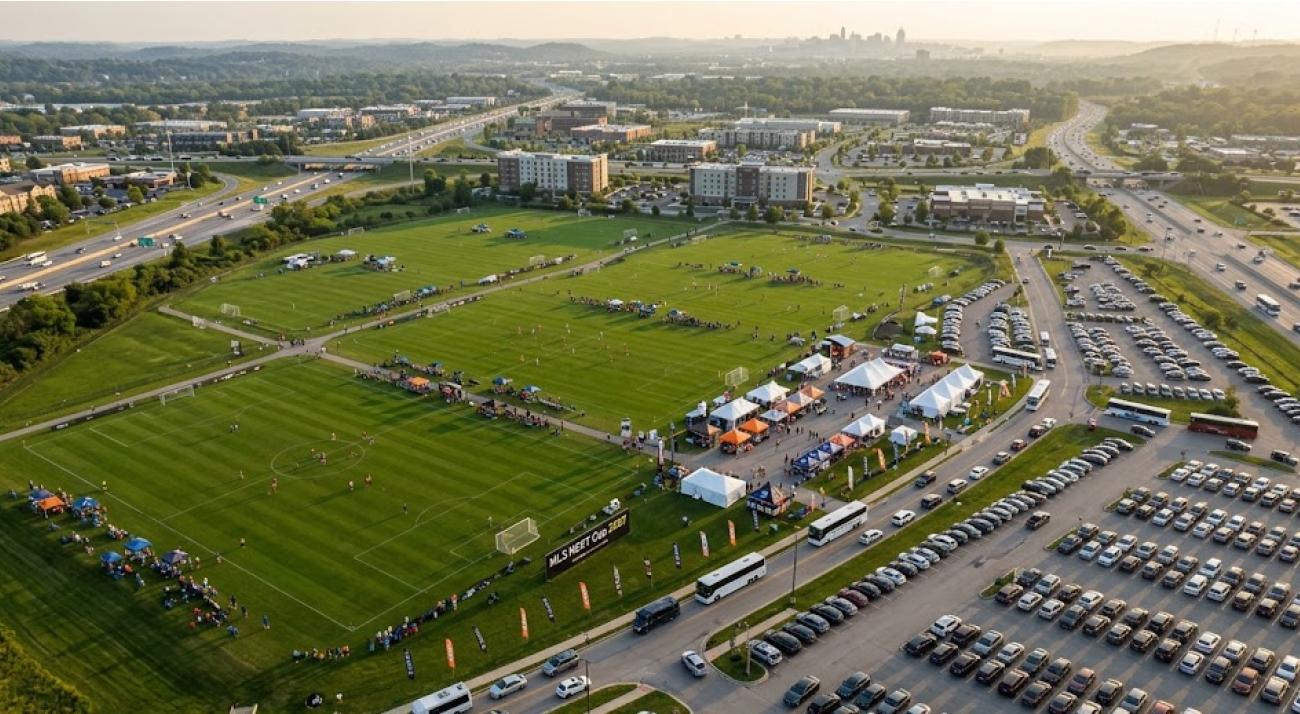
Greater Cincinnati has secured one of the biggest youth soccer events in North America, and the economic opportunity extends well beyond the fields. The region will host the 2027 MLS NEXT Cup presented by Allstate from June 5–13, 2027, bringing elite youth clubs to venues across Southwest Ohio for a week of championship competition.
Regional organizers estimate the tournament could generate approximately $30 million in economic impact and about 50,000 hotel room nights. The event is expected to bring hundreds of teams and thousands of players, coaches, family members and scouts into Greater Cincinnati, creating a concentrated demand for hotels, restaurants, retail, transportation and entertainment.
The larger significance is that Cincinnati did not win the event simply because it has a professional soccer stadium. Its bid was supported by a network of youth-sports facilities, destination-marketing organizations, local governments and sports-tourism professionals that have spent years building the capacity to host tournaments at scale.
That makes the MLS NEXT Cup a useful case study in how investment in sports infrastructure can become an economic-development strategy.
The $30 Million Projection Starts With 50,000 Hotel Room Nights
The headline economic number is substantial, but the 50,000 projected hotel room nights may be an even more useful measurement for understanding the tournament’s potential.
A week-long youth tournament produces a different visitor pattern than a single professional sporting event. Families often arrive early, stay several nights and move between competition sites, restaurants and attractions. Coaches, club administrators and scouts can also remain in the market for much of the tournament.
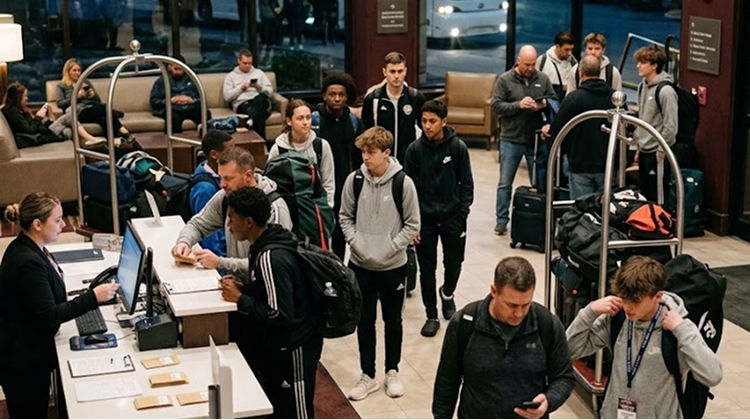
The Cincinnati Regional Sports Commission and regional partners estimate the 2027 MLS NEXT Cup will generate about $30 million in economic impact while booking approximately 50,000 hotel room nights.
That translates into roughly $600 of projected economic impact per hotel room night if the $30 million figure and 50,000 room-night estimate are considered together. That is not a measure of hotel revenue alone; the economic-impact estimate encompasses spending throughout the visitor economy.
The distinction matters. The value of a tournament is spread across lodging, food and beverage, transportation, recreation, retail and other visitor expenditures rather than concentrated at the stadium gate.
Greater Cincinnati already has a substantial tourism economy. A 2026 Tourism Economics analysis reported that Hamilton County generated $4.5 billion in direct visitor spending, supporting 48,365 full- and part-time jobs, while total economic impact reached $7.4 billion.
The MLS NEXT Cup therefore arrives in a market that already has the hotels, restaurants and visitor infrastructure needed to absorb a major tournament.
Greater Cincinnati Has Built A Sports-Tourism Network Around Multiple Venues
The tournament’s venue strategy is one of its most important economic characteristics.
MLS NEXT has selected Voice of America Park, Warren County Sports Park and TQL Stadium as the primary locations for the 2027 championship. The competition will cover six age groups from U13 through U19.
That geographic distribution changes the economics of the event.
Instead of concentrating thousands of visitors around a single stadium, the tournament will move activity through multiple communities. Players and families can stay in different parts of the region, eat near different facilities and use local businesses across Butler County, Warren County and Cincinnati.
The Cincy sports tourism network already promotes more than 150 sports locations throughout the region, alongside four professional venues in downtown Cincinnati. That infrastructure gives tournament organizers a much broader platform than a single-field complex could provide.
The model also demonstrates why sports tourism increasingly depends on regional cooperation. A youth tournament this large does not fit neatly within one municipal boundary. Hotels may be located miles from fields, while restaurants, attractions and transportation services can benefit in communities that never host an actual match.
The economic-development opportunity is therefore regional by design.
Voice Of America Park Shows Why Field Capacity Matters
One of the clearest examples of the infrastructure behind Cincinnati’s bid is the Voice of America MetroPark Athletic Complex in West Chester.
The facility has 25 multipurpose fields, including 23 grass fields and two illuminated turf fields, along with practice fields, a three-mile cross-country course, a cricket pitch and a 3,400-square-foot fieldhouse.
That capacity is critical for a tournament involving hundreds of teams.
A conventional sports facility might be capable of hosting individual games or smaller tournaments, but national youth competitions require dozens of playable fields operating simultaneously. Scheduling, field rotation, practice space, parking, medical support, concessions and tournament administration all become part of the economic equation.
The Voice of America complex is also strategically positioned between Cincinnati and Dayton and has access to Interstate 75 and Interstate 275. MetroParks says the facility is within a one-day drive of 65% of the U.S. population, while also being accessible to two international airports.
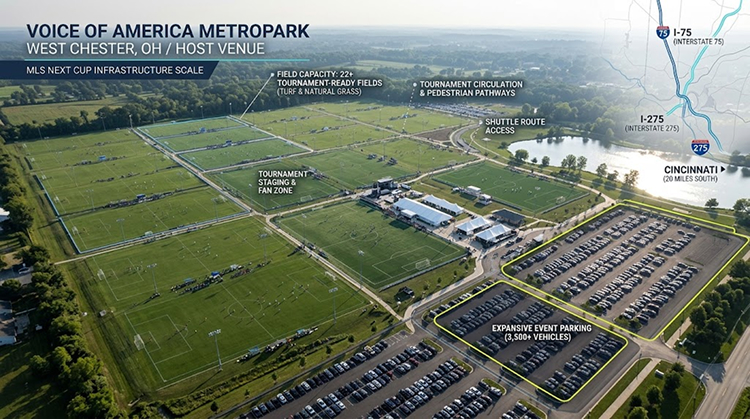
For tournament organizers, that accessibility reduces friction for traveling families.
For the local economy, it expands the potential visitor market.
Warren County Sports Park Adds Another Layer Of Regional Capacity
The second major tournament site, Warren County Sports Park, reinforces the importance of having multiple large-scale facilities within the same regional tourism market.
The 128-acre complex has been part of Warren County’s broader sports-tourism strategy for years. Ben Huffman, executive director of the Cincinnati Regional Sports Commission, previously led sports-tourism efforts in Warren County and was instrumental in the development of the facility.
During his tenure, Warren County grew from roughly $1 million in annual sports-tourism economic impact to more than $135 million, while generating more than 100,000 hotel room nights annually since 2022, according to Visit Cincy.
That history provides useful context for the MLS NEXT Cup.
The tournament is not creating Cincinnati’s sports-tourism market from scratch. It is building on an existing network of facilities and an established operating model.
That distinction is important for communities elsewhere considering similar investments. Building fields is one step; developing the sales, event-management, hospitality and regional partnerships needed to fill those fields is another.
TQL Stadium Gives The Tournament A Professional Soccer Showcase
The inclusion of TQL Stadium gives the MLS NEXT Cup a very different dimension.
Opened in 2021, the home of FC Cincinnati is a 26,000-seat soccer-specific stadium in Cincinnati’s West End. The privately funded venue cost approximately $250 million and includes 53 suites, 4,500 premium seats and a 360-degree canopy.
For the MLS NEXT Cup, TQL Stadium provides more than additional seating.
It connects the youth tournament to the professional soccer identity that FC Cincinnati has established in the region. It also gives players and families an opportunity to experience a facility associated with Major League Soccer, while giving Cincinnati another high-profile setting for championship activity.
That connection could have long-term branding value.
FC Cincinnati entered MLS in 2019 and has developed its academy system alongside the professional club. The organization says its FCC Academy was introduced in 2019, while FC Cincinnati 2 joined MLS NEXT Pro in 2022.
The MLS NEXT Cup therefore fits naturally within a broader local soccer ecosystem rather than appearing as an isolated tournament.
The 2027 Event Is Larger Than A Typical Youth Championship
The scale of the 2026–27 MLS NEXT season helps explain why Cincinnati’s selection matters.
MLS NEXT says the upcoming season will be its largest yet, with more than 53,000 players, 2,743 teams and 310 clubs, including all 30 MLS academies, participating in more than 27,000 matches across the United States and Canada.
The championship event itself will feature teams across six age groups: U13, U14, U15, U16, U17 and U19.
The Allstate Homegrown Division is also expanding. MLS NEXT plans to increase the field from 32 to 48 teams in each of the U15 through U19 age groups, creating more opportunities for elite players to compete in front of professional, national-team and college scouts.
That expansion matters economically because the tournament’s value comes from the total travel ecosystem rather than the number of spectators sitting in TQL Stadium.
Every additional team potentially represents players, coaches, parents and other traveling participants.
The Economic Impact Will Reach Businesses Beyond Sports
The most important test for Greater Cincinnati will be whether the projected visitor spending reaches a broad range of local businesses.
A successful youth tournament can generate revenue for hotels and restaurants, but the impact can also extend to grocery stores, fuel stations, attractions, retail businesses, transportation providers and entertainment venues.
Cincinnati already has evidence that sporting events can influence several parts of the visitor economy. Visit Cincy reported that its 2024 Opening Day period produced a 24.3% increase in visitor restaurant spending, a 19.7% increase in bar and nightlife spending, and a 22% increase in visitor retail spending compared with the previous month. Downtown hotel occupancy reached 89% around Opening Day.
Youth soccer operates differently from professional baseball, but the underlying principle is similar: visitors create spending opportunities well beyond the competition venue.
The length of the MLS NEXT Cup could make that especially significant. Families staying several nights have more opportunities to visit restaurants, attractions and retail districts than spectators attending a single evening match.
For local businesses, the tournament can therefore function as a week-long customer-acquisition opportunity rather than a one-day event.
The $30 Million Figure Should Be Treated As A Projection, Not A Guarantee
Economic-impact estimates can be useful for planning, but they should not be treated as guaranteed revenue.
The projected $30 million depends on assumptions about attendance, visitor behavior, hotel stays and spending. Weather, team travel patterns, hotel pricing and the geographic distribution of visitors can all influence the final result.
That makes post-event measurement particularly important.
Greater Cincinnati will have an opportunity to compare the 2027 tournament against the original projections using hotel occupancy, room-night bookings, visitor spending, sales-tax collections and business activity.
The region already has experience measuring sports-tourism performance. The 2025 Flying Pig Marathon, for example, generated an estimated $22 million in economic impact and 21,300 room nights, according to Sports Destination Management’s economic-impact awards.
That provides a useful benchmark for understanding the scale of the MLS NEXT opportunity.
The difference is that MLS NEXT will involve substantially more teams and a much larger tournament footprint.
Cincinnati’s Sports Strategy Is Becoming A Regional Economic Strategy
The creation of the Cincinnati Regional Sports Commission in 2024 was specifically intended to make sports tourism a larger component of the regional economy.
The commission’s stated purpose includes growing hotel bed-tax revenue and visitor spending through professional, collegiate, amateur and community sports while supporting long-term investment in sports and recreation facilities.
Its 2025 results suggest the strategy was already producing measurable commitments before the MLS NEXT announcement. Visit Cincy’s annual report says the organization helped generate more than 30,000 future room nights and more than $7 million in economic impact during its first year of sports-tourism activity.
The MLS NEXT Cup represents a significant step beyond those early results.
It gives the region a nationally recognized youth championship that can be marketed alongside existing professional, collegiate and amateur events.
That creates an opportunity to build a deeper event calendar rather than relying on isolated tournaments.
The April Qualifier Could Make The Opportunity Bigger Than One Week
Greater Cincinnati will also get an early test of its tournament infrastructure.
The Ohio Regional MLS NEXT Cup Qualifier is scheduled for April 9–12, 2027, at the Voice of America Athletic Complex in West Chester. The regional event will help determine which teams advance toward the national championship.
This creates an additional sports-tourism event before the main June championship.
That matters because the strongest sports-tourism markets build recurring demand around facilities. A complex that hosts one major tournament per year may have limited economic value outside that event. A complex that supports qualifying tournaments, showcases, league competition and championships throughout the calendar can become a year-round visitor asset.
The qualifier also gives local organizers a chance to evaluate traffic, parking, field operations, hospitality and visitor services before the main tournament begins.
The Next Opportunity Is Turning MLS NEXT Into A Long-Term Sports Asset
The most valuable outcome of the 2027 MLS NEXT Cup may not be the $30 million projected for the tournament itself.
The larger opportunity is whether Greater Cincinnati can use the event to establish a stronger reputation among tournament organizers, youth clubs and national sports organizations.
That reputation can influence future bids.
A successful event demonstrates that the region can manage multiple facilities, accommodate large traveling groups, coordinate transportation, support hotels and restaurants, and deliver a professional championship experience.
That is precisely the kind of capacity that can lead to additional tournaments.
Greater Cincinnati already has a substantial visitor economy, a network of more than 150 sports venues, a professional soccer stadium, large outdoor complexes and an organized regional sports commission.
The MLS NEXT Cup brings those pieces together in one high-profile test.
For communities evaluating their own sports-tourism strategies, Cincinnati’s example suggests that the economic payoff begins long before the first championship match. It starts with field capacity, transportation access, hotel inventory, event management and partnerships that make a destination credible to tournament organizers.
The $30 million projection is therefore best viewed as a measurement of what that infrastructure can make possible.
The bigger economic question is how many future events Greater Cincinnati can win because it has proven it can host this one.
