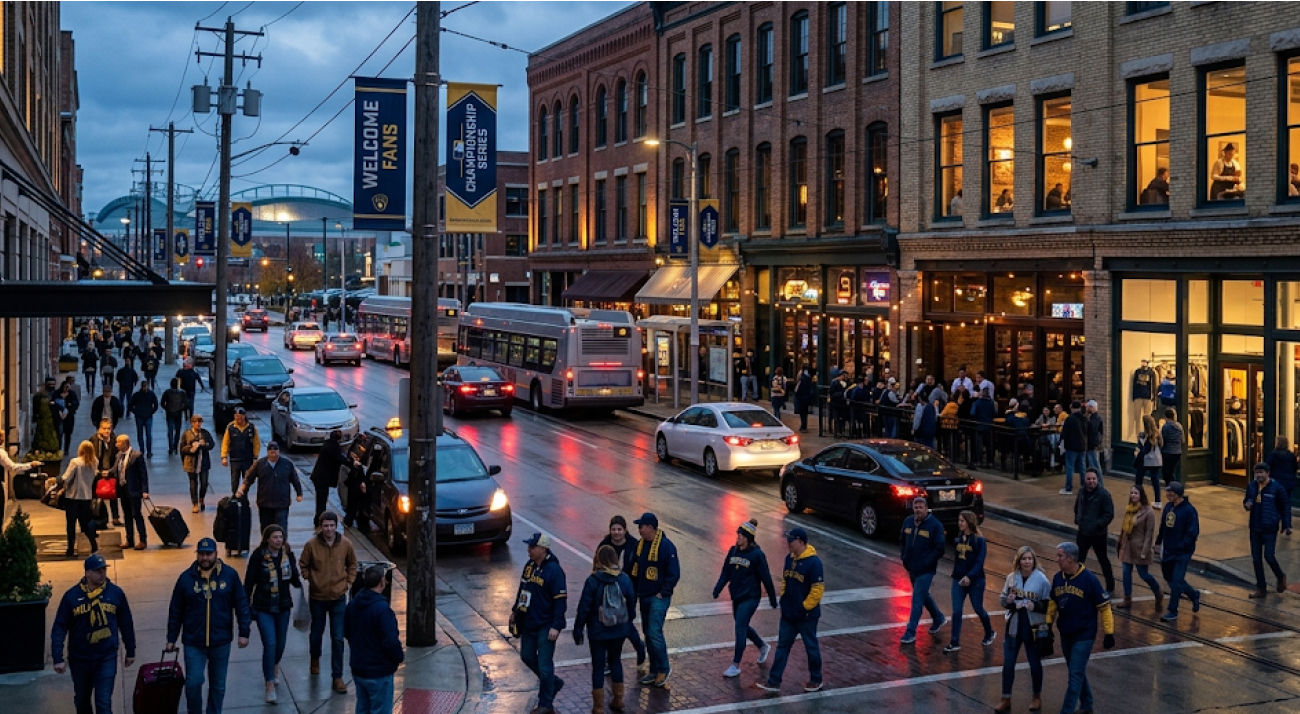
Milwaukee’s return to the World Series has created an economic opportunity that extends well beyond American Family Field. The Milwaukee Brewers’ first appearance in baseball’s championship series since 1982 has brought national attention to the city while hotels, restaurants, retailers, transportation providers and entertainment businesses prepare for an unusually large wave of visitors.
Visit Milwaukee estimates that each World Series home game could generate $10 million to $12 million in total economic impact. Earlier estimates reported by local media put the potential range as high as $15 million per home game, but Visit Milwaukee’s October 23 estimate settled at $10 million to $12 million. The organization plans to conduct a comprehensive economic-impact study after the postseason concludes, meaning the current figures remain projections rather than measured results.
The timing makes the opportunity particularly significant. Milwaukee has already experienced an estimated $5.1 million in economic impact per Brewers postseason home game during the earlier rounds. The World Series projection is roughly twice that level because the championship series attracts more out-of-town visitors, creates greater media exposure and encourages longer stays.
The Brewers entered the World Series after winning a franchise-record 103 regular-season games and sweeping the Los Angeles Dodgers in the National League Championship Series. They opened the Fall Classic at home against the Tampa Bay Rays on October 23 and 24, winning both games. After three games in Tampa Bay, Milwaukee entered October 28 with a 3–1 series lead.
A $10 Million Home-Game Estimate Shows How Sports Tourism Spreads Beyond The Stadium
The projected economic impact is much larger than ticket sales.
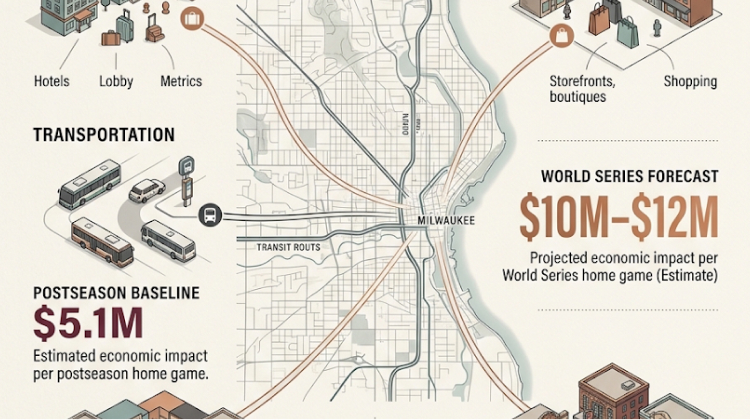
Visit Milwaukee’s estimate includes spending connected to hotels, food and beverages, retail, transportation, recreation, business services and other visitor-related activity. That distinction is important because the economic value of a major sporting event comes from the network of transactions surrounding the venue.
A fan traveling from outside Milwaukee might pay for a hotel room, dinner downtown, parking, gasoline, merchandise and transportation before or after attending the game. Another visitor might spend the evening at a bar or restaurant while watching the game. Local residents can contribute to the total through additional spending tied to watch parties, merchandise, dining and entertainment.
Visit Milwaukee reported that each postseason home game before the World Series generated approximately $5.1 million in total economic impact. A separate analysis cited by Wisconsin media estimated approximately $3.55 million in direct spending per postseason home game, with the higher $5.1 million figure reflecting a broader economic multiplier.
That distinction prevents the $10 million to $12 million World Series projection from being interpreted as $10 million in new cash flowing directly into city government or local businesses. Economic impact is a broader measure that can include indirect and induced activity.
For economic-development organizations, that difference matters. The more useful question is how much spending reaches businesses that would otherwise not receive it and how much of the activity remains in the local economy.
Milwaukee’s Hotel Market Is Already Responding To World Series Demand
Hotels are among the clearest beneficiaries of a championship series that attracts visitors from outside the region.
Before the World Series began, Visit Milwaukee said hotel occupancy typically increased 10% to 12% when the Brewers played a home game during the summer. For the World Series, tourism officials expected hotels to exceed 90% occupancy.
Hotel pricing also demonstrated how quickly demand can change. Reporting published before Games 1 and 2 found that many downtown Milwaukee rooms were selling for more than $500 per night, while some properties were sold out. One Courtyard by Marriott location was listed at $739 per night for a two-queen room for the World Series weekend, compared with substantially lower pricing for a Friday in November.
Higher room rates can increase hotel revenue, but they also illustrate a broader economic effect. Visitors who stay overnight have more opportunities to spend money elsewhere.
A fan who arrives the afternoon before a game may eat dinner downtown, visit a brewery or attraction, purchase merchandise and return for breakfast the next morning. A visitor who stays two nights creates substantially more potential economic activity than someone who attends the game and leaves immediately.
That is one reason destination organizations pay close attention to visitor origin and length of stay when evaluating major sporting events.
Restaurants And Retailers Are Turning The Series Into A Citywide Event
Milwaukee businesses are also using the Brewers’ postseason run as an opportunity to extend game-day activity into surrounding neighborhoods.
Third Ward Beer Garden planned a block-party-style viewing experience with large screens, food trucks and extended activity around the games. Other businesses have created themed menus, merchandise and watch parties designed to capture spending from fans who cannot attend American Family Field.
Visit Milwaukee has encouraged businesses to display Brewers-themed posters and participate in postseason promotions. The organization also highlighted the Ambassador Hotel, which created a baseball-themed scavenger hunt and won its partner decorating contest.
The effect is especially visible among smaller businesses. TMJ4 reported that Kins + Noah Co., a clothing company in Bristol, experienced a surge in demand for Brewers-themed apparel after promoting its products online. Owner Sara Zuelsdorf said the business received more than 100 orders in about a week. O&H Danish Bakery in Racine also introduced Brewers-inspired products featuring Wisconsin’s signature kringle.
These examples show how sports tourism can reach businesses located outside the immediate stadium district.
A baseball game provides the initial reason for travel, but the economic activity can spread across an entire metropolitan area when businesses create products, experiences and promotions that connect with visitors.
The Brewers’ 44-Year Wait Has Increased The Destination Value
Milwaukee’s economic opportunity is also tied to the rarity of the event.
The Brewers had not appeared in the World Series since 1982, when the franchise lost to the St. Louis Cardinals in seven games. The 2026 appearance is only the second World Series in franchise history.
That 44-year gap gives the event a different character from a routine regular-season game.
Visitors who might ordinarily have little reason to travel to Milwaukee for baseball now have an opportunity that may not return for decades. The same dynamic applies to fans throughout Wisconsin and neighboring states who want to participate in the atmosphere even without tickets.
The demand was evident before the championship series began. The Brewers sold out watch parties for Games 3 and 4 at American Family Field in less than 20 minutes, with attendance capped at 31,000 fans per event and tickets priced at $15.
The organization had already drawn 16,228 fans to American Family Field for a watch party during the National League Championship Series. Those events demonstrate that the economic opportunity does not disappear when the actual baseball game is being played hundreds of miles away.
National Exposure Could Become A Longer-Term Tourism Asset
The immediate economic benefit is only one part of Milwaukee’s opportunity.
Visit Milwaukee is using the World Series to promote the city to national audiences. The tourism organization launched a campaign featuring former Brewers catcher Jonathan Lucroy, with planned advertising in the Tampa-St. Petersburg market, national radio placements, YouTube, social media and other channels.
That strategy is based on a simple economic principle: the value of a major sporting event can continue after the final game if visitors associate the destination with a positive experience.
The organization estimates that tourism already contributes approximately $6.85 billion to Milwaukee’s local economy and supports more than 45,000 hospitality jobs. Visit Milwaukee also has more than 1,000 members, including hotels, restaurants, attractions and other businesses.
The World Series therefore represents an opportunity to reinforce an existing tourism economy rather than create one from scratch.
National television coverage gives Milwaukee exposure that would be expensive to purchase through conventional advertising. Images of downtown streets, restaurants, fans, the lakefront and American Family Field can reach viewers who may never have considered the city for a future trip.
The long-term value will depend on whether that attention translates into future hotel bookings, conventions, leisure travel and sporting events.
Sports Milwaukee Can Use The Moment To Attract Future Events
The Brewers’ postseason success also gives Milwaukee an opportunity to promote itself within the sports-event industry.
Visit Milwaukee’s Sports Milwaukee team is using the World Series spotlight while preparing for Milwaukee to host the TEAMS Conference & Expo in October 2027, an event focused on sports-event organizers and rights holders.
That connection is significant because the city is competing for events that can generate economic activity beyond professional baseball.
Youth tournaments, collegiate championships, amateur competitions, sports conferences and national governing-body events can all bring visitors who need hotels, restaurants, transportation and meeting space.
Visit Milwaukee reported that Sports Milwaukee generated 79,424 room nights and $125 million in economic impact in 2025. That existing performance provides context for why the organization is interested in converting the Brewers’ national exposure into future event business.
The World Series can function as a showcase for that broader capability.
Milwaukee’s Experience Shows Why Event Impact Should Be Measured Beyond Attendance
The most useful lesson from Milwaukee may be how the city measures the economic value of a major event.

Attendance is easy to report. Economic impact is harder.
A stadium can sell every available seat while generating a smaller visitor-economy benefit than expected if most attendees live nearby and return home after the game. Conversely, an event with a smaller crowd can produce substantial economic activity if a large share of attendees travel from outside the market and stay multiple nights.
That is why Visit Milwaukee plans a full economic-impact study after the World Series. The organization has said it will examine activity across hotels, food and beverage, retail, transportation, event services and other sectors.
For a chamber of commerce or economic-development organization, several measurements can provide a clearer picture:
- Visitor origin: How many attendees came from outside the metropolitan area?
- Overnight stays: How many hotel room nights were generated by the event?
- Business spending: How much activity occurred at restaurants, retailers and other local businesses?
- Tax revenue: What additional sales, lodging and other tax collections were generated?
- Repeat visitation: Did first-time visitors return to Milwaukee after the event?
These measures help separate the excitement surrounding a championship from the economic results that can be demonstrated afterward.
The World Series Could Generate $20 Million Or More From Two Milwaukee Games
Milwaukee was guaranteed at least two World Series home games because the Brewers finished the regular season with the best record in Major League Baseball at 103–59, compared with Tampa Bay’s 98–64 record. Games 1 and 2 were played at American Family Field on October 23 and 24.
At Visit Milwaukee’s $10 million to $12 million projection per home game, those two games alone represented a potential $20 million to $24 million in total economic impact.
The Brewers won both contests, 3–2 and 5–4, before the series shifted to Tampa Bay. Milwaukee then won Game 3 by a 10–1 score on October 26, while Tampa Bay won Game 4 by a 4–3 score on October 27. As of October 28, Milwaukee leads the series 3–1.
If the series returns to Milwaukee for Game 6 on October 30, another $10 million to $12 million projection would apply. A Game 7 on October 31 would create another potential home-game opportunity.
Those additional games are conditional, so they should not be counted as guaranteed economic activity.
Milwaukee’s Opportunity Extends Beyond The Final Out
The Brewers’ 2026 World Series run has given Milwaukee something that few economic-development campaigns can manufacture: national attention tied to a genuine community event.
The immediate financial opportunity is substantial. Visit Milwaukee projects $10 million to $12 million in total economic impact for each World Series home game, compared with roughly $5.1 million for earlier postseason home games. Hotels are seeing stronger demand, restaurants and retailers are developing promotions, and tourism officials are using the national spotlight to market Milwaukee as a destination.
But the more significant test will come after the championship ends.
Milwaukee will need to determine how much of the projected impact actually occurred, which businesses benefited, how many visitors stayed overnight, and whether the exposure produces additional tourism and sports-event business in the months and years ahead.
For communities such as Richland that are evaluating the value of sports tourism, the Milwaukee example offers a useful framework. A successful sports event is not measured solely by the number of people inside a venue. Its broader value comes from the hotels, restaurants, retailers, transportation providers, attractions and local businesses that participate in the visitor experience.
Milwaukee’s World Series run demonstrates how a championship can become an economic-development opportunity when a city is prepared to turn event attention into broader destination activity. The final number will not be known until the post-series analysis is complete, but the early evidence already shows why major sports events can have an economic footprint far beyond the stadium.
