

Let’s be honest: the rulebooks from sanctioning bodies can feel like they were written by a committee of androids. It’s a maze of legalese and checklists. But what if we stopped seeing these requirements as red tape and started seeing them as a codified blueprint for excellence?
It’s not about checking boxes for fire extinguishers and exit signs. It’s about proving your venue has a brain and a nervous system. Sanctioning bodies, in their quest to award major events, aren’t just looking for a pretty facade. They’re looking for a thinking partner.
The IAVM’s Venue Professional Competency Standards are a great example. They don’t just list tasks; they codify the institutional wisdom of the industry. It’s not just about “Manage Risk” or “Conduct Marketing.” It’s about proving your venue can think on its feet—whether that’s managing a budget overrun or coaching a staffer through a crisis. This is the real sanctioning gauntlet: proving you have the operational and intellectual infrastructure to not just host a world-class event, but to survive it with your reputation and plumbing intact.
This moves the conversation from simple compliance to a more strategic pitch for major events. It’s the difference between having a building and having a proven, thinking venue. The sanctioning process isn’t a hurdle; it’s the blueprint for proving you’re not just a space, but a strategic partner.
Facility Compliance Checklist
Understanding venue standards is more than just passing an inspection. It’s about being ready for anything with careful planning. Forget simple yes/no checklists. We’re creating a detailed threat-assessment matrix.
This matrix is like having an AI that predicts problems before they happen. It’s about being proactive, not just reacting to issues.
Using the IAVM framework, we turn venue standards into a living guide. It’s not just about following rules. It’s about making sure your whole operation is ready.
For example, the IAVM competency A8 is about following laws and rules. The old way asks if you’re following them. Our matrix asks how important it is to follow them.
It’s not just about checking boxes. It’s about testing your systems under all possible scenarios. You need to think about how bad a failure would be, how often it could happen, and how hard it is to fix.
This new way of thinking changes everything. “Maintain Standards” (A1) is no longer just a dusty book. It’s a constant check of your emergency plans.
“Oversee Maintenance” (A5) is about preventing problems before they start. It’s not just fixing things when they break. It’s about stopping problems before they happen.
The matrix doesn’t just list tasks. It rates them based on risk. Here’s how some IAVM competencies look through a risk-based lens:
| IAVM Competency | Threat Vector (Example) | Criticality (Impact) | Operational Focus |
|---|---|---|---|
| A1: Maintain Standards | Outdated evacuation plans during a structural fire. | Severe | Documentation & Training |
| A5: Oversee Maintenance | HVAC failure during a heatwave at a sold-out event. | High | Predictive & Preventative |
| A8: Comply with Legislation | Non-compliance with new accessibility or safety codes. | Severe (Legal/Financial) | Legal & Regulatory Monitoring |
| D2: Eliminate Business Risk | Power grid failure with no backup for life safety systems. | Critical | Business Continuity |
| D4: Promote Workplace Safety | Slip-and-fall hazard from unmarked wet flooring. | High (Liability) | Active Hazard Mitigation |
This matrix turns a static list into a dynamic risk register. Notice D2 (Eliminate Business Risk)? Its “Severe” criticality rating isn’t about a fine; it’s about survival. A power outage isn’t just a problem; it’s a disaster waiting to happen.
Your checklist question changes from “Do we have a backup generator?” to “What happens if both power sources fail, and how do we tell 20,000 people?”
This image is more than a graphic. It’s a mindset. Your venue standards checklist is now a threat-assessment dashboard. The competency G2, “Monitor Venue Attendee Satisfaction,” is the final, critical feedback loop.
It’s not just “were they happy?” It’s about linking real-time feedback with specific areas of your venue. Did a HVAC failure in Section 203 cause a 40% drop in concession sales? The matrix evolves.
Embodying venue standards means your culture is your checklist. It’s a system that doesn’t just pass inspections; it anticipates them. You’re not just compliant; you’re resilient. You’re not just maintaining a facility; you’re testing it like a living system.
This is the difference between a venue that opens its doors and one that commands the stage, no matter what.
Ancillary Spaces (Media, Broadcast, Doping Control)
The main arena is like the star of the show, but the backstage crew, soundstage, and green rooms are just as important. Your event bid is about more than just selling a stadium. It’s about creating a complete, working environment. If you forget about the media center’s power or the doping control room’s privacy, your bid could fail.
Think of these areas as their own countries within your venue. Each has its own needs for power, access, and security. You need to be a broadcast engineer one minute and a medical professional the next. This is where being a “generalist with a specialty” is key.
The Media Compound: The Nerve Center of the Narrative
The real story of a major event often happens in the media center and broadcast compound. It’s not just a room with Wi-Fi. It’s a place that needs a lot of bandwidth and power.
A bad internet stream or a dead zone for interviews can hurt the event’s image fast. Planning this space is like doing media diplomacy. It shows you know the event is a global broadcast, not just a local game.
The broadcast compound is like its own city. It has satellite trucks, production trucks, and lots of cable. Your event bid must show you’ve planned for its power, security, and satellite uplinks. This is where IAVM’s skills in maintaining outlets and developing concepts are vital. You’re not just providing space; you’re building the global broadcast’s nerve center.
The Doping Control Suite: Where Privacy is Paramout
The Doping Control area is quiet and very secure, unlike the media center. It’s not just a bathroom stall. It’s a place where keeping everything in order is critical.
Poor ventilation, bad storage, or a layout that invades privacy can ruin a test or an athlete’s career. Managing this space needs the precision implied by IAVM’s “A4 – Monitor Event Operations.” It’s a place with its own rules: strict chain-of-custody, witness protocols, and zero-tolerance for contamination. Getting this wrong can be disastrous.
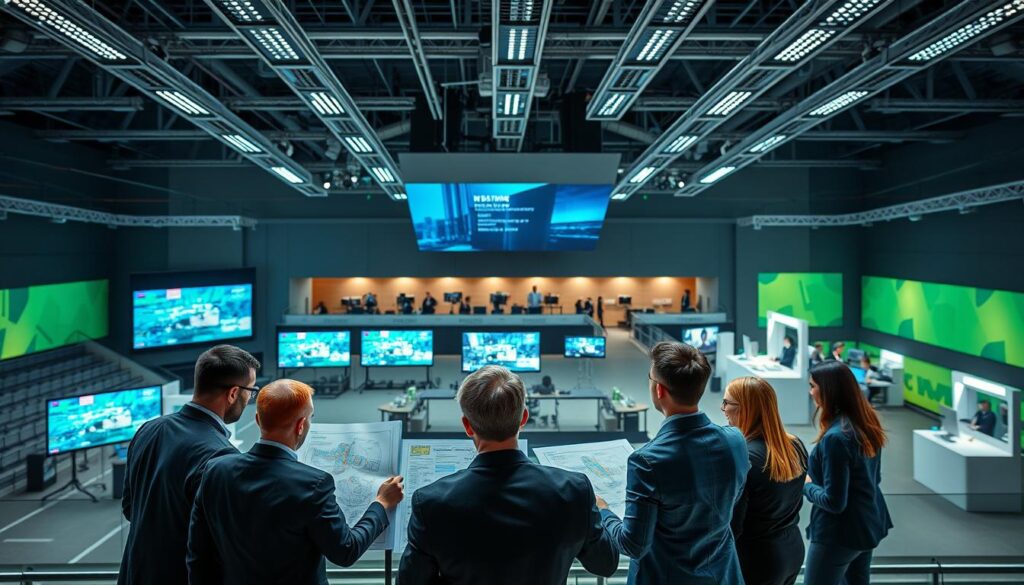
This image shows the ecosystem of a major event. The main arena is the star, but the ancillary spaces—the media compound, the broadcast trucks, the back-of-house labyrinth—are the vital organs. Your event bid must show you understand this.
Operational Harmony: The IAVM Mindset in Action
This is where the IAVM’s “Manage Operations” framework is your guide. It’s not about managing three separate zones; it’s about making a venue-wide symphony work. The media compound needs constant power and fiber optic cables. The broadcast facility needs clean camera positions and fiber runs. Doping control needs a private, secure, and controlled environment.
Your bid must show you can handle different tasks. You need to think like a broadcast engineer about bandwidth, like a lab technician about chain-of-custody, and like a venue manager about traffic flow and security. This is the “generalist with a specialty” in action. It shows you understand the ecosystem and offer a complete, flawlessly integrated operational blueprint.
In the high-stakes poker game of an event bid, the flashy arena is your ante. But the ancillary spaces are your hidden cards—the ones that win the pot. Master them, and you show a level of sophistication that turns a simple proposal into a winning bid.
Accessibility and Safety Readiness
Let’s be honest: a venue that sees accessibility as just a rule to follow is already failing. It’s like a restaurant that only serves food when the health inspector is around. True venue accessibility and safety readiness are more than just following a checklist. They are the heart of a modern, inclusive, and trustworthy place. This means more than just ramps and railings; it’s about creating a culture of service and foresight in every part of the building.
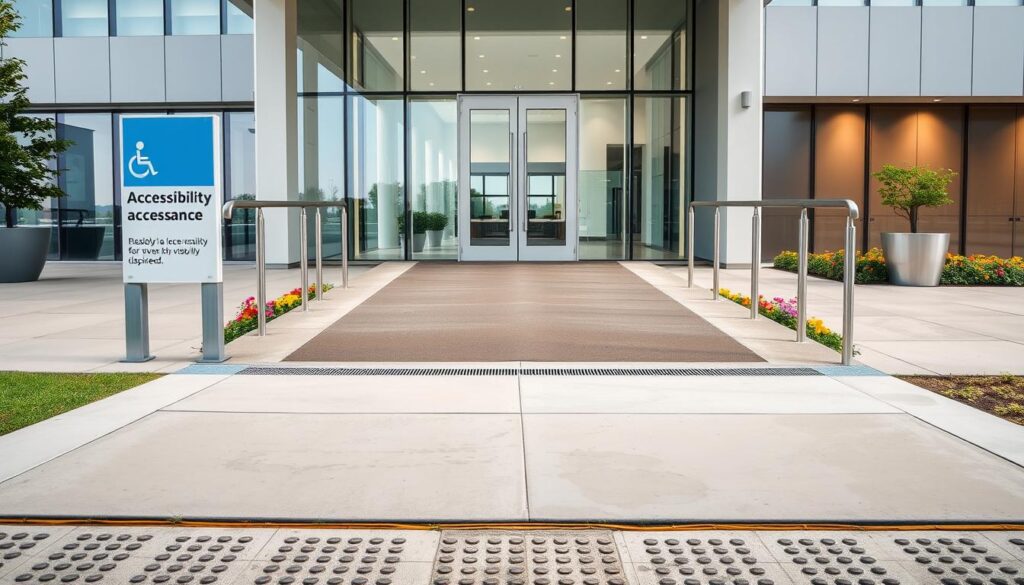
IAVM’s skills are not just a list to check off. D5: Manage Compliance is the minimum, both legally and morally. The real challenge starts with D6: Operating a Safe Environment. It’s not just about fire exits and first-aid kits. It’s about making sure everyone feels safe and seen.
IAVM’s G1: Create a Culture of Service is more than just a saying. It’s what makes a venue stand out. Staff who are trained in this way don’t just point to the elevator; they anticipate. They see a group with a stroller and a wheelchair user coming and open the accessible gate before they ask. This is not just being nice; it’s being smart and caring.
Here are some key differences between venues that just meet the minimum and those that truly excel:
- Cognitive Load & Wayfinding: Are your signs easy to understand, or do they confuse people? Clear signs are essential for everyone, but even more so for those with neurodiverse conditions.
- Sensory Considerations: Can someone with sensory issues find a quiet area? Are there guides for the visually impaired? Safety goes beyond just physical protection.
- Training Beyond the Manual: Does your staff know how to really help? Asking “Can I help you?” is not the same as asking “How can I help you?” The latter opens up possibilities.
In the world of venue safety and accessibility, treating these as extras is like building a sports car with square wheels. It might look good, but it won’t perform well. A venue that truly gets this doesn’t just meet standards; it builds trust with everyone who comes through its doors. That trust is the ultimate advantage.
Pre-Bid Site Visit Playbook
Forget the boring checklist. Your pre-bid site visit is like a secret mission. You’re not just a visitor; you’re a spy. The venue is your target. We’re not just following a checklist. We’re on a mission to find every problem and every hidden flaw.
This is your guide for that mission. You’re looking for every “driver of change” in Toronto. These are the things that could ruin your bid. This is your playbook for that mission.
Toronto’s Design & Development Process starts with “Setting the Stage.” That’s a nice way of saying it’s the beginning. In our world, it’s the “Pre-Operational Surveillance” phase. You’re gathering information on the site, stakeholders, and small details that matter.
This is like a strategy meeting with the venue and community. It’s not just about hosting the event. It’s about doing it smoothly.
Your first step is to do thorough research. This is the “environmental investigation” phase. Don’t just check if the power works. Check the soil stability and what traffic is like at busy times.
You’re not just looking at a space. You’re testing its limits. This is like a detailed check before the official audit.
Next, start “pre-engagement.” This isn’t just a casual meeting. It’s a chance to gather information from local leaders. This is where you find your allies and understand the local rules.
A pre-bid and contracts strategy needs to know the local scene. This is key.
Your goal is to find every “driver of change.” These are local issues that could affect your event. You want to know about zoning, community events, and construction.
By the time you have the official site visit, you should have all the information. You’re not just showing them a venue. You’re showing them a plan that works.
| Traditional Site Visit | Intelligence-Based Playbook | Intel Gained |
|---|---|---|
| Checks power outlets, internet speed. | Maps all power grids, tests load capacity at peak times. | Identifies need for secondary power sources. |
| Asks about local permits. | Pre-engages with permitting office, identifies key contacts. | Reduces permit approval time by 30%. |
| Notes parking space count. | Analyzes traffic flow, ride-share drop-off choke points, and egress routes. | Prevents 3pm traffic gridlock on event day. |
| Confirms venue capacity. | Tests Wi-Fi dead zones, cellular signal strength for live broadcast. | Prevents “dead air” during a critical broadcast. |
The table above shows a new way of thinking. The “Pre-Bid Site Visit Playbook” makes you the most informed person. You’re not just looking at a venue. You’re testing a complex system.
You find problems before they become big issues. This isn’t just due diligence. It’s strategic planning to make your bid the obvious choice.
Sample Bid Calendar and Roles
Forget about vague timelines. A winning bid is a detailed plan, like a military operation. Your calendar is the invasion plan. It combines the Toronto project’s phases—Setting the Stage, Design Development, Contract Tender, and Construction—over 18-24 months.
This “Construction” phase is not just about building. It’s your chance to practice everything before the big day. This is the heart of your bid’s success.
Without a clear team, your timeline is useless. This is where IAVM roles meet the RACI framework. Who is in charge of the venue staffing plan (C1)? Who is responsible for safety (D5)?
Using a RACI framework, you assign roles to each team member. This turns a list of names into a team ready to act. It eliminates any confusion.
This combination of a calendar and a team is your project plan. It turns event bidding into a mission with a deadline and a clear path to success. The sample bid calendar and IAVM roles make you compliant. Now, it’s time to take action.
