
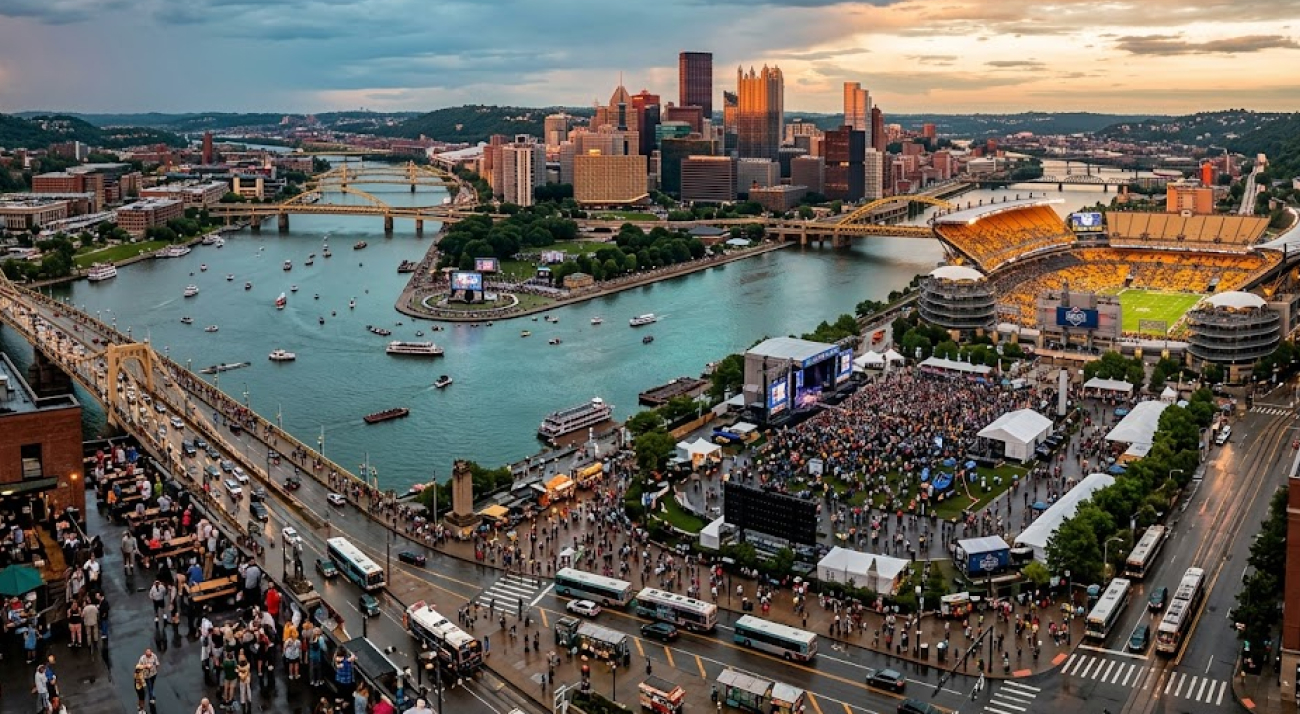
Pittsburgh’s experience hosting the 2026 NFL Draft is giving American cities a fresh way to think about the value of major sporting events. Three months after the April event, two new studies have put the direct economic impact at $177 million, while a separate analysis estimated the event generated more than $1.5 billion in overall economic value when global media exposure, social engagement, and related visibility were included. More than 55 million people worldwide watched the Draft, according to the recently released analysis.
Those numbers are significant, but they also raise a more difficult question for cities considering future events: What should count as a successful sports-hosting investment?
Pittsburgh spent more than $19 million across city, county, and state resources to host and promote the Draft, according to recent reporting. The resulting $177 million economic impact represents a substantial multiple of that public and promotional investment. But the larger $1.5 billion figure relies on a broader calculation that includes media and promotional exposure, meaning it should not be interpreted as direct money flowing into the local economy.
That distinction could become increasingly important as American cities compete for the next generation of NFL events, international tournaments, championships, and other large-scale sporting attractions.
Pittsburgh’s Draft Produced More Than A Three-Day Spectacle
The NFL Draft took place in Pittsburgh over three days in April, turning the area around Acrisure Stadium and the North Shore into a major national sports destination.
The scale exceeded many of the early expectations.
More than 800,000 people attended the Draft-related activities, according to VisitPITTSBURGH’s reporting, while visitors registered through NFL OnePass came from 105 countries. The organization also reported that 43% of attendees traveled more than 50 miles to reach the event.
That geographic reach matters because sports tourism is fundamentally different from ordinary local attendance.
A resident attending an event downtown may contribute to the atmosphere, but an out-of-town visitor can generate spending across several parts of the regional economy. Hotels, restaurants, transportation providers, attractions, retailers, and entertainment businesses can all benefit when visitors remain in the market for multiple days.
Pittsburgh’s hotel numbers illustrate that effect. Downtown hotels reached 92% peak occupancy during the three-day Draft, while occupancy across Allegheny County reached 85%, according to VisitPITTSBURGH. Pittsburgh Regional Transit also recorded a 51% increase in rides compared with a typical Thursday-to-Saturday period.
The event therefore functioned as more than a football gathering.
It temporarily changed the way people moved through Pittsburgh.
The $177 Million Figure Changes The Hosting Conversation
The newly reported $177 million economic impact provides the strongest evidence yet that Pittsburgh’s decision to host the Draft produced a meaningful regional economic result. The analysis was conducted by SportsImpacts, with additional work by Trajektory examining the event’s broader economic and exposure value.

That number becomes particularly interesting when placed against Pittsburgh’s investment.
The city, county, and state collectively spent more than $19 million to support the event, according to Axios. The city itself had previously authorized an agreement involving up to $1 million over three years for coordination of municipal and governmental services, along with in-kind city services. A later agreement authorized the city to receive up to $2 million from VisitPITTSBURGH for reimbursement of certain Draft-related expenses.
This makes the Draft an interesting case study in public-sector sports economics.
The calculation is not simply:
Event cost = $19 million
versus
Economic impact = $177 million.
Economic impact does not mean that $177 million went directly into government coffers. It measures broader activity generated throughout the regional economy.
That distinction should remain central to any serious analysis of the Draft.
Still, the ratio between the investment and the reported economic activity gives Pittsburgh a compelling argument when competing for future events.
Global Exposure Is Becoming Part Of The Economic Equation
The $177 million figure tells only part of Pittsburgh’s story.
The other major number is $1.5 billion.
Trajektory’s analysis estimated that the Draft generated more than $1.5 billion in economic value when media exposure, social engagement, and other forms of visibility were included. More than 55 million viewers watched the event globally.
This is where sports tourism economics becomes more difficult to measure.
A visitor who spends $1,000 in Pittsburgh creates an observable economic transaction.
A person in another country who watches Pittsburgh’s skyline, rivers, stadium, restaurants, and fan celebrations on television creates something different: destination exposure.
That exposure does not immediately appear in hotel receipts or restaurant sales.
Its potential value comes later, if some of those viewers decide to visit Pittsburgh, attend another sporting event, conduct business there, or recommend the city to someone else.
That makes the $1.5 billion figure useful as a measure of promotional value, but it should not be treated as equivalent to the $177 million direct economic impact.
The distinction could nevertheless become one of the most important lessons from Pittsburgh’s Draft.
Media Exposure Could Become A Major Part Of Sports-Event ROI
The most difficult part of Pittsburgh’s NFL Draft results to measure may also be the part that becomes most valuable over time.
The reported $1.5 billion in overall economic value includes media exposure and social engagement, not simply money spent by visitors in Pittsburgh. That distinction matters, but it does not make the exposure irrelevant.
Pittsburgh received an enormous international showcase during an event that attracted more than 55 million viewers globally. The city’s bridges, rivers, stadium district, neighborhoods, restaurants, sports culture, and downtown environment became part of the broadcast.
For a destination that has historically been associated with steel, manufacturing, and professional sports, the Draft presented a different version of Pittsburgh to a worldwide audience.
That creates a potential tourism pipeline.
A viewer who discovers Pittsburgh through the NFL Draft may not book a hotel the following week. But the exposure can influence future travel decisions, particularly when combined with other major events and destination marketing.
This is why organizations such as VisitPITTSBURGH increasingly have to think beyond immediate visitor spending. The real opportunity is converting temporary attention into future trips, conventions, sporting events, and business activity.
Local Businesses Received A Meaningful Share Of The Activity
One of the most important measurements is where the money went.
VisitPITTSBURGH reported that $17.7 million was spent directly with Pittsburgh-based businesses through the Draft, while 164 businesses participated in the Draft Source Program. More than 100 local contracts were issued, and 64% of those contracts went to local diverse businesses.
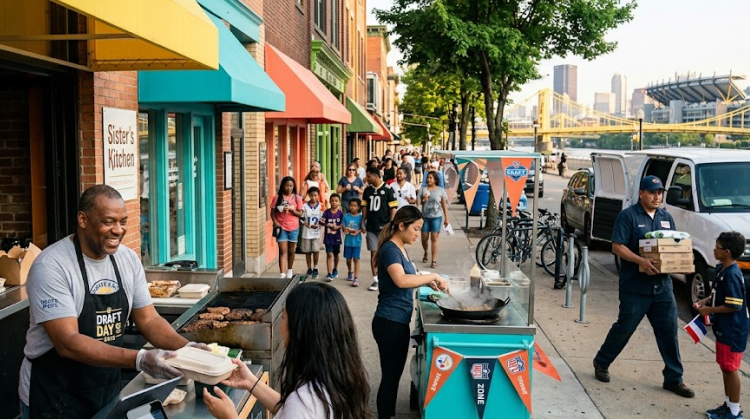
That matters because the strongest sports-tourism strategies are increasingly being judged by their distribution of economic benefits.
A city can attract hundreds of thousands of visitors without creating equally broad opportunities for local companies. If spending remains concentrated around the stadium, national chains, and event contractors, the economic impact may be less meaningful for neighborhoods outside the immediate event zone.
Pittsburgh’s Draft Source Program attempted to address that issue by connecting regional businesses directly with event-related purchasing.
This model could influence future host-city strategies.
Cities bidding for major events may increasingly ask organizers to provide opportunities for local suppliers, restaurants, transportation companies, hospitality businesses, minority-owned firms, and other regional enterprises.
The Pittsburgh sports tourism strategy now offers a useful case study for how an event can be connected to the broader business community rather than being treated as an isolated stadium attraction.
Pittsburgh’s Transportation System Became Part Of The Event
The Draft also demonstrated that sports tourism success depends heavily on transportation.
Pittsburgh Regional Transit’s reported 51% increase in rides during the Draft compared with a typical Thursday-to-Saturday period is particularly significant.
That increase provides a real-world test of the city’s ability to move hundreds of thousands of additional people without requiring every visitor to rely on a private vehicle.
For future host cities, transportation performance can become part of the event’s legacy.
A successful event does not simply fill a stadium. It tests whether airports, rail lines, buses, roads, pedestrian corridors, parking systems, rideshare operations, and downtown infrastructure can handle an extraordinary concentration of people.
Pittsburgh’s geography makes this particularly relevant.
The city is organized around three rivers and a relatively compact downtown, with major sporting facilities positioned near the North Shore. That creates both advantages and challenges for large crowds.
The Draft provided a real-world stress test.
If public transportation can absorb a substantial increase in ridership while allowing downtown businesses and attractions to remain accessible, the event provides evidence that the city’s infrastructure can support future international competitions.
The same lesson became highly relevant during the 2026 FIFA World Cup, when transportation capacity became one of the defining operational questions for U.S. host cities.
Local Business Participation May Matter More Than Total Spending
Pittsburgh’s $17.7 million in direct spending with local businesses is another number that deserves attention.
Economic impact studies often emphasize the total amount generated by an event.
But the distribution of that spending can determine whether residents and small businesses actually experience the benefits.
The Draft Source Program involved 164 businesses, with 64% of contracts going to local diverse businesses. That creates a model that other cities could adopt when negotiating major events.
Instead of asking only how much money an event will generate, municipalities could establish targets for how much event-related procurement should remain within the local economy.
That could include catering, transportation, security, construction, temporary staffing, event production, printing, hospitality, technology, cleaning, and other services.
Such policies would make sports tourism more connected to local economic development.
The NFL’s official Draft coverage also demonstrates how a host city can receive enormous national and international attention through an event that is fundamentally designed around a selection process rather than competitive games.
The audience comes for football, but the city becomes part of the product.
The Draft Shows Why Event Duration Matters
Another lesson from Pittsburgh is that the value of a sporting event is closely connected to how long visitors remain in the destination.
A single championship game may bring tens of thousands of visitors for one or two nights.
The NFL Draft operates differently.
The event lasted three days, but the surrounding programming created additional reasons for fans to arrive early and remain in Pittsburgh.
That increases hotel nights, restaurant visits, transportation usage, and spending on entertainment.
It also gives tourism officials more opportunities to introduce visitors to attractions beyond the stadium.
This is an important distinction for future event bidding.
Cities should not necessarily focus on attracting the largest possible crowd.
They should focus on attracting visitors who stay longer, spend locally, and interact with the broader destination.
A 100,000-person event that generates multiple hotel nights can potentially create more economic value than a larger event dominated by local spectators.
That is why attendance alone is becoming an increasingly weak measure of sports-tourism performance.
Pittsburgh Can Use The Draft To Build Its Next Event Pipeline
The real strategic opportunity for Pittsburgh is what happens next.
The Draft itself was temporary.
The city’s ability to use the event as evidence that it can successfully host major competitions is permanent.
A strong performance gives Pittsburgh another argument when pursuing future events.
The city can now point to:
- More than 800,000 people attending Draft-related activities.
- Visitors from 105 countries.
- 85% peak hotel occupancy across Allegheny County.
- 92% peak occupancy among downtown hotels.
- A 51% increase in regional transit rides.
- $177 million in reported economic impact.
- $17.7 million in direct local business spending.
- More than 55 million global viewers.
These figures create a portfolio of evidence.
They show potential event organizers that Pittsburgh can manage large crowds, support international visitors, generate hotel demand, activate public transportation, involve local businesses, and produce substantial media exposure.
That could matter when the city competes for future tournaments and conventions.
Sports Tourism Is Moving Toward A More Complete Scorecard
Pittsburgh’s experience also points toward a broader change in how cities should evaluate sporting events.
For years, the dominant measurements were attendance and estimated economic impact.
Those numbers remain useful, but they leave out important questions.
How many visitors came from outside the region?
How long did they stay?
How much did they spend?
How many hotel rooms were occupied?
How much money reached local businesses?
How did public transportation perform?
How much international media exposure did the destination receive?
Did visitors discover attractions outside the event zone?
Did businesses win new customers?
Did the city gain credibility for hosting another major event?
The answers together provide a much more accurate picture of sports-tourism performance.
| Metric | Pittsburgh Draft Result | Why It Matters |
|---|---|---|
| Reported economic impact | $177 million | Measures regional economic activity |
| Broader economic/media value | $1.5 billion+ | Measures exposure beyond direct spending |
| Global viewers | 55 million+ | Demonstrates international reach |
| Draft-related attendance | 800,000+ | Shows destination activation |
| Visitor countries | 105 | Demonstrates international tourism reach |
| Local business spending | $17.7 million | Measures local economic participation |
| Allegheny County hotel occupancy | 85% | Shows lodging demand |
| Downtown hotel occupancy | 92% | Shows concentration of visitor demand |
| Transit ridership increase | 51% | Tests transportation capacity |
The strength of this scorecard is that no single number has to carry the entire argument.
A city can have a strong economic impact but weak international exposure.
Another can have enormous attendance but little hotel demand.
A third can attract international attention without generating significant local business participation.
Pittsburgh’s Draft provides evidence across several categories simultaneously.
The Bigger Question Is Whether Visitors Come Back
The next stage of Pittsburgh’s sports-tourism strategy will be harder to measure.
The immediate event numbers are already available.
The long-term question is whether people who visited for the Draft return.
Some may come back for a Steelers game.
Others may return for the Penguins, Pirates, college sports, concerts, conventions, or leisure travel.
Some international visitors may eventually return to the region for entirely unrelated reasons.
This is where destination marketing becomes important.
The Draft gave Pittsburgh a global audience that would have been extremely expensive to reach through conventional advertising.
The challenge now is converting awareness into action.
That process could take years.
A visitor’s first Pittsburgh experience may begin with the NFL, but their second trip could involve museums, restaurants, cultural attractions, outdoor recreation, business travel, or another sporting event.
The value of the Draft therefore cannot be fully measured immediately after the final selection was announced.
The $19 Million Investment Raises A More Important Question
The reported investment of more than $19 million by city, county, and state entities will naturally attract attention.
At first glance, comparing that figure with $177 million in economic impact appears to make the event an obvious financial success.
But responsible analysis requires more caution.
Economic impact is not the same as tax revenue.
Public investment also includes services that may have value beyond direct event income.
And some spending would likely have occurred in Pittsburgh even without the Draft.
The correct question is therefore not whether $177 million is larger than $19 million.
It is whether the incremental economic activity, destination exposure, infrastructure testing, local-business opportunities, and future-event potential justified the public investment.
That is a much more demanding standard.
It is also the standard other American cities should apply when deciding whether to bid for major sporting events.
Pittsburgh Could Influence The Next Generation Of Host-City Decisions
The NFL Draft does not require the stadium infrastructure of a Super Bowl or the international logistical complexity of a World Cup.
That makes Pittsburgh’s example particularly useful.
It shows that a city can generate substantial tourism and economic activity from a large sporting event without hosting a multi-week international tournament.
For cities considering future events, that creates another strategic option.
Instead of competing only for the largest possible event, destinations can build a portfolio of smaller and medium-sized competitions that generate recurring visitor demand.
NFL Draft weekends, NCAA championships, professional golf tournaments, international soccer matches, college tournaments, major concerts, and other events can collectively create a year-round sports tourism ecosystem.
Pittsburgh’s experience provides a measurable example of what that ecosystem can produce.
The city’s $177 million reported economic impact is impressive on its own.
But the more important result may be the evidence that Pittsburgh can convert a major sporting event into hotel demand, local business spending, transit activity, international exposure, and future destination marketing opportunities.
That changes the case for hosting.
The strongest sports-tourism cities of the future will not simply ask how many people attended.
They will ask where those people came from, how long they stayed, how much they spent, which local businesses benefited, how they moved around the city, what they saw, and whether they returned.
Pittsburgh’s 2026 NFL Draft offers an unusually clear example of why those questions matter.
And if American cities begin using that broader scorecard when evaluating their next major sporting opportunity, the Draft’s biggest legacy may be changing how the economic value of sports tourism is measured in the first place.
