

The 2026 FIFA World Cup produced enormous crowds across the San Francisco Bay Area, but the tournament also exposed a less visible part of the mega-event economy: the cost of moving and protecting hundreds of thousands of people. The Santa Clara Valley Transportation Authority (VTA) says it incurred nearly $11 million in losses while supporting six World Cup matches at Levi’s Stadium. The agency spent approximately $21.7 million on law enforcement, security and operations, while receiving about $10.5 million in federal reimbursements. Fare revenue from the tournament totaled only $238,687, despite VTA carrying approximately 230,000 passengers to and from the matches.
The numbers create a new question for American cities preparing to host global sporting events: who should pay for the infrastructure required to make those events possible? The Bay Area successfully transported record crowds, helped demonstrate the value of public transportation and delivered a near-capacity World Cup experience at Levi’s Stadium. Yet the financial structure left a substantial portion of the transportation burden with a public agency already facing its own fiscal pressures. That tension could influence how future host cities negotiate reimbursement, security obligations and event contracts.
The Bay Area Delivered Record World Cup Transit Ridership
From an operational perspective, the World Cup was a major success for Bay Area transit.
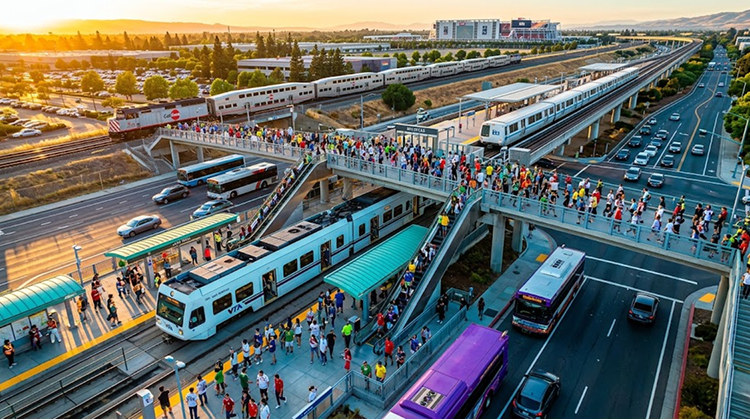
VTA recorded approximately 230,000 World Cup riders across six matches at Levi’s Stadium. During the tournament’s busiest match day, nearly 42,000 passengers used the system, while individual match days repeatedly generated ridership levels that would have been extraordinary under normal operating conditions.
The scale was anticipated before the tournament. VTA’s June planning documents said the Bay Area Host Committee expected approximately 260,000 visitors from outside the region to attend World Cup matches and related events. Transportation planners estimated that more than 14,700 spectators per match day would use VTA services to travel to and from the stadium.
The agency also had to coordinate with BART and Caltrain because Levi’s Stadium is part of a regional transportation network rather than a standalone transit destination.
That coordination became especially important because World Cup scheduling created travel demands outside conventional event hours. Late matches required extended service, additional personnel and heightened security. VTA’s January 2026 correspondence to California lawmakers had already warned that the World Cup would place extraordinary demands on local transportation, emergency management and public-safety systems.
The result was a useful demonstration of what public transit can accomplish during an international event.
But successful transportation does not automatically mean profitable transportation.
Why 230,000 Riders Produced Only A Small Fare Return
The most striking number in the new financial analysis may be the $238,687 in fare revenue generated from roughly 230,000 World Cup riders.
That works out to approximately $1.04 per passenger, a figure previously highlighted by KQED when examining VTA’s tournament performance.
This does not mean the transit system failed.
VTA has historically relied heavily on sales-tax revenue and other public funding rather than passenger fares to finance its operations. The purpose of the system during the World Cup was therefore not simply to make money from ticket sales. It was to provide a transportation network capable of moving large numbers of residents and international visitors safely and efficiently.
The problem is the difference between public transportation value and event-specific financial recovery.
A transit agency can reasonably argue that moving 230,000 passengers has value beyond fare revenue. Visitors spend money at hotels, restaurants and businesses. Employees reach their workplaces. Roads experience less congestion. Event organizers avoid having to accommodate every visitor by private vehicle.
Those benefits are real.
But they do not necessarily flow back into the transit agency’s budget.
That creates a structural problem for future mega-events. If a host city receives tourism and business benefits while its transit agency absorbs millions of dollars in additional costs, the public-sector institution carrying the operational burden may not be the same institution receiving the economic return.
The $11 Million Gap Changes The Mega-Event Calculation
The VTA’s reported numbers make the funding issue difficult to ignore.
| World Cup Transit Figure | Approximate Amount |
|---|---|
| VTA operating, security and law-enforcement costs | $21.7 million |
| Federal reimbursements | $10.5 million |
| Net reported loss | Nearly $11 million |
| World Cup riders | 230,000 |
| Fare revenue | $238,687 |
The figures show that the problem is not simply insufficient ticket revenue. It is the much larger difference between event-related operating costs and reimbursement.
That distinction matters because future host cities may face similar demands.
Mega-events require transportation agencies to run more trains and buses, extend service hours, deploy additional operators, increase maintenance capacity, manage crowd-control infrastructure and coordinate with law enforcement. These are temporary expenses, but they can be substantial.
The Bay Area was not entering the World Cup without federal support. In April, federal agencies announced nearly $60 million in combined assistance for World Cup security and transit-related costs in the Bay Area, including an $8.8 million Federal Transit Administration allocation administered through the Metropolitan Transportation Commission.
Yet VTA’s experience shows that even federal assistance may not cover the full cost of delivering the event.
That creates a potentially important policy question: should mega-event organizers be required to guarantee reimbursement for all qualified local transportation expenses before a city agrees to host?
FIFA’s Economic Benefits Do Not Automatically Pay For Local Transit
The Bay Area’s World Cup generated substantial economic activity beyond the stadium.
The six matches at the San Francisco Bay Area Stadium averaged 68,558 spectators, reaching 99.6% of stadium capacity, according to FIFA. The event also brought international visitors into hotels, restaurants, entertainment districts and commercial areas throughout the region.
Local business data reinforced that effect. Silicon Valley Business Journal reported World Cup-related increases in downtown traffic, hotel activity and beer sales in Santa Clara County during the tournament.
The difficulty is connecting those benefits to the specific public agencies that incur event costs.
A hotel may collect additional room revenue. A restaurant may experience higher sales. A retailer may benefit from international visitors. The airport may see additional passengers. But a transit agency may receive only a fraction of the additional economic value through fares.
This disconnect is at the heart of the Bay Area debate.
If the tournament produces billions of dollars in regional economic activity but a public transit agency loses $11 million, officials cannot evaluate the event solely by measuring gross visitor spending.
They need to examine who receives the revenue and who carries the costs.
That is a more demanding standard for future host-city planning.
The Host Committee Structure Is Now Under Greater Scrutiny
The Bay Area experience also raises questions about how event agreements distribute responsibilities.
The Bay Area Host Committee negotiated with FIFA and other event stakeholders, while local governments and public agencies were responsible for delivering many of the services needed for the tournament.
That arrangement can create a gap between the organization marketing the event and the public institutions responsible for making it function.
VTA’s concerns were visible before the tournament. In January, General Manager and CEO Carolyn M. Gonot told California lawmakers that the agency faced unfunded World Cup-related safety, security and operational needs. VTA identified $9 million in passenger-safety needs, $18 million in security measures and $17 million in operating needs in its request for support.
The fact that these concerns were identified months before the tournament suggests that the eventual $11 million shortfall was not simply an unexpected operational surprise.
It was part of a broader funding problem.
That could make future host-city negotiations more detailed.
Rather than simply asking whether a city can host an event, governments may increasingly ask event organizers to provide detailed financial guarantees covering transportation, policing, emergency response, sanitation, street closures and other public services.
Santa Clara Offers A Different Reimbursement Model
The Bay Area’s experience is also complicated by the fact that different local governments can have different reimbursement arrangements.
The City of Santa Clara has maintained a public dashboard tracking costs and reimbursements connected to Super Bowl LX and FIFA World Cup 2026. The city defines reimbursable expenses to include costs incurred by the City and Stadium Authority for event-related planning, preparation and operations.
Earlier city documents stated that the Bay Area Host Committee was responsible for reimbursing qualified expenses associated with World Cup support services, including planning, training, equipment and actual event costs. A preliminary estimate placed those costs at more than $12.1 million.
This distinction is important.
The Bay Area is not operating under one simple financial arrangement. Different public entities have different obligations, reimbursements and cost structures.
That makes the VTA shortfall particularly relevant because transportation agencies operate across municipal boundaries.
A World Cup match may be played in Santa Clara, but fans can stay in San Jose, ride BART through Milpitas, use Caltrain from the Peninsula or travel through San Francisco.
The economic benefits are regional.
The costs can be regional too.
Mega-Event Contracts May Need Transportation Guarantees
The next generation of host-city agreements could therefore include stronger transportation provisions.
One possible model would require organizers to establish a dedicated event mobility fund before the tournament begins. The fund could cover incremental transit operations, security, emergency transportation and crowd-management expenses.
Another option would be to establish reimbursement formulas based on actual service levels.
For example, if an event requires 100 additional bus operators, extended rail hours and additional security personnel, those incremental costs could be calculated in advance and incorporated into the event agreement.
A third model could connect organizer contributions to attendance.
The more visitors an event brings, the greater the contribution toward public transportation.
These approaches would not eliminate public investment. They would simply make the financial responsibility more explicit.
That could become particularly important as U.S. cities prepare for future global competitions, including the 2028 Los Angeles Olympic and Paralympic Games and other international tournaments.
The Bay Area’s experience offers an early warning that transportation planning cannot be treated as a secondary operational issue.
It is part of the event’s core financial infrastructure.
The Bay Area Still Proved Why Transit Matters
There is another side to the story that should not be overlooked.
Despite the financial loss, VTA moved an extraordinary number of passengers without a major transportation breakdown. The agency established an all-time special-event ridership record, while regional connections with BART and Caltrain helped distribute crowds throughout the South Bay and Peninsula.
The tournament also demonstrated why cities invest in transit capacity before major events.
A stadium holding more than 68,000 spectators cannot depend entirely on private vehicles without creating enormous congestion and parking demands.
Public transit effectively became part of the World Cup venue.
That value is difficult to measure on a balance sheet.
A fan who takes light rail instead of driving does not necessarily generate additional fare revenue large enough to cover the cost of the service. But that passenger reduces pressure on highways, parking facilities and local streets.
The transit agency is therefore providing a regional public service.
The challenge is determining how much of that public service should be funded by taxpayers and how much should be incorporated into the cost of hosting a private commercial event.
The Next Host Cities May Demand More From Event Organizers
The Bay Area’s experience could ultimately change the negotiating position of future U.S. host cities.
Cities have historically competed aggressively for the visibility associated with global sporting events. Hosting the World Cup, Olympics, Super Bowl or major professional sporting event can generate
international exposure and significant visitor spending.

But that competition can create an imbalance if governments focus on the benefits while underestimating the costs.
The VTA numbers provide a useful corrective.
A city can welcome hundreds of thousands of visitors and still leave a public agency with an eight-figure financial problem.
That does not make the World Cup a failure.
It means the distribution of costs and benefits deserves as much attention as the headline economic-impact number.
The most useful lesson from the Bay Area may therefore be less about whether cities should host mega-events and more about how they should negotiate them.
Before signing an agreement, host governments could require detailed cost estimates for every major public service, establish reimbursement guarantees, identify who bears cost overruns and publish post-event audits showing the difference between projected and actual economic benefits.
That kind of transparency would make future sports-event development more credible.
It would also help cities compare the opportunity cost of hosting a mega-event with investing the same public resources into permanent transportation improvements.
For business leaders following the broader relationship between events and regional economies, the Richland Chamber’s business community reflects the same underlying principle: major economic initiatives are ultimately judged by how effectively they strengthen the wider business environment.
The Real Legacy May Be A New Host-City Bargaining Model
The Bay Area’s World Cup experience leaves behind two very different numbers.
On one side are 230,000 VTA riders, record event demand and a stadium that operated at 99.6% of capacity. On the other is nearly $11 million in reported transit losses.
Both numbers are true.
The lesson is that a successful mega-event can still expose weaknesses in the way cities finance public services.
Future host cities may increasingly insist that organizers help cover the incremental costs required to deliver transportation, security and emergency services. Federal grants will remain important, but they may not be sufficient to protect local agencies from the full financial burden.
The Bay Area has therefore produced a case study that extends well beyond the 2026 World Cup.
If cities continue competing for global sporting events, the next phase of that competition may happen at the negotiating table rather than inside the stadium.
The question will no longer be simply how much economic activity an event can generate.
It will be how much of that value returns to the public systems that make the event possible.
