
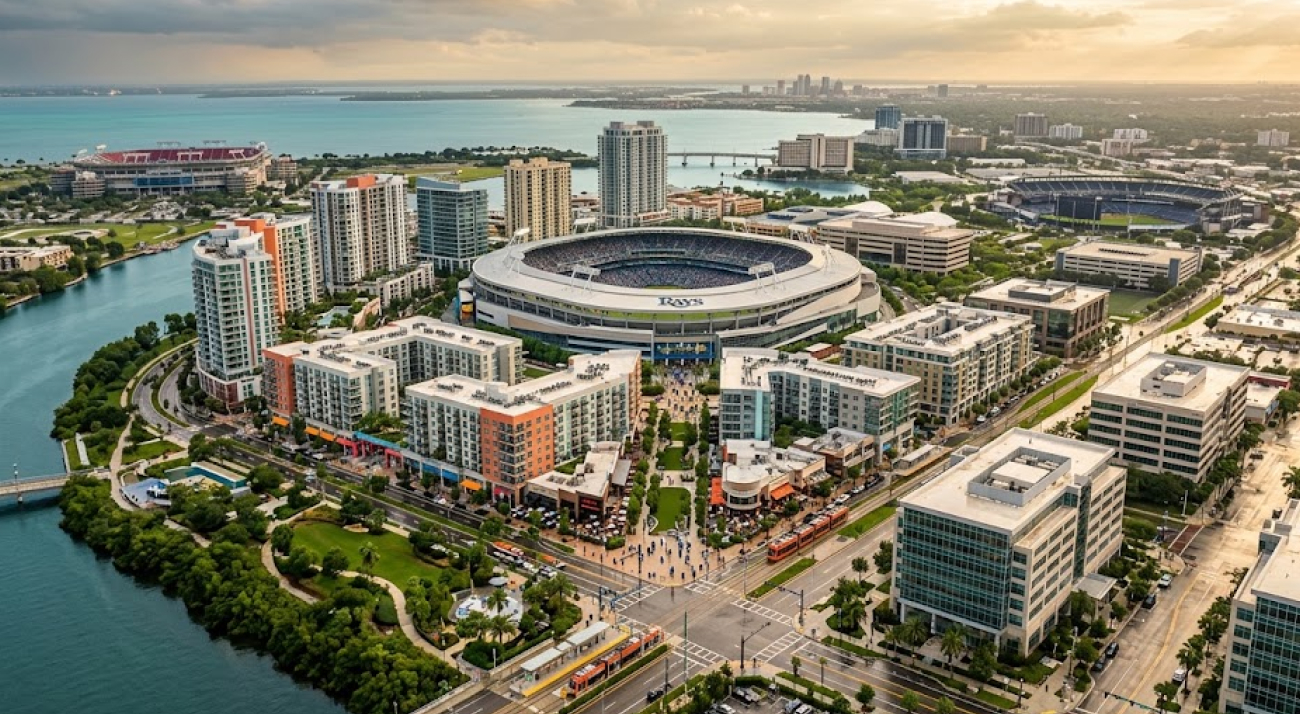
Tampa Bay is approaching a pivotal decision over a proposed $2.3 billion Tampa Bay Rays ballpark, but the project is increasingly being framed as something much larger than a baseball stadium. The latest agreement would place the Rays’ new home at the Hillsborough College Dale Mabry campus in Tampa, with the team committing approximately $1.37 billion, Hillsborough County contributing $796 million, and the City of Tampa contributing $80 million. The revised structure also includes plans for at least $8 billion in surrounding private development, potentially creating a new district with housing, offices, retail, recreation, hospitality and a reimagined college campus.
The Tampa City Council is scheduled to vote on the agreement on August 27, 2026, followed by a Hillsborough County Commission vote expected on August 28. The outcome could determine whether the Rays move forward with a planned 2029 opening and, more importantly, whether Tampa can turn a professional sports facility into a long-term urban-development platform.
The proposal therefore represents a broader test of sports-led redevelopment: can a stadium generate enough surrounding private investment and new tax value to justify the public participation required to build it?
Tampa’s Stadium Proposal Is Really A Mixed-Use Development Strategy
The most significant feature of the Rays proposal is not the stadium itself. It is what is supposed to surround it.

The team has committed to at least $8 billion in private investment in the neighborhood around the proposed ballpark. The development plan includes commercial space, residences, retail, recreation, a major hotel and a modernized Hillsborough College campus. The stated objective is to create a district where people can work, live, learn and play, rather than a facility that is occupied primarily during baseball games.
That distinction is increasingly important in American stadium development.
A traditional stadium can generate intense economic activity on roughly 81 regular-season baseball game days, plus concerts and other events. But the surrounding land can remain underutilized for much of the year if the project is designed around parking lots, isolated retail and single-purpose infrastructure.
A mixed-use district changes that equation.
Housing creates daily population. Offices create weekday activity. Hotels bring visitors. Restaurants and retail provide destinations outside game hours. Recreation adds additional traffic. A college campus creates another year-round population.
The stadium becomes an anchor rather than the entire economic proposition.
This model resembles the broader shift toward sports districts, where the venue is deliberately integrated into a larger real-estate strategy.
For Tampa, that could be the difference between constructing a $2.3 billion building and creating a new urban node.
The latest proposal has also changed substantially from the non-binding memorandum of understanding approved in May. The Rays’ direct contribution increased by approximately $100 million, while Tampa’s contribution fell from $180 million to $80 million. The public contribution was consequently reduced by roughly $100 million.
That evolution matters because the financing structure is becoming part of the project’s development strategy rather than simply a mechanism for paying for the stadium.
The City Of Tampa’s Reduced Contribution Changes The Risk Calculation
The latest agreement significantly changes Tampa’s position.
Under the earlier MOU, the city was expected to contribute $180 million. The definitive documents reduce that figure to $80 million and replace the previous structure involving the city’s Community Redevelopment Agency with a different financing arrangement tied to future development.
Mayor Jane Castor has described the revised agreement as a major step toward keeping the Rays in Tampa Bay while unlocking development potential in the area. Rays CEO Ken Babby has similarly emphasized increased private investment, reduced public contribution, protections against construction cost overruns and a 35-year non-relocation commitment.
The shift is important because public-sector exposure is one of the biggest factors determining whether a stadium project becomes politically sustainable.
A smaller direct city contribution does not eliminate public risk. It changes the form of that risk.
The revised structure depends heavily on the future performance of the surrounding development. If the private district grows as planned, property-tax revenues can support the financing structure and create additional fiscal value. If development is slower than expected, the anticipated revenue stream could take longer to materialize.
That makes the $8 billion development commitment one of the most important parts of the entire proposal.
The stadium is only one component.
The surrounding neighborhood has to work.
The $8 Billion Development Commitment Could Be More Important Than Baseball
The Rays’ pledge to invest at least $8 billion in private funds around the stadium is what gives the project its potential to redefine sports-led development.
For comparison, the ballpark itself represents $2.3 billion in projected construction costs. The surrounding private investment would therefore be several times larger than the stadium’s headline price.
That creates a different economic proposition.
| Component | Current Proposal |
|---|---|
| Proposed ballpark | $2.3 billion |
| Rays investment | Approximately $1.37 billion |
| Hillsborough County | $796 million |
| City of Tampa | $80 million |
| Planned surrounding private investment | At least $8 billion |
| Target opening | 2029 |
| Non-relocation commitment | 35 years |
The figures show why the project is being presented as an urban transformation rather than a conventional stadium deal.
The $8 billion figure, however, should not automatically be treated as guaranteed economic impact.
Investment commitments are different from completed development.
The actual test will be whether projects are financed, constructed, occupied and economically productive.
That means Tampa’s eventual measurement should include new housing units, office occupancy, hotel performance, retail sales, employment, property values, tax collections and infrastructure costs.
The city should also distinguish between economic activity that is genuinely new and activity that simply moves from another part of the region.
If a restaurant relocates from downtown Tampa to the new district, that is different from a new restaurant opening because the district attracts additional customers.
The same principle applies to housing, offices and hotels.
The real urban-development benefit comes from expanding the economic base, not merely rearranging it.
The $796 Million County Contribution Is The Central Public-Sector Question
Hillsborough County remains the largest public participant, with a proposed $796 million investment.
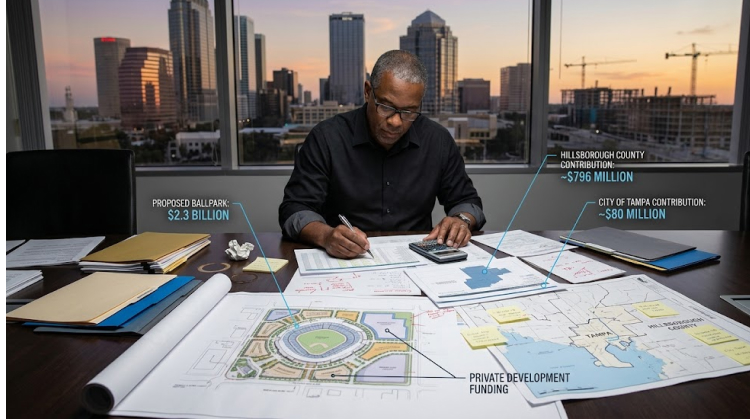
The financing structure includes approximately $303 million connected to Tourist Development Tax revenues, $360 million from the county’s Community Investment Tax, and another $103 million in other county resources, according to the definitive financing documents released August 21. The structure also identifies federal disaster-recovery funding associated with stormwater work.
This is where the debate over sports-led development becomes more complicated.
Supporters can argue that the county is not simply spending money on baseball. It is participating in a project intended to generate new development, employment, tourism, hotel demand and future property-tax revenue.
Critics can reasonably ask whether those benefits would materialize without the public contribution.
That distinction should determine how Tampa evaluates the project.
The appropriate question is not simply whether the Rays will attract fans. Major League Baseball already provides a powerful entertainment product. The more consequential question is whether the surrounding development produces enough new economic activity to compensate for the public resources committed to the project.
This is also why the location matters.
The proposed ballpark would sit across from Raymond James Stadium, home of the Tampa Bay Buccaneers, and next to George M. Steinbrenner Field, creating the potential for an unusually concentrated sports district. MLB previously described the proposed site as part of a mixed-use district at the Dale Mabry campus.
Tampa could therefore be creating a sports-and-entertainment cluster rather than a standalone MLB venue.
A New Ballpark Could Operate Far Beyond Baseball
The Rays are also explicitly planning for the new facility to function as an entertainment venue throughout the calendar.
In July, the team released renderings showing the proposed ballpark configured for a concert, college graduation, volleyball tournament and wrestling championship. The Rays said the goal is to create an economic engine capable of driving hotel occupancy, restaurant traffic, parking revenue, airport activity and transit usage.
That strategy is crucial for a baseball stadium because the regular-season schedule alone does not maximize the value of a large urban facility.
The venue’s ability to host concerts, tournaments, graduations and other large events creates a broader visitor calendar.
That could make the proposed district relevant to Tampa’s tourism strategy even when the Rays are playing elsewhere.
The stadium would also have the advantage of proximity to existing sports infrastructure.
Raymond James Stadium is already a major event destination. George M. Steinbrenner Field provides another sports facility nearby. The proposed Rays ballpark could therefore reinforce an existing cluster rather than creating an isolated attraction.
For Tampa’s hospitality industry, that concentration could be particularly valuable.
Hotels, restaurants and transportation operators benefit when several event-generating facilities are within the same area.
The result can be a more consistent visitor economy rather than isolated peaks around individual games.
Hillsborough College Makes The Project More Than A Sports District
Another distinctive element is the planned transformation of Hillsborough College’s Dale Mabry campus.
The proposed ballpark would be built on the campus site, while the broader project calls for a reimagined college environment alongside the private mixed-use development.
That creates an unusual connection between sports, education and urban development.
If properly executed, the campus could become part of the district’s everyday activity rather than simply occupying land next to the stadium.
Students provide a permanent population. Businesses provide employment. Residents provide daily demand. Visitors create additional spending.
This is fundamentally different from the traditional stadium model in which thousands of people arrive for a game and then leave.
The more successful the district becomes outside baseball hours, the less dependent its economic performance becomes on the Rays’ schedule.
That could ultimately be the project’s most important test.
Tampa’s Experience Could Influence Future Stadium Deals
The Rays agreement arrives during a period when American cities are reassessing how much public money should be committed to professional sports facilities.
The traditional argument for stadium subsidies has often relied on jobs, tourism and economic activity. The newer model is more sophisticated: cities increasingly want stadiums connected to housing, commercial development, public spaces, transportation and long-term tax growth.
Tampa’s proposal reflects that transition.
The project is structured around a privately financed neighborhood, with the stadium functioning as its anchor. The latest agreement also includes a 35-year non-relocation commitment, giving local officials a longer horizon for evaluating the investment.
That commitment matters because urban redevelopment takes years.
A city cannot realistically evaluate a project of this scale only by looking at its first season.
The relevant timeframe extends through multiple development cycles.
For cities considering their own major-event strategies, Tampa’s approach provides an increasingly important template: demand more private capital, connect the venue to surrounding development, create multiple uses for the facility and structure public participation around measurable future value.
This is closely connected to the broader question of whether sports events can become catalysts for downtown and district revitalization rather than simply temporary entertainment attractions.
The Biggest Risk Is Building The Stadium Faster Than The Neighborhood
The most important challenge for Tampa may ultimately have little to do with baseball.
It is development sequencing.
A stadium can be built in several years. A genuine mixed-use neighborhood takes much longer.
If the ballpark opens in 2029 but surrounding residential, commercial and hospitality projects lag behind, Tampa could initially have a spectacular new venue without the economic ecosystem that is supposed to support it.
That would weaken the central argument for the project.
The opposite outcome would be much more significant.
If the private development arrives alongside the stadium, if businesses occupy the district, if housing adds residents, if hotels attract visitors and if the college campus becomes integrated into the area, the ballpark could function as the catalyst its supporters envision.
The project would then offer a case study in how a sports franchise can participate in city-building rather than simply stadium-building.
Tampa’s Final Test Will Be The Development Around The Rays
The Tampa Bay Rays’ proposed $2.3 billion ballpark is therefore much more than a question about where the team plays baseball after 2028.
It is a test of whether a major professional sports facility can serve as the anchor for a new mixed-use urban district while reducing the city’s direct financial exposure and increasing private investment.
The latest agreement is already different from the proposal approved in May. The Rays’ commitment has risen to approximately $1.37 billion, Tampa’s contribution has fallen to $80 million, Hillsborough County remains at $796 million and the team continues to promise at least $8 billion in surrounding private development.
The decisive votes on August 27 and August 28 will determine whether the agreement advances.
But approval would only begin the real test.
Tampa will eventually have to prove that the promised neighborhood materializes, that the new development produces measurable economic value and that the public investment generates benefits extending beyond baseball.
If those pieces come together, the Rays’ new home could become a powerful example for cities across the United States.
The future of sports-led development may be less about building a stadium and more about building everything around it.
