

The Kansas City Chiefs’ planned move from Missouri to Kansas is becoming much more than a stadium project. With a $3 billion enclosed stadium in Wyandotte County, a $300 million headquarters and training facility in Olathe, and another $1.2 billion in private ancillary development, the Chiefs’ plan represents a broader attempt to use professional sports as a foundation for long-term real estate, tourism, employment and economic development.
The latest phase arrived on August 31, 2026, when the Chiefs and Hunt Midwest announced Two-Point Development, a joint real estate venture that will oversee mixed-use districts around both the future stadium in Kansas City, Kansas, and the new team headquarters in Olathe. The development strategy is significant because it moves the conversation beyond the value of the stadium itself and toward what happens around it every day of the year. Kansas economic development plans show that the broader project is expected to include sports, entertainment, dining, retail, hotels, offices and residential uses.
That distinction could become one of the most important lessons from the Chiefs’ move. A stadium can create concentrated economic activity on game days, but a successful sports-led development strategy needs restaurants, businesses, housing, events and public spaces that continue generating activity when there is no football game.
The Chiefs Project Is Bigger Than A $3 Billion Stadium
The headline number is the $3 billion stadium, but the full Kansas investment is considerably larger.
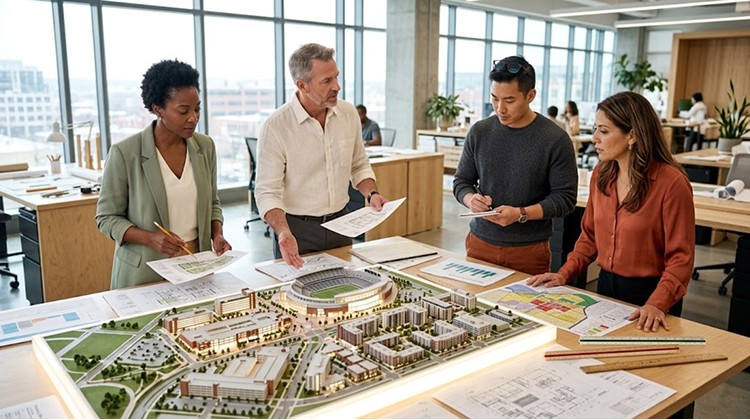
The Chiefs’ updated regional economic projections released in June put the combined capital investment at $4.5 billion. That figure includes the stadium, the Olathe headquarters and practice facility, and $1.2 billion in private ancillary real estate development surrounding the two facilities. The team estimates the construction period will generate $8.2 billion in one-time economic impact, while ongoing operations and visitor spending could generate approximately $1.5 billion annually once the facilities are operating.
Those figures are projections rather than guaranteed outcomes, which makes the structure of the development particularly important.
| Project Component | Current Plan |
|---|---|
| New Chiefs stadium | $3 billion |
| Olathe headquarters and training facility | $300 million |
| Ancillary private development | $1.2 billion |
| Total capital investment | $4.5 billion |
| Stadium opening target | 2031 |
The stadium itself is expected to accommodate approximately 70,000 spectators and will feature a fully enclosed translucent ETFE roof. Kansas City-based MANICA is leading stadium design, while HNTB is serving as architect of record and CAA ICON as owner’s representative.
The scale matters because the project is being positioned as an economic-development district rather than a single-use football facility. That changes what Kansas will ultimately need to measure.
Attendance at Chiefs games will matter, but so will hotel occupancy, restaurant sales, retail activity, employment, property development, tax collections and the number of visitors attracted to the region for concerts, championship events and other major competitions.
Kansas Is Using A Different Stadium Financing Model
The financing structure is another reason the Chiefs project deserves attention from communities studying sports-led development.
Kansas and the Chiefs agreed to a public-private partnership in which the public portion is funded primarily through Sales Tax and Revenue, or STAR, bonds, along with the state’s Attracting Professional Sports to Kansas Fund. The Kansas Department of Commerce says the structure is intended to avoid new state taxes and direct impacts on the state budget.
STAR bonds work differently from traditional general-obligation financing. Rather than simply appropriating existing tax revenue, the mechanism allows designated portions of future sales-tax revenue generated within the project and surrounding participating jurisdictions to support the development.
The concept creates an important economic-development test: Can the project generate enough new taxable activity to justify the public investment?
That question is more meaningful than simply asking whether the stadium will produce billions of dollars in economic impact.
The state and local governments must ultimately evaluate whether the new restaurants, hotels, retail operations, entertainment venues and other businesses create sufficient incremental economic activity to support the financing structure while still producing measurable public benefits.
For communities considering similar projects, this is one of the most useful aspects of the Chiefs deal. The financing mechanism attempts to connect public support with future economic activity rather than treating the stadium as an isolated government expense.
Olathe Adds A Second Economic Development Engine
The Chiefs’ relocation strategy also distributes the investment across two Kansas communities.
The stadium will be located in Wyandotte County, while the new headquarters and training facility will be built in Olathe, in Johnson County. The Chiefs announced in July that Kansas City-based Populous had been selected as lead design architect for the $300 million headquarters and practice facility, which is scheduled to open ahead of the 2031 season. The site covers approximately 155 acres near College Boulevard and Ridgeview Road.
This creates a different economic-development pattern from a conventional stadium district.
Olathe does not need to rely on football games alone. A headquarters and training complex creates daily employment, corporate activity, team operations, community programming and surrounding commercial demand.
The two sites could therefore develop complementary roles.
Wyandotte County can become the region’s major sports and entertainment destination, while Olathe develops a business, training and community-oriented district around the franchise’s daily operations.
That geographic distribution could help spread the economic effects of the project across the Kansas side of the metropolitan area rather than concentrating everything around one stadium.
Mixed-Use Development Could Determine The Project’s Long-Term Value
The most consequential development announced recently may actually be the creation of Two-Point Development.
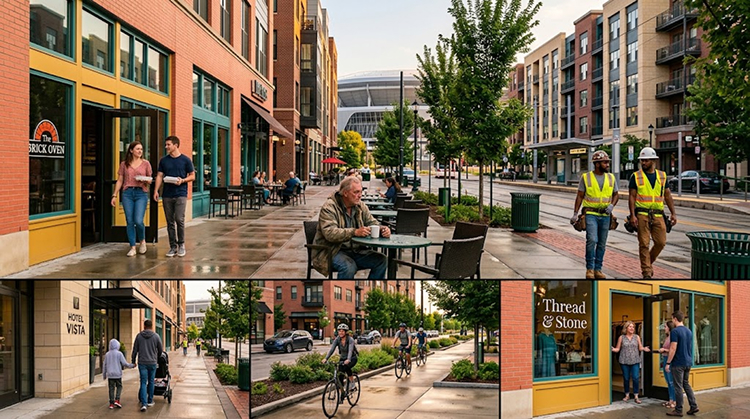
The joint venture between the Chiefs and Hunt Midwest will serve as the development platform for two separate districts: one surrounding the future stadium in Wyandotte County and another surrounding the Chiefs’ new headquarters and practice facility in Olathe. The organization says the districts are intended to combine entertainment, hospitality, retail, residential and public gathering spaces.
That model reflects a broader shift in sports-led development.
Instead of treating a stadium as an isolated destination, cities are increasingly trying to use major sports facilities as anchors for surrounding development. The objective is to capture economic activity before and after games and to give visitors reasons to remain in the district.
For Kansas City, that could mean a visitor arriving for a Chiefs game also staying at a nearby hotel, eating at a local restaurant, visiting retail businesses and attending another event. Residents could use the same district for dining, entertainment and public gatherings without attending a football game.
The economic-development value therefore depends on how much activity the stadium helps generate around itself rather than simply how many tickets it sells.
This is where the Chiefs’ new mixed-use development strategy becomes particularly important. The August 31 announcement describes the districts as year-round sports and entertainment destinations designed to attract investment, create jobs and build community hubs.
The Biggest Opportunity May Be Sports Tourism
A major enclosed NFL stadium gives Kansas City another asset for attracting events that extend beyond the regular football schedule.
The Chiefs and Kansas officials have pointed to potential opportunities involving major sporting competitions, concerts and championship events. The state has specifically promoted the stadium’s potential to host events such as Super Bowls, College Football Playoff games and Final Fours.
This is where sports tourism can become a more important component of the economic model.
A regular-season NFL game typically produces a predictable burst of activity. A major national or international event can create a much larger visitor footprint, particularly when spectators travel from outside the metropolitan area.
Visitors need hotels, restaurants, transportation, entertainment and retail services. Those expenditures reach businesses that may have no direct connection to the stadium.
The economic-development strategy therefore becomes stronger when the facility is capable of supporting a diverse event calendar.
Kansas City’s existing tourism infrastructure provides an important base for that strategy. The new stadium would add another major venue to a metropolitan area already accustomed to hosting professional sports, conventions, concerts and large public events.
For businesses across the region, the potential benefit extends beyond the stadium district itself. The Kansas City tourism industry can benefit when major events increase hotel demand and encourage visitors to spend additional time exploring restaurants, attractions and entertainment venues throughout the metropolitan area.
The Numbers Will Need To Be Tested After Opening
The Chiefs’ projections are substantial, but the most important economic-development story will begin after construction ends.
The team projects 36,500 full-time-equivalent job-years during construction, approximately 8,500 full-time-equivalent jobs once the facilities and surrounding developments are operating, and $1.5 billion in annual regional economic impact.
Those numbers create a clear measurement framework for policymakers.
Future evaluations should examine:
- How many jobs are actually created and retained.
- How much new hotel and lodging demand is generated.
- Whether surrounding commercial development reaches projected occupancy.
- How much visitor spending remains within Kansas.
- Whether small and local businesses gain measurable new customers.
- How tax collections compare with debt-service requirements.
- How frequently the facilities host events beyond Chiefs games.
This type of evaluation is particularly relevant because large sports projects can produce impressive headline figures while distributing benefits unevenly.
A project can have a large gross economic impact without every neighborhood or business experiencing the same benefit. For Kansas City, the quality of the surrounding development will therefore matter almost as much as the stadium itself.
Local Businesses Could Become A Critical Part Of The Model
A sports district cannot function on stadium revenue alone.
Restaurants, hotels, retailers, transportation companies, entertainment businesses and service providers all contribute to the visitor experience. That creates an opportunity for regional economic organizations to connect smaller companies with the larger sports economy.
For a chamber of commerce, this is where Richland Chamber’s business resources provide a useful parallel. Large projects create the greatest community value when local businesses have the capacity and connections to participate in the demand they generate.
Kansas City will face the same challenge.
If most economic activity is captured by a small group of large developers and national chains, the broader community benefit could be more limited. If local restaurants, entrepreneurs, contractors, retailers, hotels and service companies become part of the stadium ecosystem, the economic impact can circulate more widely.
That means procurement opportunities, business networking, tourism promotion and local vendor participation could become important pieces of the project’s long-term legacy.
Public Investment Will Still Require Long-Term Accountability
The Chiefs’ project is being promoted as an investment that will create jobs, attract visitors and generate new tax revenue without imposing new state taxes. But avoiding a traditional tax increase does not eliminate the need for accountability.
Public financing mechanisms still depend on future economic activity.
The central question for Kansas will be whether the projected growth materializes at the scale and pace necessary to support the financing structure while producing additional benefits for residents.
That makes transparency especially important.
Kansas will have years to evaluate whether visitor spending, commercial development, employment and tax collections are meeting expectations. The same data can help determine whether additional public incentives are justified for future sports and entertainment projects.
The project could ultimately become a useful case study in how governments structure public-private partnerships around major sports facilities.
The Chiefs Could Create A New Model For Sports-Led Development
The most significant aspect of the Chiefs’ Kansas move may be that the project is being built around an economic ecosystem rather than a stadium alone.
The $3 billion stadium is the centerpiece, but the larger strategy includes a $300 million headquarters and training facility, $1.2 billion in private ancillary development, two mixed-use districts and a financing structure tied to future economic activity.
That makes the project relevant far beyond Kansas City.
Cities across the United States are evaluating how professional sports can contribute to downtown revitalization, tourism, infrastructure and long-term economic growth. The Chiefs’ approach offers a different possibility: build the sports facility as an anchor, but measure success by what develops around it.
If Kansas can transform the stadium district into a year-round destination, create strong business participation and generate sustained visitor spending, the project could become an example of sports infrastructure functioning as a broader economic-development platform.
If those surrounding investments fail to reach expectations, however, the project will demonstrate the limits of using projected economic growth to justify large public commitments.
The distinction will become clear over time.
By the time the Chiefs are scheduled to open their new Kansas stadium for the 2031 NFL season, the success of the project will be measured by far more than the noise inside a 70,000-seat building. Its real economic legacy will depend on whether the surrounding districts attract businesses, visitors, residents and investment throughout the year—and whether those gains remain visible across the communities that helped finance the project.
