

Pinellas County is taking a different approach to sports tourism investment than cities that spend hundreds of millions of dollars building or upgrading stadiums. On August 25, 2026, county commissioners unanimously approved another round of funding for major events, bringing the annual commitment through Visit St. Pete-Clearwater’s Elite Event Funding Program to approximately $3.37 million across 47 events. The events’ most recent editions collectively attracted more than 1 million attendees, including more than 500,000 tourists.
The strategy is significant because the county is distributing relatively modest amounts of public money across a large portfolio of events rather than concentrating the investment around one permanent venue.
The money comes from Pinellas County’s 6% Tourist Development Tax, which is collected on short-term lodging such as hotels and vacation rentals. The county then uses those visitor-generated funds to support events intended to attract additional visitors and spending.
That creates an economic-development model built around repetition, variety, and measurable visitor demand.
Instead of asking whether one stadium can generate enough economic activity to justify a large public investment, Pinellas County is asking a different question: How many tourism-producing events can be supported with the same pool of public resources?
That distinction could have implications for communities across the United States that want to expand sports tourism without assuming the financial risk associated with major stadium construction.
Pinellas County Is Building A Portfolio Of Events
The Elite Event Funding Program was created by the Pinellas County Board of County Commissioners and is administered by Visit St. Pete-Clearwater. Its stated purpose is to attract and retain large-scale events capable of generating visitation from outside the county.
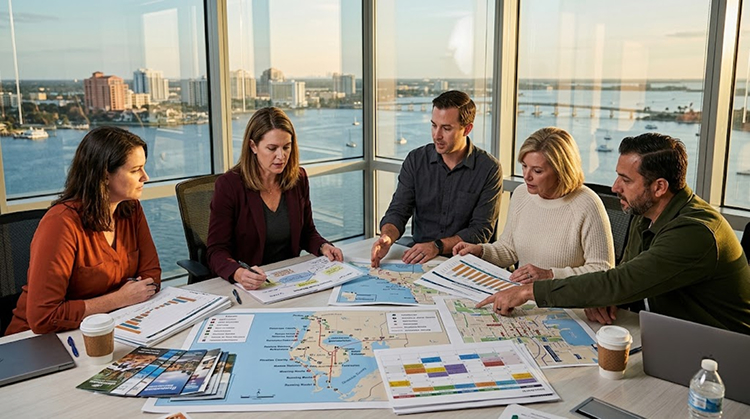
The program’s 2026 scale is particularly notable. Approximately $3.37 million is being distributed among 47 events, meaning the average allocation is roughly $71,700 per event if the total were divided evenly.
In reality, allocations vary significantly depending on the event’s projected tourism performance and eligibility.
A major competition can receive substantially more than a smaller festival, while the program’s evaluation process considers expected attendance, room nights, economic impact, marketing value, and other factors.
That creates a portfolio approach to tourism investment.
| Pinellas County Event | FY26 Recommended Funding | Projected Economic Impact |
|---|---|---|
| Firestone Grand Prix of St. Petersburg | $250,000 | $14.64 million |
| Valspar Championship | $250,000 | $18.22 million |
| St Pete Pride | $150,000 | $12.48 million |
| Clearwater Offshore Nationals | $125,000 | $6.01 million |
| St. Pete Powerboat Grand Prix | $125,000 | $9.47 million |
| Clearwater Jazz Holiday | $75,000 | $5.65 million |
The FY26 recommendations show how the program evaluates events individually rather than treating all tourism activity as equal. For example, the Valspar Championship was projected to generate more than $18.2 million in economic impact from 107,784 attendees and 19,578 room nights while receiving a $250,000 recommendation.
The Elite Event Funding Program also requires applicants to provide documentation and economic information, reinforcing the idea that public support is connected to measurable tourism performance rather than simply the popularity of an event.
That structure could become increasingly attractive to smaller and mid-sized destinations that cannot justify billion-dollar sports infrastructure projects.
The Tourist Development Tax Creates A Different Funding Cycle
Pinellas County’s model has another important characteristic: the primary funding source is generated by visitors.
The Tourist Development Tax is a 6% tax on overnight stays in hotels and vacation rentals. Visit St. Pete-Clearwater describes the revenue as visitor-generated money that is reinvested into destination marketing, events, capital projects, and other tourism-related initiatives.
This creates a circular economic model.
Visitors spend money on accommodation. A portion of that lodging activity produces tax revenue. The county then uses some of that revenue to attract additional visitors through events and destination investment.
That does not make the funding cost-free. Public officials still have to determine whether the money could produce a greater return through alternative uses.
But the model is different from using general municipal revenues to subsidize a professional sports facility.
It also gives tourism officials an opportunity to build a direct connection between the performance of the visitor economy and future event investment.
Pinellas County reported that tourism generated more than $10 billion in economic impact in 2025 and supported approximately 100,000 jobs. During that year, the county approved more than $153.1 million in Tourist Development Tax investments, including funding for 40 Elite Events, capital projects, museums, attractions, sports complexes, and beach nourishment.
The Pinellas County Tourist Development Council advises the county commission on how Tourist Development Tax revenue should be spent, including Elite Events and capital-project funding.
The broader system therefore connects individual sporting events to a much larger tourism economy.
Smaller Events Can Reduce The Risk Of Sports Tourism Investment
The distributed nature of the program may offer an important advantage: diversification.
A city that invests $100 million or more in a sports facility becomes highly dependent on the facility’s long-term performance.
Pinellas County can spread $3.37 million across 47 events.
If one event underperforms because of weather, scheduling problems, competition from another destination, or weaker-than-expected attendance, the financial effect is contained.
Other events can continue producing visitor activity.
That is similar to an investment portfolio.
The county is effectively purchasing access to multiple tourism opportunities rather than betting the entire strategy on one stadium, franchise, or annual competition.
The approach also creates geographic diversity.
Events take place across communities including St. Petersburg, Clearwater, Dunedin, Largo, and other parts of Pinellas County. This means visitor spending can reach businesses across a broader area rather than concentrating almost entirely around one stadium district.
For local business organizations, that can make sports tourism more relevant.
A restaurant does not need to be adjacent to a major stadium to benefit from a regional event. A hotel in Clearwater can benefit from a competition in St. Petersburg. A retailer in Dunedin can capture spending from visitors attending an event elsewhere in the county.
The Visit St. Pete-Clearwater partner resources also emphasize connections between tourism promotion, local businesses, events, destination marketing, and industry participation.
This creates a broader economic footprint than a single-site development project.
The Economics Start With Visitor Spending
The most important distinction in Pinellas County’s strategy is the difference between attendance and tourism.
An event can attract tens of thousands of people without generating the same economic value as an event that brings visitors from outside the region who stay in hotels, eat at local restaurants, use transportation services, shop, and spend several days in the destination.

That is why the county’s funding system places significant emphasis on tourists and room nights.
The September 25–27, 2026 Xinsurance Clearwater Offshore Nationals provides a useful example. Pinellas County approved up to $125,000 for the powerboat race, which is projected to attract 14,375 attendees, including 11,136 tourists.
That means roughly 77% of the expected audience is projected to come from outside the immediate local market.
For a tourism destination, that ratio can be more meaningful than raw attendance.
Visitors require accommodation, transportation, food, entertainment, and other services. Those purchases spread economic activity across businesses that may have no direct relationship with the event organizer.
The Pinellas County tourism investment model explicitly connects the Tourist Development Tax to events and destination improvements designed to generate additional economic activity for local businesses and residents.
This makes sports tourism less about filling a venue and more about filling hotel rooms, restaurants, attractions, and local businesses.
That distinction is becoming particularly important as communities evaluate the real economic value of sporting events.
Event Funding Can Support More Than Sports
Although sports tourism is a major component of the strategy, Pinellas County’s funding portfolio is broader than traditional athletics.
The FY26 recommendations included the Firestone Grand Prix of St. Petersburg, Valspar Championship, powerboat races, St. Pete Pride, Clearwater Jazz Holiday, St. Pete BikeFest, festivals, cultural events, holiday attractions, and other large gatherings.
That variety is strategically important.
A tourism destination does not need every visitor to arrive for the same reason.
One weekend may be driven by motorsports. Another can be driven by golf. Another can involve music, food, cultural celebrations, boating, or family-oriented attractions.
This can help smooth seasonal demand.
Hotels and restaurants benefit when visitor activity is distributed throughout the calendar rather than concentrated around a handful of major events.
The model also creates opportunities for local businesses to develop specialized products around different visitor groups.
A powerboat event can generate demand for waterfront restaurants and marine services. A golf tournament can benefit hotels and upscale dining. A music festival can produce demand for transportation, nightlife, retail, and entertainment.
The economic-development value therefore comes from the interaction between events and the existing business ecosystem.
Pinellas County Is Measuring Performance Before Expanding Investment
One of the most important features of the program is that event funding is connected to evaluation.
The county’s application requirements call for applicants that have previously received Elite Event funding to provide an economic-impact report or visitor-profile study.
That requirement matters because it gives officials a mechanism to compare projected results with actual results.
A destination can ask whether an event delivered the attendance it promised.
It can examine whether tourists actually arrived.
It can evaluate hotel demand, room nights, economic impact, marketing exposure, and other indicators.
That creates the possibility of performance-based tourism funding.
For local governments, this is potentially more useful than relying on broad claims about how much an event is “worth.”
A funding program can establish measurable expectations before allocating public money and then examine performance afterward.
That makes future funding decisions easier to defend.
It also creates an incentive for event organizers to produce accurate projections.
If organizers consistently overestimate attendance or tourism activity, their credibility can suffer in future funding cycles.
If they deliver or exceed projections, they strengthen the case for continued support.
The Model Could Be More Scalable Than Stadium Construction
The comparison with stadium financing is particularly relevant after recent major stadium deals across the United States.
Tampa Bay’s new Rays agreement involves approximately $2.36 billion in stadium development, including substantial public participation. Las Vegas recently approved up to $75 million in public funding toward a $158 million Allegiant Stadium expansion.
Pinellas County’s $3.37 million event strategy operates at an entirely different financial scale.
For the price of one major stadium improvement, a destination could support many years of event programming across multiple communities.
That does not mean event funding is inherently better.
A stadium can provide permanent infrastructure, attract major franchises, host dozens of events annually, and become an anchor for larger redevelopment.
But a distributed event strategy can be more flexible.
If visitor preferences change, funding can shift.
If one event becomes less successful, another can receive greater attention.
If a new sport becomes popular, the destination can recruit it without constructing a new stadium.
That flexibility may become increasingly valuable as cities compete for visitors in a crowded sports and entertainment market.
The Real Measure Is The Return Per Public Dollar
The most useful metric emerging from Pinellas County’s strategy may be the relationship between public funding and visitor-generated economic activity.
Consider the Valspar Championship’s FY26 recommendation.
The event was projected to generate approximately $18.2 million in economic impact while receiving a recommended $250,000 allocation. That represents roughly $73 in projected economic impact for every dollar of recommended event funding, based on the program’s own projected figures.
That calculation should not be treated as a direct return on investment because economic impact and public revenue are different measurements.
Still, it illustrates why destination officials may find event funding attractive.
The public contribution can be relatively small compared with the volume of visitor activity the event is expected to generate.
The same logic applies to the Clearwater Offshore Nationals, which has a $125,000 funding recommendation and a projected audience heavily weighted toward tourists.
The key question for future years will be whether these projections hold up after events take place.
If actual visitor spending and tourism activity consistently meet expectations, the program becomes easier to justify.
If results regularly fall below projections, the county will have evidence that funding criteria need to change.
That feedback loop is essential.
Small Businesses Could Become The Biggest Beneficiaries
Sports tourism is often discussed in terms of stadiums, teams, athletes, and event organizers.
The economic effect on smaller businesses can be less visible but potentially more important.
A visitor who travels to Pinellas County for a sporting event may never purchase anything from the event organizer beyond a ticket.
But that same visitor may stay in a locally owned hotel, eat at an independent restaurant, rent a vehicle, hire a fishing charter, visit an attraction, purchase merchandise, or extend the trip by another night.
That spending can reach businesses throughout the community.
Visit St. Pete-Clearwater specifically identifies local business owners, including fishing charter operators and boating services, among the businesses that benefit from visitor spending.
This is where sports tourism becomes an economic-development strategy rather than simply an entertainment strategy.
For chambers of commerce, the opportunity is to help businesses become part of that visitor economy.
The Richland Chamber’s business resources provide an example of how a chamber can connect local businesses with broader opportunities for visibility, growth, and community economic activity.
In Pinellas County, the effectiveness of the event strategy will ultimately depend on how much of the visitor spending reaches businesses outside the event venue.
The Next Phase Of Sports Tourism May Be More Distributed
Pinellas County’s $3.37 million commitment does not eliminate the need for major stadiums or large sporting events.
Instead, it demonstrates that a destination can build a substantial sports-tourism economy without depending exclusively on mega-projects.
The county’s tourism economy already generated more than $10 billion in economic impact in 2025, while its event program is distributing millions across dozens of competitions and attractions.
That combination creates a different model for community investment.
The strategy is based on many events, multiple destinations, recurring visitor demand, measurable performance, and reinvestment of visitor-generated tax revenue.
For other U.S. communities, the lesson may be less about copying Pinellas County’s exact $3.37 million budget and more about examining the structure behind it.
A community does not necessarily need to own a professional sports franchise to participate in sports tourism.
It may need the ability to identify events that attract outside visitors, support those events with targeted investments, measure their results, and connect visiting fans with local businesses.
That is a much more accessible proposition for smaller cities and regional destinations.
A Different Way To Think About Sports Tourism Investment
Pinellas County’s strategy is ultimately testing a simple proposition: sports tourism does not always require a billion-dollar stadium to create measurable economic value.
The county’s $3.37 million commitment to 47 events represents a relatively small public investment compared with major stadium projects, yet the events’ most recent editions collectively attracted more than 1 million attendees and more than 500,000 tourists.
The significance is the structure.
Public money is distributed across multiple events. Funding comes from a visitor-generated tax. Applicants are evaluated using tourism and economic data. Events are spread across different communities and seasons. Local businesses can participate in the resulting visitor economy.
The model still carries risks. Attendance projections can be wrong, weather can disrupt outdoor competitions, economic-impact estimates can vary, and public funding must compete with other tourism priorities.
But the approach gives Pinellas County something that large stadium projects often struggle to provide: flexibility.
The county can adjust the portfolio from year to year.
If an event produces strong visitor results, it can strengthen its case for continued funding. If another event consistently underperforms, resources can be redirected.
That may be the most important lesson for the next generation of sports tourism policy.
Instead of asking only how much a city should spend to build the next major sports venue, economic-development leaders may increasingly ask a more practical question:
How many visitors can we attract, how much can they spend locally, and how efficiently can public investment turn that spending into sustained business activity?
Pinellas County’s 2026 experiment provides one answer—and its performance could influence how other destinations approach sports tourism long after the 47 funded events have finished.
