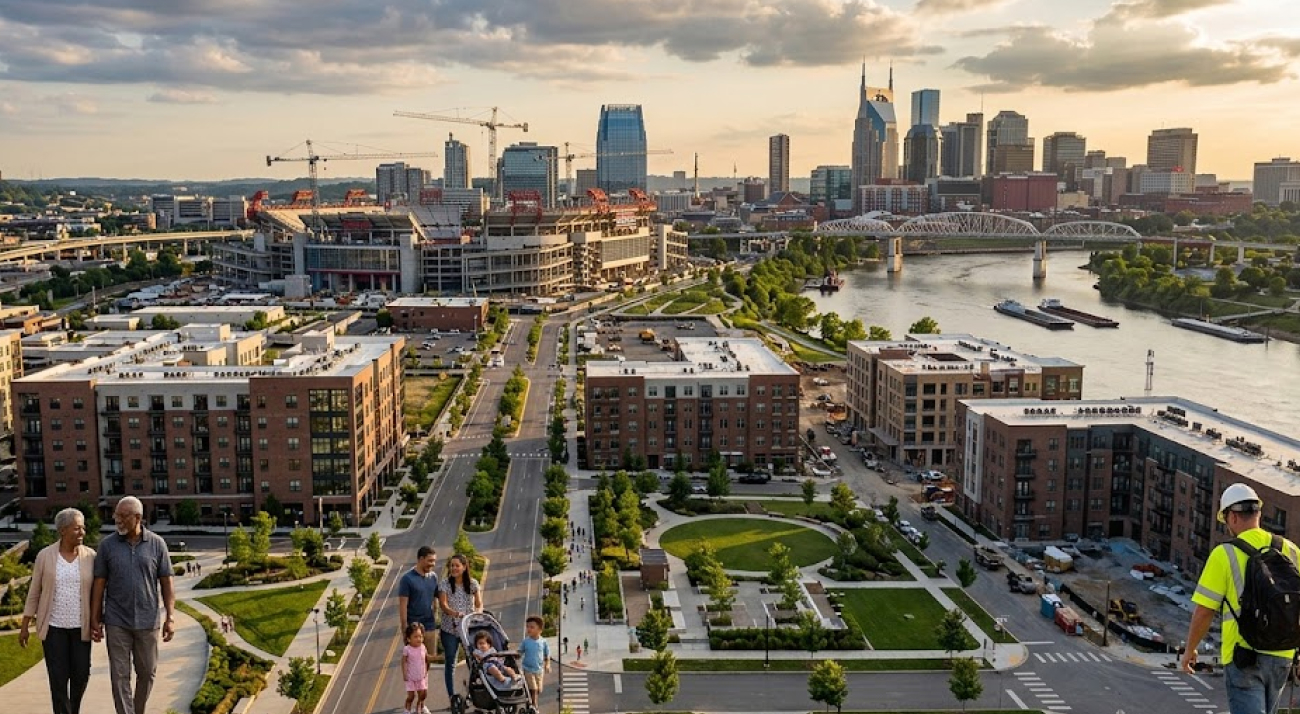
Nashville is taking an unusual approach to one of the largest sports-led redevelopment projects in the United States. Instead of allowing hotels, restaurants, offices and luxury housing to establish the identity of the area surrounding the Tennessee Titans’ new $2.2 billion stadium, the first major vertical project in the district is affordable housing.
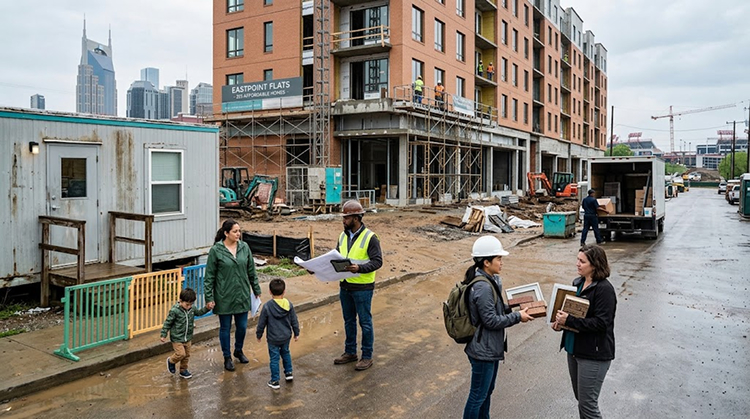
Eastpoint Flats, a 323-unit affordable housing development on Nashville’s East Bank, broke ground in May 2026 as the first building inside the 30-acre Eastpoint development area. The project includes an 8,420-square-foot childcare facility and 12,600 square feet of retail space. More significantly, the homes are protected by a 99-year ground lease that keeps the units income-restricted for nearly a century. Nashville’s East Bank development is therefore becoming a test of whether a major sports project can serve as the foundation for a mixed-income neighborhood rather than simply a catalyst for higher property values.
That distinction matters because Nashville is facing a substantial housing challenge at the same time it is investing in a new sports and entertainment district. Metro Nashville’s Unified Housing Strategy estimates that Davidson County will need more than 90,000 additional homes over the next decade to meet projected demand. The city estimates that roughly 20,000 of those homes need to be affordable to households earning 60% of area median income or less.
The East Bank project consequently offers a different model for sports-led economic development. The question is no longer simply whether a new stadium can attract major events. It is whether the surrounding investment can help solve some of the everyday challenges facing the residents who live and work in the city.
Nashville Is Building A Neighborhood Around The Stadium
The new Nissan Stadium is scheduled to open in 2027 on the East Bank of the Cumberland River, immediately east of the existing Nissan Stadium. The enclosed venue is being developed as the future home of the Titans while also being positioned to host concerts, college football and major national events. The Titans have also promoted Nashville as a potential future host for Super Bowls and other large-scale competitions.
But the stadium represents only one component of the larger East Bank transformation.
The East Bank covers approximately 550 acres and includes 130 acres of Metro-owned property. Much of the area currently consists of surface parking, industrial uses and commercial land. The city’s long-term plan calls for a mixed-use district containing housing, retail, entertainment, public spaces, transportation connections and parks.
That creates an important economic-development distinction.
A stadium can generate intense economic activity on game days while remaining relatively inactive during the rest of the week. A neighborhood operates differently. Residents create demand for groceries, childcare, restaurants, services, transportation and public amenities throughout the year.
Nashville’s strategy is therefore based on creating a district where the stadium becomes one economic anchor among many rather than the entire reason for the area’s existence.
This is particularly relevant for chambers of commerce and local economic-development organizations tracking how major projects influence surrounding businesses. The success of a sports district is increasingly measured by what happens outside the stadium gates, including whether local companies gain customers, whether residents can access employment centers and whether new infrastructure improves daily mobility.
For organizations focused on regional business development, Nashville provides a useful case study in connecting major-event infrastructure with broader community objectives.
Eastpoint Flats Changes The Usual Development Sequence
Traditional sports-led redevelopment often follows a recognizable sequence. A city builds or approves a stadium, private developers follow with hotels and entertainment venues, residential projects emerge as land values rise, and affordable housing becomes a secondary issue.
Nashville is attempting to reverse that order.
Eastpoint Flats is the first building underway within the Eastpoint district, and its 323 units will be income-restricted. The development is being delivered by The Fallon Company and Elmington Capital, with Metro Nashville providing the land through a long-term ground lease. The 99-year structure is particularly important because it prevents the affordability requirement from disappearing after a short regulatory period.
The development also combines housing with services.
The planned childcare center is more than an additional amenity. Childcare availability can directly affect whether parents can participate in the workforce, especially in a growing metropolitan economy where housing and transportation costs can make employment decisions more difficult.
Retail space adds another layer. Instead of creating a residential complex that functions as an isolated affordable housing development, Eastpoint Flats is being integrated into a walkable mixed-use district.
That approach reflects one of the central challenges of urban redevelopment: housing affordability cannot be separated entirely from access to employment, transportation and everyday services.
Nashville’s broader agreement with Fallon calls for 1,550 residential units across the Initial Development Area, with 695 designated as affordable at 80% of area median income or below. The agreement also includes requirements for two buildings with 100% affordable units and affordability protections lasting for the duration of the 99-year ground leases.
The scale is meaningful, but it must also be viewed against Nashville’s larger housing requirements. Even 1,550 units represent a relatively small share of the more than 90,000 additional homes projected to be needed over the next decade.
That is why the significance of Eastpoint Flats may extend beyond its unit count.
The project is testing whether affordability can be embedded into a major redevelopment plan before surrounding land becomes substantially more expensive.
The $2.2 Billion Stadium Is Part Of A Much Larger Public Investment
The headline figure attached to Nashville’s stadium is approximately $2.2 billion, but examining the project through the stadium price alone misses much of the public infrastructure involved in transforming the East Bank.
Metro Nashville’s preliminary financial documents estimate that public infrastructure investment for the broader East Bank could exceed $700 million, with overall funding estimated at approximately $1.55 billion. The city has emphasized that these figures are expected to grow as development becomes more intense.
That makes infrastructure one of the most important factors in determining whether the development produces a lasting economic return.
New housing requires roads, utilities, pedestrian connections, transit access, parks and other public systems. The East Bank development agreement estimated approximately $147 million in infrastructure costs for the Initial Development Area, including projects such as utility relocation, new street connections and an extension of the John Seigenthaler Pedestrian Bridge.
The funding structure is also significant because the city and private developers are sharing responsibilities.
Fallon’s agreement covers approximately 49% of the Initial Development Area infrastructure costs, while the Tennessee Performing Arts Center is responsible for roughly 46% and Metro Nashville for about 5%, according to the city’s published figures.
This creates a broader public-private development model in which the stadium, housing, entertainment facilities and transportation infrastructure reinforce each other.
The key question for Nashville will be whether that coordination produces a district capable of supporting economic activity throughout the week rather than concentrating benefits around football games and major concerts.
Affordable Housing Could Protect The Stadium District From Becoming A Luxury Enclave
One of the greatest risks associated with successful urban redevelopment is that rising land values can push out the very populations that policymakers hoped would benefit from investment.
Nashville has experienced substantial population and economic growth, increasing demand for housing while putting pressure on affordability. The city’s housing strategy estimates that 90,000 additional homes will be needed over the next decade and identifies a particularly significant shortage at lower income levels.
The East Bank’s affordability requirements are an attempt to address that issue before the neighborhood fully develops.
The 99-year ground leases are particularly important because they establish affordability as a long-term characteristic of the district rather than a temporary condition attached to an initial development phase.
| East Bank Development Measure | Current Figure |
|---|---|
| Initial Development Area | 30 acres |
| Total Metro-owned East Bank land | 130 acres |
| Affordable housing units required in IDA | 695 |
| Total residential units required | 1,550 |
| Eastpoint Flats affordable units | 323 |
| Affordable housing protection | 99 years |
| Eastpoint Flats childcare space | 8,420 sq. ft. |
| Eastpoint Flats retail space | 12,600 sq. ft. |
The numbers demonstrate why Eastpoint Flats deserves attention as an economic-development project rather than simply a housing development.
The location places affordable residents inside a future employment and entertainment district, close to downtown Nashville and the Cumberland River. If transportation connections develop as planned, residents could benefit from access to jobs and services without relying exclusively on long-distance commuting.
That connection between housing and mobility is critical. Nashville’s own planning documents have warned that insufficient housing supply can push residents farther from Davidson County, increasing commuting distances and adding congestion and air pollution.
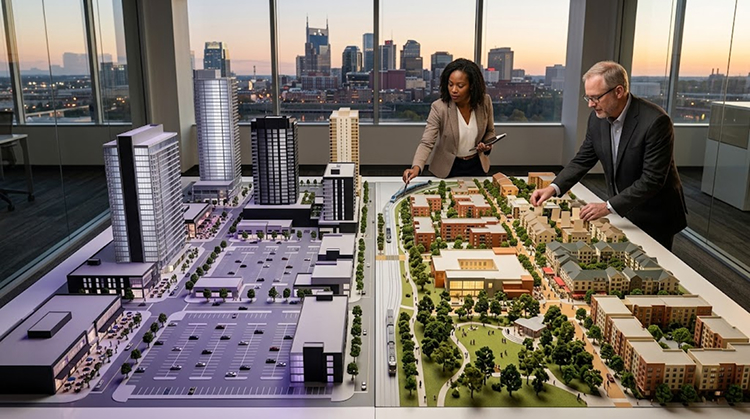
The stadium therefore becomes part of a much larger question: can Nashville build an economically productive district without creating another high-cost enclave?
The Stadium Could Still Become A Major Sports Tourism Asset
Affordable housing does not diminish the commercial ambitions of the new Nissan Stadium.
The Titans expect the venue to host NFL games, concerts, TSU football and other major events. Team executives have also discussed the possibility of bringing major NFL events to Nashville once the new building has established itself. The stadium is scheduled for completion in early 2027, with the Titans expected to begin playing there during the 2027 season.
That creates substantial potential for sports tourism.
Major events can increase hotel demand, restaurant spending, transportation activity and visitor traffic across an entire metropolitan area. Nashville already has an established tourism economy and a globally recognized entertainment industry, giving the stadium a market that extends well beyond Titans football.
The economic-development challenge is making sure those visitor dollars circulate beyond the stadium itself.
Hotels, restaurants, retailers, transportation providers, event contractors and local entertainment businesses all have opportunities to participate. A successful East Bank district could connect stadium visitors with nearby neighborhoods, downtown attractions and riverfront destinations.
That is where Nashville’s affordable housing strategy becomes relevant to sports tourism. A neighborhood with permanent residents, local businesses, childcare, parks and public transportation is more likely to remain active between major events than a district dominated by surface parking and event-specific development.
The city is also planning significant public-space improvements. A new River North greenway opened in September 2026 as part of a broader plan to expand connections and eventually introduce 118 acres of parks within the East Bank development area.
The combination of housing, parks, entertainment and sports facilities creates a more diversified economic base.
Nashville Is Testing Whether Sports Infrastructure Can Deliver A Social Return
The most interesting aspect of Nashville’s strategy is that affordable housing was established as a condition of the surrounding development rather than added after the stadium district was already established.
That changes the definition of a successful sports project.
For decades, the debate around professional stadiums has focused heavily on attendance, construction costs, tax revenue, tourism and event bookings. Those measurements remain important, but they do not capture whether a project strengthens the city’s housing supply or improves everyday quality of life.
Nashville’s approach introduces additional measurements.
How many affordable homes remain available after several decades? How many residents live within walking distance of jobs and services? How much retail activity is generated by permanent residents rather than event visitors? Do public transportation improvements reduce car dependency? Do surrounding neighborhoods benefit from the investment?
These questions could ultimately matter as much as the number of Super Bowls or concerts secured by the new stadium.
The Titans project also demonstrates why sports tourism and economic development increasingly overlap. A stadium can attract visitors, but the surrounding land-use strategy determines whether those visitors encounter a functioning neighborhood or simply an entertainment complex.
Nashville has an opportunity to create the former.
The East Bank Could Become A Model For Future Sports-Led Development
The East Bank is still under construction, so it is too early to declare the strategy successful.
Eastpoint Flats is an important first step, but 323 affordable units cannot resolve Nashville’s housing shortage by themselves. The broader redevelopment must still deliver the remaining housing commitments, infrastructure, parks, transportation connections and commercial development.
The financial scale also means Nashville will face years of scrutiny over whether public investment generates sufficient economic and community returns.
Still, the sequencing is significant.
By putting affordable housing first, Nashville is making a statement about what the East Bank should become before market pressures fully shape it. Instead of asking how a stadium can increase surrounding property values, the city is asking how rising investment can be structured so that more residents can remain part of the growth.
That may become the most important legacy of the $2.2 billion Titans stadium.
The new Nissan Stadium will eventually host NFL games, concerts and major sporting events. Those events can bring visitors and spending to Nashville. But the long-term economic-development test will take place outside the stadium, in the homes, businesses, parks, streets and public spaces that surround it.
If Nashville can combine major-event infrastructure with long-term affordability, accessible transportation and mixed-use development, the East Bank could offer a stronger model for sports-led urban redevelopment—one where the economic value of a stadium is measured by the quality of the neighborhood it helps create.
