
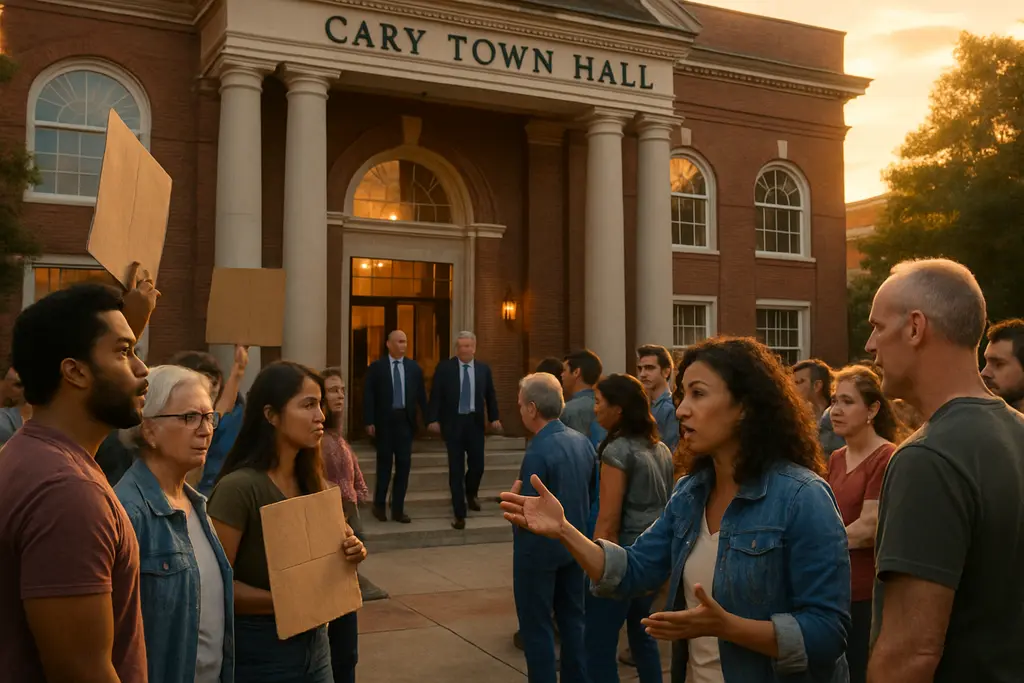
The Cary data center moratorium approved by the Cary Town Council on August 28, 2026, put an immediate 18-month pause on data center development inside town limits while staff study how these projects should fit into local land-use and infrastructure plans. The council approved the measure unanimously, and WRAL reported that no pending data center applications were affected at the time of adoption WRAL reported.
For Cary residents, employers and property owners, the decision is not simply about one type of technology facility. It is a planning decision about electricity demand, water use, noise, vibration, site design and buffers before projects reach the permit stage. The pause gives the town a fixed window to decide what standards should apply before larger proposals arrive.
Cary data center moratorium Timeline And Civic Process
What The Cary data center moratorium Covers
The moratorium began immediately after the August 28, 2026, vote and is scheduled to expire in February 2028, according to the WRAL report. During that period, Cary staff are expected to review land-use rules, power needs, water consumption, noise and vibration concerns, site design and buffering. Those categories matter because large data processing facilities can place demands on utilities and nearby properties in ways that differ from many office, retail or light industrial uses.
The town’s action also includes exemptions. WRAL reported that “enterprise, small-scale, collocated data processing equipment” remains exempt if it draws less than one megawatt of power. That means smaller server rooms located inside offices, hospitals or similar buildings are not treated the same as larger stand-alone facilities during the pause. For business owners, that distinction is significant because ordinary internal technology infrastructure can continue under the exemption described in the public reporting.
The Cary data center moratorium also applies to cryptocurrency mining operations and other high-impact data processing facilities, according to the public meeting record. The meeting record lists a planning path that includes a first draft of permanent rules in October 2027, Planning and Zoning Board review in December 2027, and a final council decision in February 2028 NC Govwatch meeting record.
Why The Schedule Matters
The schedule gives the public several points to follow. A draft ordinance in October 2027 would show how staff propose to define facilities, set review standards and place limits or conditions on future projects. Planning and Zoning Board review in December 2027 would provide another public step before the Cary Town Council considers final action in February 2028.
That sequence matters for civic engagement because residents and businesses will not have to wait until the final council vote to understand the direction of the rules. If the town follows the schedule listed in the meeting record, the most useful time for public comment may begin when the first draft is released in October 2027. Property owners, utility customers, nearby neighborhoods and business groups can then respond to specific text rather than broad ideas.
How The Cary data center moratorium Affects Infrastructure
Power, Water And Site Design Questions
Data centers are often discussed as economic development projects, but Cary’s decision places infrastructure capacity at the center of the local conversation. Based on the council action described in the cited reports, town staff will study power demand and water consumption before recommending permanent rules. Those two items affect more than the project site. They can shape utility planning, system upgrades, service reliability and the way costs are considered across the community.
Noise and vibration are also part of Cary’s review. Those concerns are especially relevant when high-intensity mechanical equipment operates near residential areas, schools, offices or other sensitive uses. The moratorium gives staff time to examine whether buffering, setbacks, building orientation, screening, equipment placement or operational standards should be written into local rules.
Site design is another practical issue. A large data processing facility may look different from a standard office building even if both are located in a commercial or employment district. Cary’s review period allows staff to consider how buildings, parking, service yards, generators, cooling equipment, stormwater systems and property edges should be handled before a project is filed.
What The Pause Does Not Decide
The moratorium does not, by itself, establish the final rules for data centers. It creates time for the town to write those rules. It also does not appear, based on WRAL’s reporting, to stop any already pending application, because no such applications were affected when the moratorium was adopted.
That distinction should reduce confusion for residents following the issue. The town has not approved a final permanent ordinance. It has approved a temporary pause while staff prepare one. The lasting policy decision is expected in February 2028, after the draft and board review steps listed in the meeting record.
What Residents And Businesses Should Track

Public Input Before February 2028
The practical question for Cary residents is how to stay involved without waiting until the end of the process. The October 2027 draft ordinance, if released as scheduled, should be the first key document to review. Residents will want to look for definitions, zoning districts, distance standards, noise limits, utility review requirements and how the rules distinguish between small internal server rooms and larger high-impact facilities.
Businesses should pay close attention to the one-megawatt exemption. Companies with internal data needs may want clarity on whether their equipment falls within the exempted category and whether any building, electrical or site permits remain necessary under other town codes. The cited reporting only establishes the moratorium exemption; it does not eliminate ordinary compliance obligations that may apply under separate rules.
Neighborhood groups may focus on buffering, sound, vibration, stormwater and traffic impacts. Utility customers may focus on how the town evaluates power and water capacity before approving large users. Developers and property owners may focus on which zoning districts remain available for future projects after the permanent ordinance is adopted.
Regional Civic Context
Cary’s vote reflects a local government taking time to match development review with infrastructure planning. The available records show a defined pause, a defined exemption and a planned path toward a permanent ordinance. For those interested in similar regional public-policy decisions, further related insights are shared by ITPR.
The town’s approach is pragmatic: pause new high-impact facilities, study the impacts, publish draft rules, send the issue through board review, and return to the council before the moratorium expires. That process gives stakeholders a clearer way to participate than a case-by-case debate after a major application is filed.
Cary data center moratorium And Local Planning
The Cary Town Council’s August 28, 2026, action gives the town until February 2028 to decide how large data processing facilities should be reviewed, where they may belong and what infrastructure standards should apply. The key civic value of the pause is timing. Cary is trying to answer utility, land-use and neighborhood compatibility questions before projects create pressure for quick decisions.
The next major point for public attention is the first draft of permanent regulations expected in October 2027. That document should show whether Cary plans to rely on zoning limits, performance standards, utility review, buffering rules or some combination of those tools. The Planning and Zoning Board review expected in December 2027 will then give the community another chance to evaluate the proposal before the council’s planned February 2028 decision.
For residents, the most useful step is to track the draft ordinance and compare it with the issues the council directed staff to study: power demand, water consumption, noise, vibration, site design and buffering. For local businesses, the central question is whether the final rules provide enough clarity for ordinary internal technology needs while setting expectations for larger facilities. For Cary as a whole, the moratorium is a planning checkpoint before infrastructure commitments are made.
