
A vacant casino property in Henderson, Nevada, could soon become something fundamentally different: a sports-centered destination designed around youth tournaments, hospitality, dining, retail, entertainment, and community recreation.
The City of Henderson announced in September 2026 that it had reached an agreement with Agora Realty & Management Inc. for the purchase and redevelopment of the former Fiesta Henderson site. The 35-acre property is planned to become a mixed-use destination anchored by an indoor sports fieldhouse, with a hotel, commercial space, restaurants, retail, employment opportunities, and public gathering areas forming the broader development. Agora has agreed to purchase the property for $30 million and fund construction of the indoor fieldhouse.
The proposal is significant because the property has been vacant since the former Fiesta Henderson hotel-casino closed during the pandemic. Instead of rebuilding another casino, Henderson is pursuing a redevelopment model centered on sports and community activity.
That shift could give the site a different economic role within Southern Nevada.
The project also illustrates how cities are increasingly using sports facilities to reactivate underused properties. Rather than treating a sports complex as an isolated venue, Henderson’s plan places the facility inside a larger commercial ecosystem where tournament visitors, residents, families, hotel guests, restaurant customers, and local businesses can interact throughout the year.
A Former Casino Property Is Being Repositioned Around Sports
The Fiesta Henderson property has a long history as one of Henderson’s major commercial sites.
Station Casinos closed the property during the COVID-19 pandemic and later announced that Fiesta Henderson would not reopen. Henderson subsequently purchased the site from Station Casinos in December 2022 for $32 million through its Redevelopment Agency. The purchase included $30 million in redevelopment funds and $2 million from the city’s General Fund.
The city’s original objective was already connected to sports.
When Henderson approved the acquisition in 2022, officials described plans for a multi-use indoor community sports facility intended to provide year-round recreation while attracting regional and national tournaments.
The latest agreement with Agora represents the next stage of that strategy.
Under the proposed arrangement, the city would sell the property to Agora for $30 million. The developer would then take responsibility for constructing, managing, and operating the indoor fieldhouse, along with developing the surrounding commercial components.
That structure changes the city’s role.
Rather than directly constructing and operating the entire sports facility, Henderson would transfer the property to a private developer while retaining an economic-development objective for the site. The city can therefore use the redevelopment to address a vacant property while shifting construction and operating responsibilities to Agora.
For a municipality dealing with an underused major property, that can be an important distinction.
The project also sits in a strategically important location near Lake Mead Parkway and Interstate 11, close to the gateway into Downtown Henderson. The city has described the property as a priority redevelopment opportunity because of its location and potential to attract investment into an established part of the community.
The Indoor Fieldhouse Could Become The Development’s Economic Anchor
The centerpiece of the proposed redevelopment is a substantial indoor sports facility.
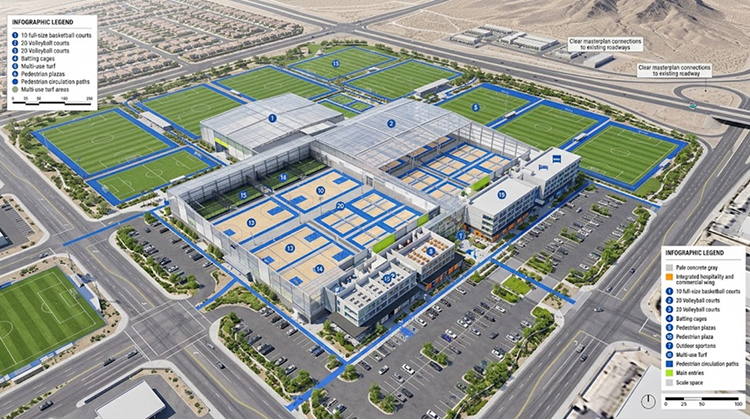
Current plans call for a 150,000-square-foot fieldhouse with 10 basketball courts, 20 volleyball courts, and approximately 10,000 square feet of batting cages. The broader concept also includes outdoor sports fields, creating a facility capable of supporting multiple sports and tournament formats.
That combination is important because tournament sports generate a different visitor pattern from professional sporting events.
A professional basketball game might attract thousands of spectators for a few hours. A youth volleyball or basketball tournament can bring athletes, parents, coaches, officials, and teams into a market for an entire weekend.
That creates demand for hotel rooms, restaurants, grocery stores, transportation, entertainment, and other services.
The proposed facility therefore has the potential to operate as a sports-tourism engine rather than simply a recreation center.
| Proposed Component | Planned Role |
|---|---|
| 150,000-square-foot fieldhouse | Indoor tournaments and recreation |
| 10 basketball courts | Basketball tournaments and community programs |
| 20 volleyball courts | Volleyball tournaments and competitions |
| 10,000-square-foot batting cages | Baseball and softball training |
| Outdoor sports fields | Additional tournaments and recreation |
| Hotel | Accommodates visiting athletes and families |
| Retail and restaurants | Captures visitor and resident spending |
| Office space | Adds employment and weekday activity |
| Public spaces | Supports gatherings and community events |
The scale also creates opportunities for events that extend beyond youth sports.
Agora CEO Cary Lefton described the proposed fieldhouse as a tournament-oriented facility designed around basketball, volleyball, and other scheduled community activities.
That flexibility matters because facilities with multiple sports and event configurations can maintain more consistent utilization throughout the calendar.
For Henderson, the economic question will therefore be less about how many people attend a single tournament and more about how many visitor nights and local spending occasions the facility can generate over an entire year.
The Hotel And Retail Components Could Multiply The Sports Impact
The fieldhouse is only one component of the redevelopment.
The current concept calls for a hotel, approximately 75,000 square feet of retail and restaurant space, roughly 30,000 square feet of office space, outdoor recreation, green spaces, and public plazas.
That combination is important because sports tourism works most effectively when visitors can spend money across multiple categories.
An athlete arriving for a weekend tournament needs somewhere to sleep. Families need restaurants. Teams may need meeting space. Visitors may look for entertainment between games. Coaches and tournament organizers can create additional demand for services and commercial space.
The development can capture more of that spending if those services are located directly within or adjacent to the sports destination.
This creates a different economic model from a standalone sports complex.
A standalone fieldhouse can generate tournament revenue, but much of the surrounding spending leaves the property. A mixed-use development gives the project an opportunity to capture some of that visitor economy through hotel rooms, restaurants, retail, entertainment, and office activity.
For Henderson’s broader business community, that could also increase the value of nearby commercial properties and established businesses.
The city’s Henderson Sport & Social fieldhouse project in West Henderson provides another example of how the municipality is expanding its sports infrastructure. That facility combines athletic courts and turf fields with food and beverage, flexible event space, and family entertainment, illustrating Henderson’s broader interest in making sports facilities destinations rather than single-purpose venues.
The former Fiesta property would take that strategy to a much larger scale.
Youth Sports Could Give Henderson A New Tourism Niche
Las Vegas is already one of the world’s most recognizable tourism destinations, but Henderson has increasingly developed its own identity within Southern Nevada.
A large tournament-oriented fieldhouse could strengthen that distinction.
Youth sports tourism is particularly attractive because visitors often travel in groups. A single athlete can bring parents, siblings, coaches, teammates, and other family members.
That creates a different visitor profile from conventional tourism.
A weekend tournament can generate repeated hotel nights and restaurant visits while also encouraging families to spend time outside the competition itself.
The location near major road infrastructure is another advantage. The site has access to Lake Mead Parkway and Interstate 11, giving tournament organizers and visitors direct connections to Henderson and the wider Las Vegas Valley.
The project’s location also means visitors could combine a tournament with attractions elsewhere in Southern Nevada.
That creates a potential regional tourism model rather than a purely local sports facility.
Henderson could market tournament packages that connect competition schedules with hotels, restaurants, entertainment, parks, and other attractions throughout the valley.
The result would be a sports destination that contributes to the broader tourism economy without needing to compete directly with the Las Vegas Strip.
Community Feedback Shaped The Development Strategy
One of the more significant aspects of the project is how the development concept emerged.
Henderson began community outreach regarding the future of the property in September 2023. Residents were asked what they wanted to see replace the vacant casino site.

The feedback included strong interest in an indoor recreation facility, gathering spaces, dining, retail, and new employment opportunities. The city says the proposed Agora development incorporates those priorities while allowing the private developer to assume responsibility for constructing and operating the fieldhouse.
That process matters because redevelopment of a former casino site could easily have focused exclusively on commercial return.
Instead, the proposed concept attempts to combine economic development with community amenities.
The challenge will be maintaining that balance as the project advances.
A sports facility designed primarily for large tournaments may generate substantial visitor spending, but residents also need access to recreation and public spaces. A hotel and retail district can increase economic activity, but its long-term value depends on whether it also integrates successfully with the surrounding community.
The city’s earlier redevelopment documents explicitly emphasized the need for public spaces and a destination that serves both residents and visitors.
That gives Henderson several measurable outcomes to track once the development begins.
These could include tournament attendance, hotel occupancy, visitor spending, local employment, retail leasing, facility utilization, resident participation, and the number of major tournaments attracted to the site.
For regional business organizations, Richland Chamber events provide a useful example of how business and community activity can be connected through programming rather than treated as separate functions.
The $30 Million Land Sale Changes The Public-Private Equation
The financial structure is one of the most interesting aspects of the redevelopment.
Henderson acquired the property for $32 million in 2022. Under the latest agreement, Agora would purchase the property for $30 million and assume responsibility for construction of the indoor fieldhouse and operation of the development.
The land sale therefore cannot be evaluated simply by comparing the $30 million sale price with the city’s earlier $32 million acquisition price.
The city used redevelopment resources to acquire a vacant property and prepare it for a future economic use. Agora is then expected to provide substantial private capital for construction and future development.
That means the potential public return could come through several channels beyond the land transaction itself.
New property activity can generate taxes and fees. New businesses can create employment. Hotel guests can contribute to tourism-related spending. Tournaments can attract visitors from outside Nevada. Existing businesses can benefit from additional demand.
The city has also emphasized that the redevelopment funds used for the original acquisition were legally designated for addressing blight and supporting economic investment within redevelopment areas rather than functioning as ordinary General Fund spending.
This distinction will matter as Henderson evaluates the project’s eventual performance.
A successful redevelopment should ultimately demonstrate that the public investment used to acquire and reposition the property helped unlock substantially greater private investment and economic activity.
That is the central test for the project.
The Former Casino Could Become A Regional Sports Tourism Connector
The most ambitious interpretation of the Fiesta Henderson redevelopment is that it could connect several economic sectors that are often developed separately.
Sports can bring visitors.
Hotels can keep those visitors in Henderson.
Restaurants and retail can capture their spending.
Public spaces can attract residents.
Office space can create weekday activity.
Outdoor recreation can expand the facility’s tournament calendar.
Entertainment can give families reasons to stay longer.
Together, these components can create a more resilient commercial destination than a single-purpose sports venue.
The concept also reflects a larger shift in American sports development.
Cities and private developers are increasingly looking for ways to turn sports facilities into mixed-use economic districts. Denver’s Ball Arena redevelopment, for example, combines an arena renovation with a much larger neighborhood development strategy. Henderson’s proposal approaches the same general challenge from a different starting point: instead of expanding an established professional sports district, it is using youth and amateur sports to reactivate a vacant commercial property.
That distinction could make Henderson’s model particularly interesting.
The project does not depend on an NBA or NHL franchise to generate its visitor base. Instead, its potential audience includes youth basketball players, volleyball teams, baseball and softball participants, families, coaches, tournaments, local residents, and other recreational users.
The result could be a destination whose economic calendar is driven by hundreds of smaller events rather than a limited number of major professional games.
Henderson Could Turn A Vacant Casino Into A Long-Term Economic Asset
The former Fiesta Henderson site represents a difficult redevelopment challenge that many American communities recognize.
A large commercial property closes. The buildings disappear or remain underused. The surrounding area loses an important source of activity. The municipality then has to determine how to reposition the land without recreating the conditions that contributed to the property’s decline.
Henderson’s answer is increasingly centered on sports.
The city purchased the property in 2022 with the stated objective of creating an indoor community sports facility. Four years later, it has reached an agreement with Agora Realty & Management for a 35-acre mixed-use destination anchored by a 150,000-square-foot indoor sports complex.
The proposed development still has important steps ahead. The purchase and development agreements must go before the Henderson City Council for consideration, meaning the September announcement represents an agreement and development plan rather than a completed project.
That makes the next phase especially important.
Henderson will have to translate a compelling concept into construction, tournament recruitment, hotel demand, commercial leasing, community access, and measurable economic activity.
If that happens, the site’s history could become part of its economic story rather than an obstacle.
The property that once depended on casino gaming could instead depend on basketball tournaments, volleyball competitions, youth sports, restaurants, hotel guests, family entertainment, retail customers, community events, and regional visitors.
That would represent a substantial change in how a former casino property contributes to the local economy.
For Henderson, the larger opportunity is therefore not simply replacing an empty site.
It is demonstrating that sports can serve as the anchor for a new type of regional destination—one where recreation, tourism, private investment, local business activity, and community development reinforce one another throughout the year.
