

Kansas City is moving forward with a proposed $2.05 billion Kansas City Royals ballpark project at Crown Center, but the size of the investment is only part of the story. The larger economic-development strategy involves an estimated $3 billion in surrounding investment, an 85-acre district, new infrastructure, public spaces, hospitality, entertainment and commercial development. The Royals have committed approximately $911.2 million, while public sources would provide roughly $1.14 billion, including a $600 million commitment from Kansas City. The structure is designed to use future tax revenue generated by the development to help finance today’s investment, making the project a significant test of how stadium financing can function as a broader urban-development tool.
The project would move the Royals from Kauffman Stadium in the Truman Sports Complex to a new downtown location near Crown Center and Washington Square Park. Construction is expected to begin in 2027, with the ballpark targeted for the 2030 MLB season. The stadium would contain roughly 1.2 million square feet and at least 30,000 seats, while the surrounding district would add restaurants, entertainment, public spaces and other development. The Royals downtown development plan frames the project as a partnership between baseball, Hallmark Cards and Kansas City’s broader redevelopment strategy.
The $2.05 Billion Project Is Larger Than A Baseball Stadium
The financing documents show why the Royals project is being discussed as a development strategy rather than simply a stadium replacement.
The proposed ballpark itself is expected to cost approximately $1.9 billion, including construction, infrastructure and related costs. When construction financing and other expenses are included, the stadium portion reaches approximately $2.05 billion. The Royals’ contribution is approximately $911.2 million, while public sources account for approximately $1.14 billion.
Kansas City’s commitment is fixed at $600 million. Approximately $510 million would be provided through city-supported bonds for the stadium and related facilities, while another $90 million would support infrastructure. The financing plan also identifies up to $381.9 million in reimbursable project costs through tax increment financing and related revenue mechanisms.
That distinction matters because the city’s $600 million commitment does not represent the entire public contribution to the project.
Missouri is expected to provide additional public support through its stadium financing program and other sources. Earlier project documents identified approximately $254 million through Missouri’s stadium funding program, $50 million in state tax credits, $35 million in additional state infrastructure funding and $100 million from the Missouri Department of Transportation, alongside other public sources.
The financing structure therefore combines team investment, city borrowing, state participation, tax incentives and future district-generated revenue.
That is fundamentally different from simply appropriating money for a stadium.
The Infrastructure Around The Ballpark May Matter As Much As The Venue
The proposed development includes approximately $422.7 million in infrastructure improvements within the primary redevelopment area.
According to the Economic Development Corporation of Kansas City, those improvements include streets, utilities, pedestrian paths, public plazas, traffic management, highway access, streetcar-stop upgrades and green infrastructure.
This changes the economic-development equation.
A stadium has a relatively specific function. Infrastructure serves a much broader population.
A new pedestrian connection can benefit workers and residents every day. Street improvements can make nearby commercial properties more accessible. Utility upgrades can support future construction. Public plazas can create space for events outside baseball season.
That is why the surrounding district is central to the project’s economic argument.
The Royals and Hallmark announced the broader 85-acre development in April 2026, describing a plan that would combine a new ballpark with mixed-use development and substantial private investment. The organizations said the surrounding development could represent $2 billion or more in private investment, while the full district has subsequently been estimated at approximately $3 billion in total investment.
For Kansas City, the objective is therefore broader than moving a baseball team closer to downtown.
The project is intended to create a new development node between established downtown districts and Crown Center.
Construction Could Generate 16,000 Jobs And $1.1 Billion In Labor Income
The employment projections provide another way to evaluate the scale of the project.
The TIF plan estimates approximately 16,000 construction jobs and $1.1 billion in labor income during the construction period. After completion, the stadium is projected to support approximately 2,275 permanent jobs, including full-time, part-time and seasonal positions.
The permanent employment figure requires some context.
Of the projected 2,275 positions, approximately 2,075 are existing team and stadium-support jobs that would be retained, while approximately 200 are expected to represent new Kansas City jobs.
That means the employment argument is not based entirely on creating thousands of entirely new positions.
Instead, the project combines job retention with construction employment and a smaller number of additional permanent positions.
The distinction is important for economic-development analysis because job retention and job creation have different implications.
Construction activity produces a temporary surge in employment and wages. A new downtown district could produce a longer-term employment base through restaurants, retail, hospitality, entertainment, offices and other businesses.
The long-term economic question is therefore whether the development surrounding the stadium produces enough activity to support employment beyond game days.
The Royals Are Also Taking On A Significant Private Share
The public financing discussion can sometimes obscure the size of the Royals’ own contribution.
The team has committed approximately $911.2 million toward the stadium project. That represents a substantial private investment and is one of the central components of the project’s financing structure.
The Royals are also entering into a long-term lease arrangement with Kansas City.
The framework approved by the City Council in August established a 30-year lease, with five optional two-year extensions. The team would be responsible for repair, maintenance, utilities and operations associated with the new facility. The city would also receive 5% of net profits from non-baseball events under the approved framework.
These provisions connect the team’s future obligations to the long-term operation of the facility.
The project also includes a Community Impact Partnership Agreement worth at least $55 million. The city says $24 million would be provided upfront, while at least $1.03 million annually would be contributed, with the annual amount adjusted by the Consumer Price Index. The agreement identifies funding for areas including housing and homelessness initiatives, the Negro Leagues Baseball Museum, Washington Square Park and arts-related activities.
For local businesses and civic organizations, these commitments could become part of the broader economic footprint of the development. Organizations such as the Richland Chamber business network demonstrate how business networks can help connect companies with broader regional development opportunities.
Kansas City Is Betting On A Year-Round District
A major challenge for any baseball-centered development is seasonality.
MLB teams play 81 home games each regular season, but a successful downtown district cannot rely on baseball alone to maintain activity.
Kansas City’s plan attempts to address this through restaurants, entertainment, public spaces, hospitality, offices and other uses surrounding the ballpark.
The city framework also gives the municipality a direct financial interest in non-baseball events through its share of net profits.
That creates an incentive for the stadium to operate as an entertainment venue beyond the baseball calendar.
Concerts, corporate events, festivals and other activities can generate visitor traffic during periods when the Royals are not playing.
The district’s location is also intended to strengthen connections between Crown Center, downtown, Union Station and nearby neighborhoods.
This is where the project begins to resemble a conventional mixed-use redevelopment rather than a traditional stadium construction program.
The stadium becomes the anchor.
The surrounding infrastructure and private development become the larger economic ecosystem.
Tax Increment Financing Is At The Center Of The Strategy
The most important financial mechanism is tax increment financing, or TIF.
Kansas City’s Downtown Stadium TIF Plan would use a portion of new tax revenue associated with the redevelopment area to help reimburse eligible project costs. The plan was recommended by the city’s Tax Increment Financing Commission on September 9, 2026, and subsequently moved to the City Council for consideration.
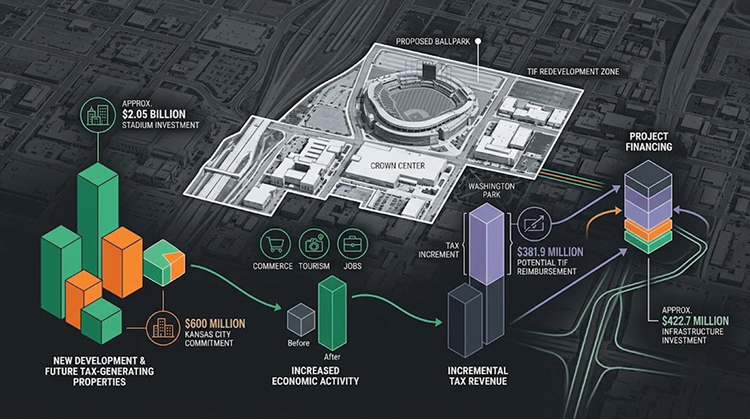
The mechanism works around a basic development assumption: a redeveloped property generates more economic activity and therefore more tax revenue than the area would have produced without the investment.
Under the proposed plan, up to $381.9 million in project costs could be reimbursed through the TIF structure, along with financing costs. The plan also anticipates additional economic activity taxes and Community Improvement District revenues.
Kansas City is also considering a new sales tax of up to 1% within portions of the district, with some of that revenue potentially supporting project costs. A separate mechanism would direct half of certain increases in sales and earnings taxes toward debt repayment for 23 years. Other city taxes could also contribute over a longer period.
The advantage of this approach is that the city attempts to connect repayment with economic activity created by the project.
The risk is equally straightforward: if the projected economic activity does not materialize at the expected level, the revenue stream available for debt repayment could be smaller than anticipated.
That makes the Royals project a useful case study in how municipalities are increasingly attempting to link stadium financing to measurable development performance.
New Construction Partners Signal A Shift Toward Implementation
The project moved another step toward implementation in September when the Royals announced their construction partners.
Mortenson and McCownGordon will serve as the construction manager-at-risk joint venture for the new ballpark, while JE Dunn will work on the surrounding 85-acre district. The proposed stadium is approximately 1.25 million square feet, with a planned capacity of roughly 34,000 seats in current renderings and project materials.
The current schedule calls for pre-construction activity followed by groundbreaking in May 2027. The project is expected to be substantially completed by December 2029, allowing the Royals to target their first home game at the new facility in March 2030.
Selecting experienced construction firms also illustrates the project’s local economic dimension.
Mortenson and McCownGordon will build the stadium, while Kansas City-based JE Dunn is involved with the surrounding development. That creates opportunities for regional contractors, suppliers, professional services companies and workers to participate in a multiyear construction program.
The economic impact therefore begins before the first pitch.
The Financing Model Creates A Clear Test For The District
Kansas City’s approach ultimately depends on whether the new district generates enough incremental economic activity to support the financing assumptions.
That creates several measurable benchmarks.
| Project Measure | Current Figure |
|---|---|
| Stadium project investment | Approximately $2.05 billion |
| Royals contribution | Approximately $911.2 million |
| Kansas City commitment | $600 million |
| Potential TIF reimbursement | Up to $381.9 million |
| Infrastructure improvements | Approximately $422.7 million |
| Broader district investment estimate | Approximately $3 billion |
| Construction employment | Approximately 16,000 jobs |
| Construction labor income | Approximately $1.1 billion |
| Permanent jobs | Approximately 2,275 |
| Community Impact Partnership | At least $55 million |
| Target opening | 2030 MLB season |
The most important measurements will emerge over time.
Kansas City can track property values, sales-tax collections, hotel activity, employment, business openings, pedestrian activity, residential development and private investment around Crown Center.
Those indicators can show whether the district is becoming a self-sustaining economic center or remaining heavily dependent on stadium-related activity.
The city’s financing structure makes those measurements especially important because future tax revenue is being incorporated into the repayment strategy.
Public Financing Concerns Are Part Of The Economic Equation
The financial structure has also generated scrutiny.
KCUR reported in September that Kansas City’s plan relies on revenue associated with the stadium and surrounding district to help repay approximately $510 million in city-supported bonds. If those revenues fall short, the city could face pressure to identify alternative resources for debt repayment because the Royals would not be responsible for repaying those bonds.
That is a key distinction between economic projections and financial guarantees.
The projected development activity can support the financing model, but projections cannot guarantee that actual revenue will match forecasts.
Supporters have emphasized the potential for infrastructure improvements, long-term development and job creation. Critics have raised questions about public exposure and whether the anticipated economic activity will justify the city’s financial commitment. Those positions represent different interpretations of the same underlying financing structure and should be evaluated against actual performance as the project develops.
The issue is therefore less about whether a stadium produces economic activity—it clearly can—and more about who captures that activity, who pays for the infrastructure and who carries the financial risk if projections fall short.
That distinction will matter long after the first game is played.
Crown Center Could Become The Real Economic Story
The most consequential part of Kansas City’s Royals project may eventually be the land surrounding the stadium.
A baseball team plays roughly 81 regular-season home games. A mixed-use district operates every day.
If the redevelopment successfully attracts restaurants, hotels, offices, housing, entertainment, retail and public events, the economic footprint could extend well beyond the baseball calendar.
That is the central premise behind the $3 billion district strategy.
The stadium provides a powerful anchor capable of attracting visitors and investment. Infrastructure improves access. Public spaces increase pedestrian activity. Private development adds additional economic uses. Tax revenue generated by that activity can then support portions of the public financing structure.
Each component is connected.
Kansas City’s experience could therefore become relevant to other cities evaluating major sports investments. Rather than treating stadium financing as a standalone question, municipalities may increasingly examine whether the venue can be integrated into a larger development plan with measurable infrastructure, employment, business and tourism objectives.
The Royals project is particularly significant because it places that strategy directly in the downtown environment.
The ultimate measure will not be the size of the stadium or the number of baseball games it hosts.
It will be whether Crown Center becomes a stronger economic district because the stadium was built there—and whether the public investment produces infrastructure, businesses, jobs and tax activity that remain valuable throughout the 2030s and beyond.
