
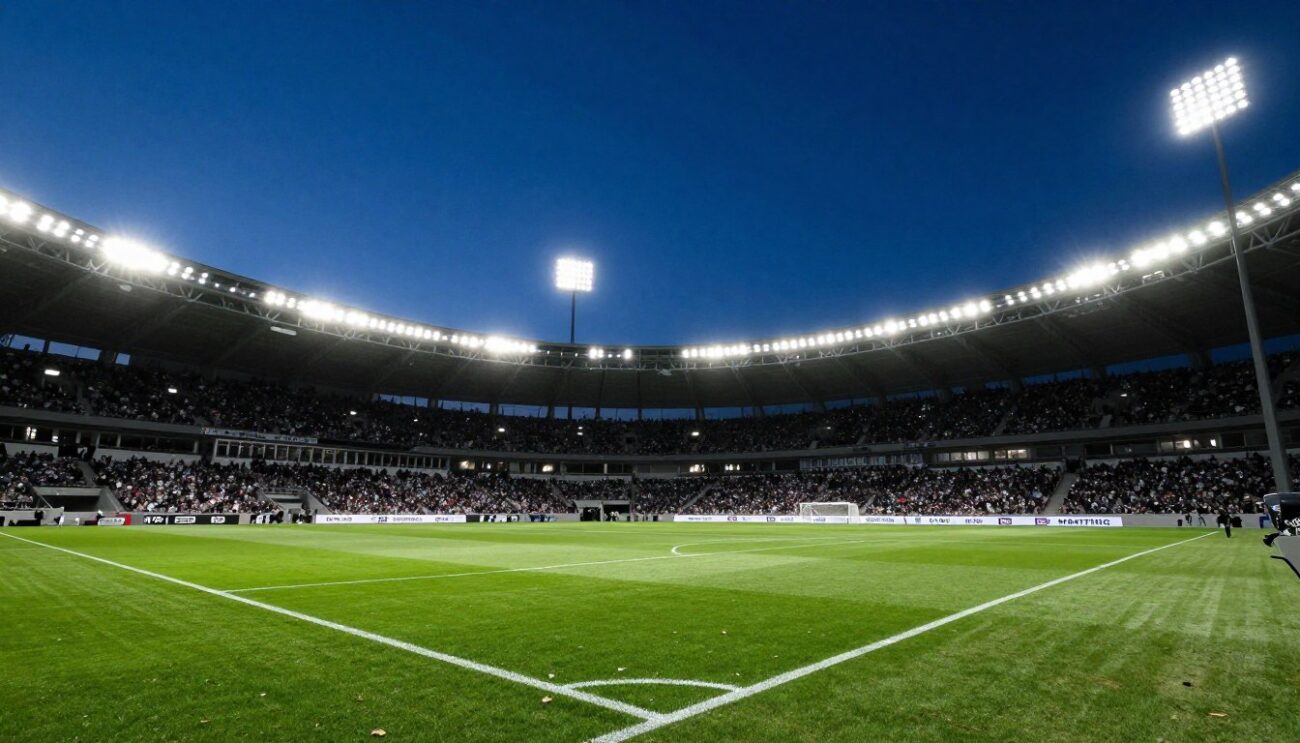
Modern sports venues are more than just places to watch games. They offer an experience for fans everywhere. The right lighting is key for player safety and performance. It’s also essential for clear HD TV broadcasts.
Professional sports have strict lighting standards. These are measured in footcandles (fc). The Illuminating Engineering Society (IES) sets these rules. For example, a top soccer match needs much more light than a casual game.
FIFA, soccer’s top governing body, demands at least 110 footcandles for pro games. A local park might have only 20. This shows why a detailed plan is vital for any venue project.
Meeting these high standards requires modern tech. LED sports lighting is the answer. It offers the quality and consistency HD cameras and athletes need.
Glare, Spill, and Community Impact
Glare and light spill are more than just technical issues. They can lead to conflicts between sports facilities and their communities. A modern venue’s lighting system must consider environmental and social responsibilities.
It’s important to know three key terms in any lighting design:
- Glare: Too much brightness that causes eye strain for players, officials, and fans.
- Spill Light: Light that goes beyond the playing field, unwanted.
- Sky Glow: Brightening of the night sky, often seen as an orange haze.
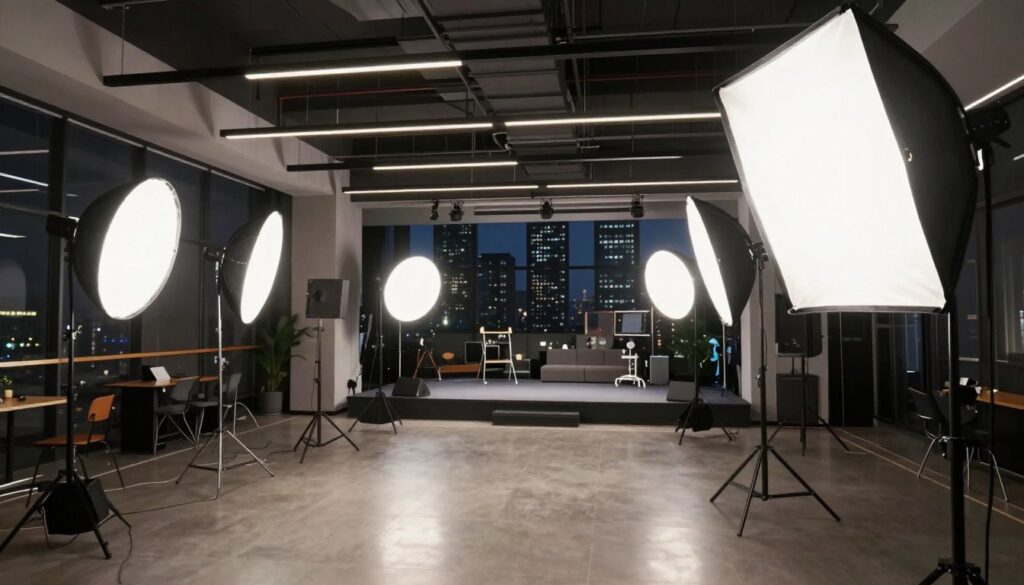
Poor glare management ruins the stadium experience. Fans have trouble seeing, and players miss important cues. Spill light and sky glow affect areas far beyond the stadium.
Unwanted light can disturb nearby homes and businesses. It can harm local wildlife and break light pollution laws. These problems quickly turn into regulatory issues and community disputes.
Advanced LED sports lighting offers a solution. It uses precise optics to direct light exactly where needed. This reduces spill and sky glow and minimizes glare for better viewing.
This technology respects the environment and follows local rules. It also helps with broadcast standards. Uncontrolled light is a camera operator’s worst enemy. It ruins images and forces constant adjustments.
Good lighting design is key to community relations. It shows a venue cares about its neighbors. This positive image boosts attendance and supports long-term success.
Broadcast Color Rendering and Flicker-Free Specs
Good stadium lights and top-notch broadcast illumination differ in two key areas: color rendering and flicker. For any venue hosting televised games, meeting broadcast standards is a must. The lighting should make the game look alive and vibrant for viewers at home.
Color accuracy is measured by the Color Rendering Index, or CRI. This score shows how well a light source shows colors. A high CRI is key for HD TV. It makes sure a team’s red jerseys look red, the green turf looks green, and players’ skin tones look natural. Without it, colors can appear washed out or odd on camera.
For sports broadcasting, the Television Lighting Consistency Index (TLCI) is used. TLCI predicts how lighting will look under TV cameras. Top LED sports lights, like the KL PROFILECOMPACT, score high: a CRI of 94.9 and a TLCI of 95. This means the colors on screen are true to life.
Old LED tech sometimes disrupted broadcast signals. But today’s tech has solved this issue. Modern systems deliver perfect color for TV without any signal problems.
Flicker is a big problem for high-quality video. It’s when light output changes quickly, even if you can’t see it. TV cameras, in slow-motion or high-speed replay, can catch this flicker. It causes bad strobe effects or dark bands on the screen, ruining the view.
Flicker-free operation is key for pro LED stadium lighting. These systems give steady, consistent light at all dimming levels. They match global camera shutter speeds to get rid of any banding or strobing. This makes sure the footage is smooth and clean, no matter how many times it’s replayed.
| Metric | What It Measures | Why It Matters for Broadcast | Target Score for Pro Events |
|---|---|---|---|
| CRI (Color Rendering Index) | Accuracy of color reproduction under the light | Makes uniforms, turf, and skin tones look natural on TV | >90 (90+ is excellent) |
| TLCI (Television Lighting Consistency Index) | How lighting will perform for TV camera color reproduction | Directly predicts on-screen color quality for broadcast | >90 (90+ is excellent) |
| Flicker Percentage | The amount of rapid fluctuation in light output | Prevents strobe effects and banding in slow-motion footage | |
| Color Temperature Consistency | Uniformity of light color (e.g., 5000K) across all fixtures | Ensures a consistent, neutral white balance for cameras across the entire field | Minimal variance (±100K) |
To meet all essential broadcast standards, your lighting system must excel in these areas:
- High CRI & TLCI Ratings: For perfect color fidelity on camera.
- Flicker-Free Design: Certified performance across all dimming levels to protect video quality.
- Precise Color Temperature Control: Uniform white light that cameras can easily balance.
Investing in lighting with these specs is an investment in your venue’s professional image. It delivers the stunning visual quality that networks, fans, and sponsors expect from a major televised event.
Controls, Zoning, and Energy Savings
Smart controls and zoning in LED stadium lights boost efficiency and cut energy use. This smart setup turns your lights into a dynamic, programmable asset.
Zoning is a key feature. It lets you group lights to fit your field’s layout. You can brighten areas like the infield or penalty area. The outfield or running track can have slightly less light, saving energy.
Modern control systems offer detailed control over each light. You can dim lights or set schedules from a computer or mobile. This allows for cool pre-game shows or community-friendly settings.

Instant-on capability saves a lot of energy. Unlike old metal halide lamps, LED sports lighting turns on fast. LEDs use 40-75% less energy and work well at any power level.
| Feature | Traditional Metal Halide Lighting | Modern LED Sports Lighting |
|---|---|---|
| Start-up Time | 15-20 minute warm-up to full brightness | Instant on at full brightness |
| Dimming Capability | Limited or none; often requires special gear | Fully dimmable from 0% to 100% |
| Operational Control | Basic on/off per circuit; manual overrides | Individual fixture control, zoning, automated schedules |
| Typical Lifespan | 10,000 – 15,000 hours | 50,000 – 100,000 hours |
| Typical Lifespan | High wattage consumption; energy wasted during warm-up | 40-75% less energy for equivalent light |
LEDs last a long time, often over 50,000 hours. This means less maintenance and lower costs. With smart controls and efficient tech, LED sports lighting is a smart investment.
Commissioning and Testing Checklist
The final phase of your LED sports lighting project turns design into real action. Commissioning checks if everything works as planned.
Check the light levels and how even they are across the field. This makes sure the field is safe and good for playing.
Measure the Color Rendering Index (CRI) and correlated color temperature (CCT) right on the field. Tools like the Konica Minolta CL-200A Chromaticity Meter give exact data. This confirms the colors are right for TV broadcasts.
Test the control system’s zones and dimming for all scenes. Make sure there’s no flicker when cameras capture it. A detailed control system commissioning checklist helps a lot.
Do a final check at night. Make sure there’s no glare or light spill that could bother the community.
Good commissioning means your LED sports lighting works great, is safe, and saves energy for a long time.
