
San Francisco has received another major sporting-event opportunity at a moment when the city is trying to turn renewed visitor activity into a broader downtown recovery. On August 14, 2026, Major League Baseball announced that Oracle Park will host the 2028 MLB All-Star Game, bringing the Midsummer Classic back to San Francisco for the first time since 2007. The game is scheduled for July 12, 2028, making it the fourth All-Star Game hosted by San Francisco since the Giants moved to the city. For readers interested in the broader sports-entertainment landscape, Why pick Heritage Sports offers additional context on the sports market surrounding major events.
The timing is significant. San Francisco is already experiencing a stronger tourism cycle, while city officials and private organizations are investing in downtown programming, public spaces, safety, business development and waterfront improvements. The 2028 All-Star Game therefore arrives less as an isolated sporting attraction and more as another potential catalyst in an ongoing urban recovery strategy.
The opportunity is substantial. San Francisco Travel projects 24.2 million visitors and $9.9 billion in visitor spending in 2026, surpassing the city’s pre-pandemic visitor-spending record of $9.6 billion in 2019. In 2025, tourism generated $655 million in city tax revenue and supported approximately 63,900 jobs.
The challenge will be converting a week of baseball attention into something that lasts well beyond the final All-Star pitch.
San Francisco Is Entering The All-Star Game From A Stronger Tourism Position
The 2028 event is arriving while San Francisco’s visitor economy is already moving in a more positive direction.
San Francisco Travel’s latest forecast projects visitor spending to reach $9.9 billion in 2026, while hotel occupancy is expected to reach 69%. The organization also forecasts 38 Moscone Center events generating more than 674,000 hotel room nights during the year.
That matters because major sporting events are most valuable when they reinforce an existing tourism ecosystem rather than operate as isolated attractions.
A baseball fan traveling to San Francisco for All-Star Week can potentially spend money on hotels, restaurants, public transportation, museums, retail, nightlife and other attractions. The city can also use the event to introduce visitors to neighborhoods outside the immediate Oracle Park area.
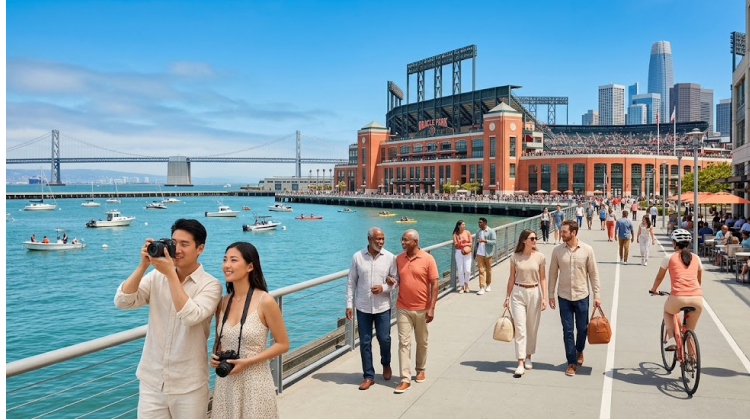
The Giants’ waterfront stadium is particularly well positioned for this strategy. Oracle Park sits at the southern edge of the downtown core, adjacent to Mission Bay and the Embarcadero, with direct connections to the city’s broader visitor economy.
The San Francisco tourism economy therefore provides a foundation that many host cities would like to have before receiving a major sporting event.
The 2028 All-Star Game can build on that foundation if city officials treat the event as a citywide activation opportunity rather than simply a baseball game.
Oracle Park Gives MLB A Built-In Waterfront Destination
Oracle Park is one of the strongest physical assets in San Francisco’s sports-tourism portfolio.
The stadium sits directly along McCovey Cove and the San Francisco Bay, giving television audiences an instantly recognizable backdrop. That visual identity has commercial value because the destination becomes part of the event’s broadcast.
The 2025 NBA All-Star Game provides a useful comparison. A study commissioned by the Golden State Warriors found that the event generated $328.2 million in economic impact across the San Francisco Bay Area, with 142,881 attendees traveling from 40 states and 44 countries. The event also produced an estimated $101.1 million in earned media value.
The lesson is important for the Giants and city officials.
The economic impact does not come only from people sitting inside the arena or stadium.
It comes from everything surrounding the event.
Hotels benefit from visitors staying multiple nights. Restaurants receive additional customers. Retailers gain exposure. Public transportation carries more passengers. Attractions receive visitors who might otherwise have chosen another destination.
The 2028 All-Star Game could replicate that pattern at a much larger citywide scale because All-Star Week typically includes activities beyond the game itself.
Downtown Revitalization Gives The Event A Larger Purpose
San Francisco’s downtown recovery is no longer being approached solely as an office-market problem.
City leaders increasingly want downtown to function as a mixed-use neighborhood where people work, live, visit, eat, shop and participate in cultural activities.
Mayor Daniel Lurie has made that objective central to his administration’s “Heart of the City” strategy. In July, the city approved the expansion and renewal of the Downtown SF Partnership Community Benefit District, increasing its privately funded annual operating budget from approximately $4.8 million to $11 million and expanding the district from 43 to 70 blocks to include the waterfront and Ferry Building area.
That geographic expansion is particularly relevant to the All-Star Game.
The new district connects areas that could benefit from large event traffic: downtown, the Embarcadero, the Ferry Building and public spaces closer to the waterfront.
Instead of concentrating visitors around Oracle Park, San Francisco can build an event corridor extending north through the waterfront and into the heart of downtown.
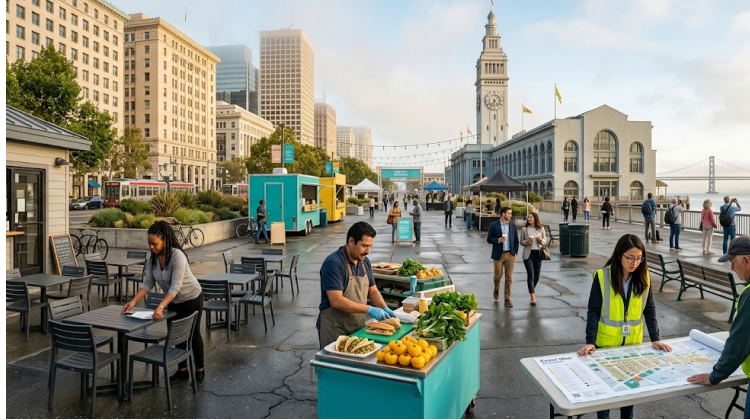
That creates a potentially valuable relationship between sports tourism and urban revitalization.
The City Already Has Evidence That Events Can Increase Downtown Activity
San Francisco does not have to wait until 2028 to test this strategy.
The city has already used major events to bring visitors back into downtown districts.
Following Super Bowl LX, Mayor Lurie announced that programming in Union Square would continue through summer 2027. The city described the initiative as part of its broader effort to increase foot traffic and economic activity downtown.
Another example is Downtown First Thursdays, which began in 2024 as a monthly activation designed to increase foot traffic, spending and civic activity.
According to organizers, the program has attracted more than 300,000 attendees since launch and generated a projected $27.9 million in spending at downtown businesses and locally owned vendors.
These programs offer an important lesson for 2028.
A major sporting event can create a temporary spike in visitors, but the stronger strategy is to connect that spike to permanent or recurring programming.
All-Star Week could therefore become one of several major moments in a broader calendar of downtown activity.
The Waterfront Could Become The Bridge Between Baseball And Downtown
One of San Francisco’s biggest advantages is geography.
Oracle Park is not isolated from downtown. It is part of a waterfront environment that already contains restaurants, residential development, parks, transportation connections and public spaces.
That gives city planners an opportunity to create a visitor experience that begins at the ballpark but continues into the city.
A fan attending an All-Star event could walk along the waterfront, visit the Ferry Building, continue toward Union Square, eat at a neighborhood restaurant and return to the stadium later.
That type of movement is exactly what downtown revitalization efforts need.
The San Francisco County Transportation Authority has identified changes in downtown travel patterns as one of the central challenges of the post-pandemic period, including lower transit use and increased private-vehicle travel.
At the same time, recent data show improvement in downtown transit activity. Average weekly BART exits at four core downtown stations reached approximately 330,547 in early 2026, up 22.8% from early 2024.
The 2028 All-Star Game could therefore become another real-world test of whether San Francisco can move large numbers of visitors between downtown, the waterfront and the stadium efficiently.
All-Star Week Could Spread Economic Activity Beyond Oracle Park
The strongest version of the event would not simply fill Oracle Park.
It would fill San Francisco.
That distinction matters.
Major sporting events can generate concentrated spending around stadium districts while leaving other neighborhoods largely untouched. San Francisco has the opportunity to avoid that pattern because of its dense visitor infrastructure.
The city already has an established network of restaurants, hotels, museums, cultural attractions and entertainment districts.
MLB’s announcement gives city officials nearly two years to create a citywide program around the July 12, 2028 game.
Potential programming could connect baseball to:
- Waterfront festivals and public-space activations.
- Baseball history and cultural exhibitions.
- Local restaurant promotions.
- Youth baseball and softball programs.
- Small-business events.
- Public viewing areas.
- Neighborhood arts and entertainment.
- Transportation incentives connecting major visitor districts.
The objective should be to make the All-Star Game feel like a San Francisco event, rather than simply an MLB event taking place in San Francisco.
International Visibility Could Be As Valuable As Direct Spending
San Francisco’s All-Star opportunity also extends beyond the people who physically attend.
Major League Baseball has a global audience, and San Francisco’s visual identity is particularly valuable in a broadcast environment.
Every shot of Oracle Park can potentially include the Bay Bridge, San Francisco Bay, the skyline or the waterfront.
That creates destination exposure.
The city experienced a similar effect during the 2025 NBA All-Star Game, when the Warriors’ commissioned economic study estimated more than $101 million in earned media value.
The important distinction is that earned media value is not the same as direct economic impact.
However, it can support long-term destination marketing by introducing potential visitors to a city without requiring San Francisco to purchase equivalent advertising space.
That makes the 2028 All-Star Game potentially valuable even for people who never attend a baseball event.
The Bigger Test Will Be What Remains After July 2028
The most important measure of the All-Star Game will not necessarily be attendance.
San Francisco should be asking what changes because the event happened.
Did hotel demand increase?
Did visitors stay longer?
Did downtown restaurants capture new customers?
Did public transportation handle the additional demand?
Did small businesses participate?
Did visitors explore areas outside Oracle Park?
Did international tourists return later?
Did new sports events choose San Francisco because the city demonstrated its capabilities?
These questions turn the All-Star Game into a measurable urban-development project.
| Potential All-Star Legacy Measure | What San Francisco Could Track |
|---|---|
| Visitor spending | Hotel, restaurant, retail and attraction spending |
| Downtown activity | Foot traffic and business activity |
| Transit performance | BART, Muni and waterfront transportation usage |
| Hotel demand | Occupancy, ADR and room nights |
| Local business participation | Contracts, sales and event-related revenue |
| International tourism | New international arrivals and repeat visits |
| Public-space activation | Attendance at citywide events |
| Long-term event pipeline | Future sports and convention bookings |
San Francisco already has the data infrastructure to track many of these indicators. The next step is connecting them directly to the All-Star Week strategy.
San Francisco’s Biggest Opportunity Is To Make The Event Repeatable
The 2028 MLB All-Star Game will last only a few days.
Downtown revitalization has to last decades.
That means the event should be treated as a catalyst rather than an endpoint.
If temporary public programming attracts visitors to a downtown plaza, city officials should determine whether the program can continue afterward.
If All-Star visitors discover a restaurant district, tourism organizations can market that district to future visitors.
If transit performs well under exceptional demand, that experience can inform future major-event planning.
If local businesses benefit from MLB-related spending, organizers can create procurement systems that remain available for other events.
This is how a sporting event becomes part of urban policy.
San Francisco’s recent recovery provides an unusually strong platform for this approach. The city is projected to surpass its previous visitor-spending record in 2026, downtown BART activity is improving, private investment in the downtown business district is increasing, and public programming is already being used to attract people back into the urban core.
The All-Star Game arrives in the middle of that transition.
Its success will depend less on whether San Francisco can fill Oracle Park—something the Giants and MLB are likely to accomplish—and more on whether the city can use the event to connect baseball, tourism, transportation, local business and downtown life.
The 2028 Midsummer Classic could ultimately become another high-profile moment in San Francisco’s recovery story. But the stronger opportunity is to make it part of a longer sequence of events that continually brings visitors, residents and investment back into the city’s core.
If San Francisco can accomplish that, the All-Star Game will represent more than a return of baseball’s biggest summer showcase.
It could become a practical test of whether major sporting events can help turn short-term visitor surges into long-term downtown revitalization.
