
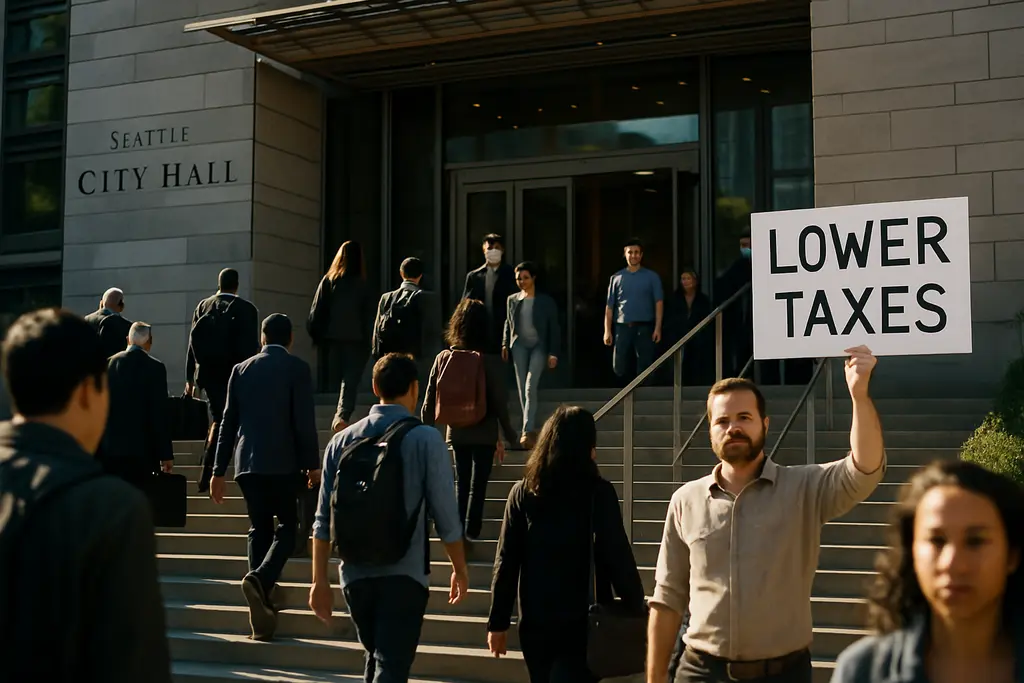
Seattle Business Taxes became a near-term City Hall issue on September 10, 2026, when the Seattle Metropolitan Chamber of Commerce urged Mayor Katie Wilson to avoid any new business taxes or regulations. The request was delivered at the Chamber’s annual meeting and came as Wilson was reported to be considering business tax proposals tied to a projected $175 million gap in Seattle’s 2027 budget, according to AM 1300 The ANSWER.
The Chamber’s message was not only about tax rates. It was a warning about how employers read policy signals from City Hall. Joe Nguyen, the Chamber’s president and chief executive, said companies have choices and that other regions are competing aggressively, according to the same report. That argument places Seattle’s budget discussion inside a local civic question: how the city funds services while keeping employers invested in Seattle neighborhoods, offices, storefronts, and job centers.
What Changed At Seattle City Hall
A Public Request To Mayor Wilson
The September 10 letter gave Seattle’s business community a clear position before the 2027 budget process moved further into public debate. The Chamber asked the mayor not to add new business taxes or new regulations. That request matters because Seattle’s budget decisions affect employers of different sizes, from large headquarters to small service firms that depend on predictable local costs.
The Chamber also said Seattle’s economic activity generates nearly 70% of the revenue that funds the city budget, according to the reported letter. That figure was used by the Chamber to argue that a larger burden on employers could weaken the same activity the city depends on for public services. The civic tension is direct: Seattle needs revenue for housing, homelessness response, transportation, education-related work, and public safety, but the Chamber is asking elected officials to consider whether new costs could reduce the tax base over time.
The Coalition Behind The Letter
The letter was not presented as a single-organization complaint. The same report listed business and civic leaders among the signers, including Microsoft Vice Chair Brad Smith, Starbucks CEO Brian Niccol, Costco CEO Ron Vachris, Nordstrom co-CEO Erik Nordstrom, and Alaska Air CEO Ben Minicucci. Their involvement signaled that the request came from major regional employers as well as the Chamber.
For residents, that coalition has practical meaning. Large employers influence commuting patterns, downtown foot traffic, supplier contracts, charitable giving, and hiring pipelines. Small businesses often feel the effects when major employers shift office space, hiring, or spending patterns. The Chamber’s argument is that business tax policy should be measured not only by expected revenue, but also by how it affects location decisions and private investment within the city.
Seattle Business Taxes As A Budget Flashpoint
Why Seattle Business Taxes Are Now A Budget Test
The projected $175 million 2027 budget gap is the policy pressure behind the current debate. If the city needs new revenue, business taxes may appear to be one available option. The Chamber’s request pushes back against that path by arguing that employers have already absorbed several rounds of new costs.
For the Chamber, Seattle Business Taxes are now a test of fiscal judgment. City leaders must decide whether to seek revenue from employers, cut or restructure spending, find other sources, or combine several approaches. Each option has tradeoffs. A revenue proposal may protect programs that residents use. A spending-only response may force difficult service decisions. A mixed approach may spread the impact but can be harder to explain to voters and employers.
The public value of the Chamber’s letter is that it gives residents a specific position to evaluate before budget votes occur. Instead of a general business climate concern, the Chamber has identified a policy request: no new business taxes or regulations as the city prepares for the 2027 fiscal year.
Prior Taxes Shape The Chamber’s Position
The Chamber pointed to earlier city tax actions it opposed or could not stop, including the JumpStart payroll tax, which took effect in 2021, and a tax to fund new affordable housing that took effect in 2025, according to the reported letter. Those examples explain why the Chamber is treating the 2027 budget conversation as part of a longer pattern rather than a one-time dispute.
That history is relevant for civic participation. Residents and business owners who speak at budget hearings will likely hear competing claims about service needs, employer costs, housing affordability, and Seattle’s ability to compete with nearby jurisdictions. The strongest public comments will be those that connect a proposed revenue source to measurable outcomes, neighborhood impacts, and likely consequences for hiring or services.
State Tax Concerns Add Regional Context
Business Groups Had Already Raised A 2026 Warning
The September request followed a broader 2026 pattern in which the Chamber and other business groups opposed new tax proposals at the state level. On March 10, 2026, the Chamber joined other organizations in opposing Washington’s first state-wide income tax, saying it would harm affordability, weaken economic competitiveness, and place pressure on small- and medium-sized businesses already facing rising state and local taxes, according to a Seattle Metro Chamber statement.
That state-level position helps explain the Chamber’s local message to Mayor Wilson. The organization is not treating Seattle’s 2027 budget gap in isolation. It is linking city policy to a broader cost environment for employers across Washington. Whether city officials accept that framing will become one of the central questions in the budget debate.
Accountability Is Likely To Be A Key Demand
The Chamber’s recent public positions emphasize accountability, clarity, and measurable results when governments consider new taxes or rules. That theme is likely to shape the Seattle debate because business groups are asking not just how much money City Hall needs, but what the money would buy and how residents would know whether it worked.
This is where civic engagement can be useful. Business owners, workers, neighborhood groups, and service providers can ask the same practical questions at council meetings, budget forums, and chamber events:
- Which city programs are tied to the projected 2027 shortfall?
- What revenue options are under consideration, and who would pay them?
- What outcomes would be measured if new revenue is approved?
- How would the city assess effects on hiring, small businesses, and commercial districts?
- What alternatives exist before a new tax or regulation is adopted?
Readers comparing how regional chambers discuss business costs and civic priorities can also follow Trinity Chamber, a related site within the same network.
What Local Businesses And Residents Should Watch

The Next Civic Step Is The Budget Process
The next step for residents is not to treat the Chamber letter as the end of the discussion. It is an opening position before the city’s budget process. Mayor Wilson’s budget choices and any later Seattle City Council action will determine whether new employer-focused revenue proposals move forward.
Local businesses should watch for the exact structure of any proposal. A payroll-style tax, a gross receipts measure, a fee, or a sector-specific regulation can affect firms in different ways. Residents should watch the spending side with equal care. If City Hall asks employers for more money, the public should expect clear explanations of the services being protected or expanded.
Neighborhood effects should also be part of the discussion. Downtown employers, industrial firms, neighborhood restaurants, retailers, professional services offices, and nonprofit partners do not experience city policy in the same way. A public process that captures those differences will give officials better information than a debate framed only around large companies.
Public Participation Can Shift The Terms
Seattle’s budget debate will be strongest if public testimony moves beyond broad support or opposition. Employers can provide data on hiring, leases, wages, and operating costs. Workers can explain how business location decisions affect commute times and job access. Service organizations can identify where city funding gaps are visible. Residents can ask whether proposed spending will produce results in their neighborhoods.
Seattle Business Taxes will remain a central phrase in the debate, but the bigger civic issue is how Seattle balances revenue needs with economic stability. The Chamber has made its request public. City officials now have to show how they will weigh that request against public service demands and the projected 2027 gap.
Seattle Business Taxes And The Mayor’s Budget Choice
The immediate civic value of the Seattle Business Taxes debate is that it gives residents a clear decision point to follow. Mayor Wilson has a reported budget gap to address, the Chamber has asked for no new business taxes or regulations, and major regional employers have attached their names to that request. The question for Seattle is not whether business should help fund public services; the Chamber’s own argument recognizes that economic activity already funds a large share of the city budget. The question is whether new taxes or rules would strengthen Seattle’s capacity to deliver services or weaken the employer base that supports that capacity.
For local businesses and residents, the practical task is to track the proposal details, demand clear outcomes, and participate before decisions are final. That is where civic engagement can turn a high-level chamber letter into a grounded public discussion about jobs, services, and the city’s fiscal direction.
