
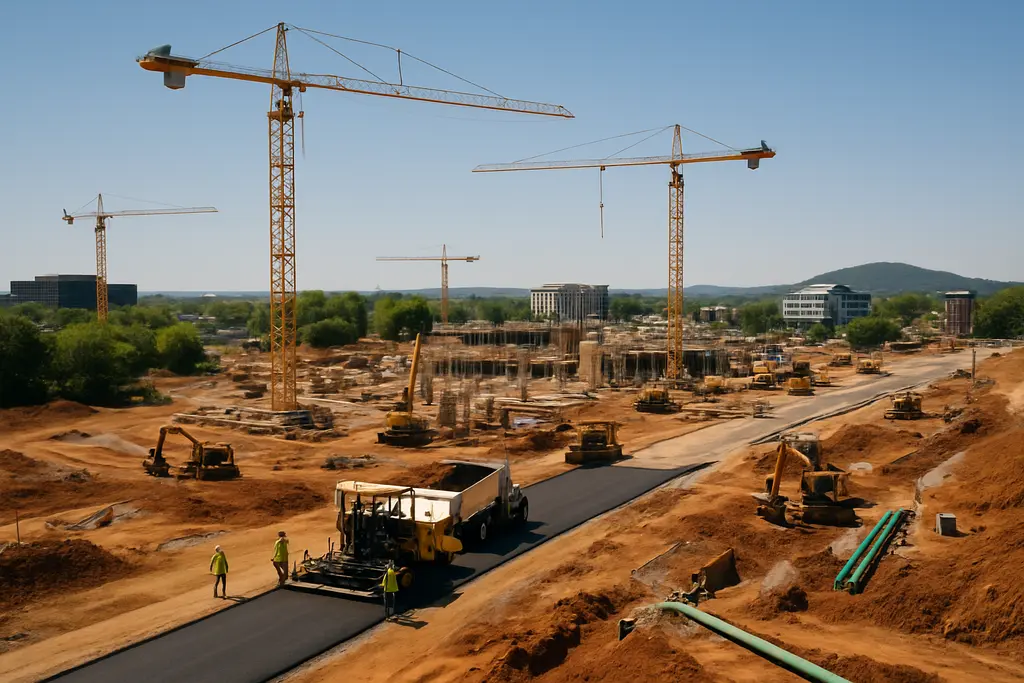
Huntsville TIF 8 moved into public view on September 10, 2026, when Huntsville city leaders outlined a proposed tax increment financing district in Limestone County tied to industrial growth west of the airport. The proposal covers about 9,091.82 acres north and south of Interstate 565 and includes the site of a major Eli Lilly & Company campus, according to the City of Huntsville.
The civic question now is practical: whether the city, Limestone County and local school interests can use future growth in property tax revenue to pay for roads, utilities, public safety and school capacity before the area becomes more strained by new development. The next formal steps are scheduled for October 2026, giving residents, business owners and public agencies a short window to study how the district would work.
Huntsville TIF 8 Infrastructure Plan
What The City Put On The Table
The proposed district is designed to fund an estimated $230 million in public infrastructure work, according to the City of Huntsville. City officials described the plan as a package of projects tied to transportation, utility service, land needs, fire protection and a new K-8 school in the Limestone County portion of Huntsville.
City materials identify 11 projects in the plan, with several large items carrying most of the estimated cost. The City of Huntsville listed Swancott Road widening at $50 million, County Line Road relocation and upgrades at $40 million, and a new K-8 school at $40 million. Other stated costs include $15 million for sewer expansion, $15 million for I-565 Exit 3 improvements, $10 million each for Pryor Road and Peoples Road, $22 million for land acquisition under the Major 21st Century Manufacturing Zone, and $5 million for Fire Station 18, according to the city’s September 10 project outline Huntsville project outline.
Those figures show why the district is being framed as more than a single-company incentive. The plan is tied to a fast-growing industrial corridor, but the listed projects involve public systems used by workers, families, emergency responders, school officials, utilities and freight movement.
Huntsville TIF 8 Vote Schedule
The proposal has not received final approval as of September 21, 2026. Axios reported that the Limestone County Commission is scheduled to vote on October 5, 2026, before a Huntsville City Council vote set for October 8, 2026 Axios Huntsville report.
That sequence matters because the district sits in Limestone County while being connected to Huntsville’s municipal growth strategy. County commissioners, city council members and school-related stakeholders are therefore part of the same public finance discussion, even if their roles differ.
If approved, Huntsville TIF 8 would put the infrastructure projects on a path to begin within five years, according to the City of Huntsville. That timeline is important for businesses planning sites, families watching school capacity, and residents who already use roads near I-565 and the airport area.
How The Financing Would Work
Growth Revenue, Not A Rate Increase
The City of Huntsville stated that the proposal is not a property tax rate increase. City materials also state that it would not divert existing revenues from city, county or school budgets. Instead, the district would capture incremental growth in property tax revenue that results from higher property values inside the district.
That distinction should be central to public discussion. A TIF district does not automatically create new money without development, rising assessed values and future collections. It depends on growth inside the boundary producing revenue above the current baseline. If that growth occurs, the increment can be used to pay for public improvements identified in the project plan.
For residents, the key issue is whether the expected growth is strong enough and timely enough to support the planned investments. For businesses, the issue is whether roads, sewer, fire service and access improvements can keep pace with industrial construction and employee movement. For school officials and families, the proposed K-8 school is likely to be one of the most visible parts of the plan.
Why The Baseline Matters
City officials have described the proposal as protecting existing revenue streams while using future gains within the district. That means the baseline property tax collections would remain available to current taxing bodies, based on the city’s description. The public finance bet is on the increase above that baseline.
This is also where public reporting should remain careful. The research available for this proposal identifies project costs, acreage, planned votes and the general financing mechanism. It does not provide a detailed public cash-flow model in the notes reviewed here. Until such a model is presented in full public detail, residents should treat the $230 million figure as the estimated infrastructure program, not as a guaranteed amount of revenue already collected.
Why The Industrial Area Matters

West Of The Airport
The proposed district covers land in Limestone County on both sides of Interstate 565, including an area west of the airport. City materials connect the district to industrial expansion, including the Eli Lilly & Company campus site. That location makes transportation and utility planning especially important because industrial projects can place heavy demands on roads, water, sewer, power coordination and emergency response.
Industrial growth can bring construction activity, permanent jobs and a larger tax base, but those benefits can be limited if infrastructure lags behind private investment. Roads that are adequate for rural or low-density use may not fit the traffic patterns created by large manufacturing sites, supplier traffic, shift changes and school transportation. The city’s project list reflects those concerns through road widening, road relocation, interchange work and sewer expansion.
The Fire Station 18 item also shows that public safety is part of the proposal. Industrial development can increase calls for service and create new response geography. A planned fire station, if built, would be part of the public-service capacity that supports both commercial growth and nearby residents.
Connection To Other TIF Discussions
The TIF 8 proposal follows other tax increment financing discussions in Huntsville during 2026. Research notes show that Huntsville earlier pursued a separate TIF 9 district covering about 3,688 to 3,700 acres in the downtown core, with about $220 million in infrastructure improvements tied to that district, including a $200 million Von Braun Center expansion. The same notes indicate that one projected outcome for TIF 9 was an estimated $15 million to $20 million annual increase in property tax collections because of higher property values within that district.
The downtown proposal and the Limestone County proposal are different in geography and purpose. One is tied to the downtown core and civic venue investment; the other is tied to industrial expansion and public infrastructure in the I-565 corridor. Still, taken together, they show how Huntsville leaders are using tax increment financing as a repeated tool for growth-related public works.
For regional readers interested in related developments, further insights can be found through other network outlets like Saint Joseph Detroit.
Huntsville TIF 8 Civic Questions
What Residents Can Watch Before The Votes
The most useful public discussion before October 5 and October 8 should focus on clear, local questions rather than slogans for or against growth. Residents and business owners can ask whether the project list matches the most urgent needs in the district, how school capacity would be coordinated, how road work would be phased, and how the public will be updated if revenue growth is slower or faster than expected.
- How will the city and county track incremental property tax revenue inside the district?
- Which projects would be started first if the district is approved?
- How will school planning be coordinated with industrial and residential growth?
- What public reporting will show project costs, schedules and changes over time?
- How will road work affect residents and businesses during construction?
Those questions are not barriers to development. They are the ordinary checks that make large public finance tools more understandable to taxpayers. A district of roughly 9,091.82 acres and an estimated $230 million infrastructure program deserves plain reporting, public updates and careful votes by the governments involved.
Huntsville TIF 8 now gives Limestone County, Huntsville officials, employers and residents a specific proposal to evaluate. The plan’s value will depend on whether the future tax growth materializes, whether projects are delivered in a practical order, and whether public agencies keep the community informed as the industrial area changes.
