
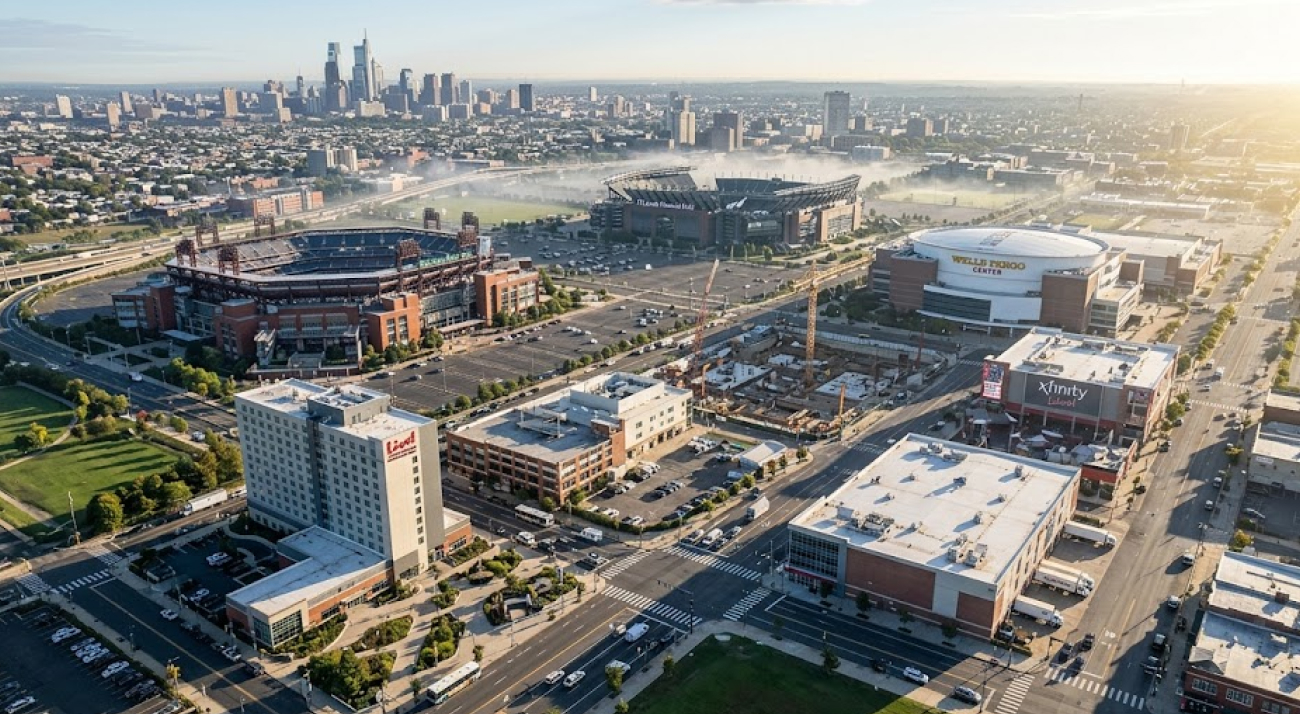
Philadelphia’s next major sports development is taking shape in a familiar location, but the economic strategy behind it is changing. On September 8, 2026, the Philadelphia 76ers and Philadelphia Flyers unveiled the first exterior renderings of a proposed new arena on the historic Spectrum site in South Philadelphia. The venue is scheduled to open in 2030 and is expected to become home to the 76ers, Flyers and Philadelphia’s future WNBA franchise.
The arena has been described as Philadelphia’s largest fully privately funded development project. Earlier plans placed the project at roughly $1.3 billion, although the latest announcement did not disclose a final construction cost. The teams now project that the development could create nearly 15,000 jobs and generate nearly $6 billion in economic activity over 10 years, along with hundreds of millions of dollars in new tax revenue for the city and School District of Philadelphia.
That makes the project more significant than a replacement venue for two professional teams. Its potential economic value depends on whether Philadelphia can turn an arena into a year-round destination that connects sports, entertainment, tourism, hospitality, restaurants, retail and surrounding development.
The question for the city is therefore not simply whether another arena can attract fans. It is whether the new facility can strengthen one of America’s largest sports districts while creating economic activity that reaches businesses and communities beyond the building itself.
South Philadelphia Already Has A Major Economic Engine
The new arena is entering an area that already generates substantial economic activity.
Philadelphia’s Sports Complex hosts more than eight million visitors annually across more than 300 events, according to Pennsylvania officials. A PFM Advisors analysis cited by the Commonwealth estimates that the complex generates approximately $2.3 billion in annual economic impact for Philadelphia, supports roughly 15,000 jobs, and contributes approximately $104 million in annual city fiscal impact. Statewide, the complex generates an estimated $2.5 billion in economic impact and supports approximately 16,000 jobs.
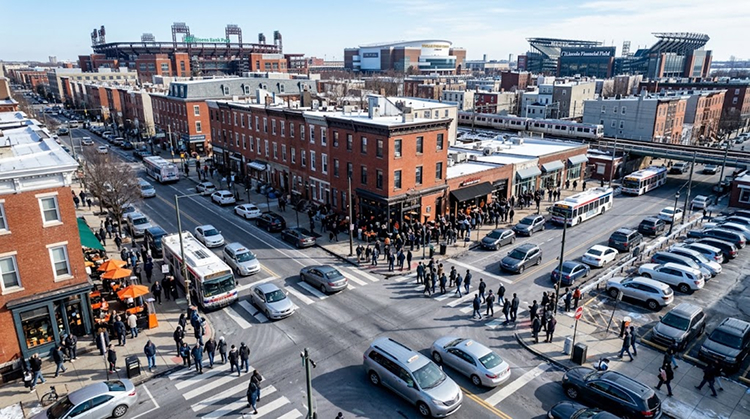
Those numbers provide important context for the new arena.
The project is not being built in an undeveloped part of Philadelphia that needs a single attraction to create an economy. It is being added to an established sports and entertainment district that already includes Lincoln Financial Field, Citizens Bank Park, the existing Xfinity Mobile Arena, Live! Casino & Hotel Philadelphia and other entertainment businesses.
That existing concentration gives the new arena an advantage. Visitors coming for a basketball game, hockey game or concert can potentially spend money at multiple businesses before and after an event rather than limiting their spending to the arena itself.
| Existing South Philadelphia Sports District | Current Economic Activity |
|---|---|
| Annual visitors | 8+ million |
| Annual events | 300+ |
| City economic impact | ~$2.3 billion |
| City fiscal impact | ~$104 million |
| Statewide economic impact | ~$2.5 billion |
| City jobs supported | ~15,000 |
The challenge will be converting that existing strength into additional activity rather than simply shifting spending from one venue to another.
That distinction will become central to judging the arena’s projected $6 billion impact.
The New Arena Could Add A Third Professional Sports Tenant
One of the most important developments is that the building will serve more than two established franchises.
The Philadelphia 76ers and Philadelphia Flyers will use the arena, while Philadelphia’s new WNBA team is also expected to make the venue its home. The building is also planned to host concerts, live entertainment and community programming.
That creates a much broader potential event calendar.
An NBA team generally provides a regular schedule from fall through spring. An NHL team adds another substantial schedule across the same portion of the year. A WNBA franchise creates additional programming during the summer, while concerts and other entertainment can fill dates between professional sporting events.
The result could be a venue with significantly more opportunities to bring visitors into South Philadelphia throughout the year.
This is especially relevant for restaurants, hotels, transportation providers and retail businesses. The economic value of a sports venue increases when visitor activity is spread across more dates rather than concentrated around a limited number of major games.
Philadelphia’s sports tourism economy could therefore gain from a venue that creates several overlapping visitor markets.
Basketball fans, hockey fans, WNBA supporters, concertgoers and tourists may have different travel patterns and spending habits. A diversified event calendar gives surrounding businesses more opportunities to capture that spending.
Transportation Could Determine How Much Economic Value The Arena Creates
The location also presents a significant infrastructure challenge.
South Philadelphia already attracts millions of visitors each year, creating traffic pressure around major events. Pennsylvania announced a nearly $30 million transportation and safety plan in May 2026 to improve access around the Sports Complex. The initiative includes a new I-76 westbound entrance ramp, traffic-management improvements, additional signage, new traffic signals and other infrastructure upgrades.
That investment is important because sports tourism depends on more than venue quality.
Visitors need to reach the destination efficiently, while residents and workers need reliable transportation during major events. If congestion becomes severe, some of the economic benefits generated by the arena can be offset by longer travel times, transportation costs and pressure on surrounding neighborhoods.
The Lower South Infrastructure & Resiliency Collaborative is attempting to address that problem by coordinating Philadelphia, PennDOT, SEPTA, the Navy Yard, PhilaPort, regional planning agencies, sports organizations and private-sector partners.
That regional approach could become one of the most valuable elements of the broader development strategy.
A new arena creates demand, but transportation infrastructure determines how effectively that demand can move through the local economy.
The $6 Billion Projection Needs To Be Viewed Carefully
The projected $6 billion in economic activity over 10 years is the figure most likely to attract attention, but it should be treated as a forecast rather than guaranteed revenue.
The teams say the project is expected to create nearly 15,000 jobs and hundreds of millions of dollars in new tax revenue for Philadelphia and the School District.
Those estimates can be valuable for understanding the potential scale of the project, but the eventual economic outcome will depend on several variables.
Construction activity will create an immediate economic boost. Once the arena opens, the longer-term effects will depend on attendance, event frequency, visitor origin, spending patterns, employment, hotel demand, restaurant activity and the performance of businesses surrounding the complex.
The most important measurement will therefore be incremental activity.
If visitors spend money at South Philadelphia restaurants that would not otherwise have received that business, the arena creates new economic value. If hotels attract travelers who would not otherwise visit Philadelphia, the tourism impact becomes more significant.
If spending simply shifts from another Philadelphia venue or entertainment district, the net economic gain is smaller.
This is why Philadelphia’s decision to conduct independent economic-impact research on its 2026 major events is particularly relevant.
In August, the Parker administration selected Epsilon Economics to analyze the economic and fiscal effects of Philadelphia’s FIFA World Cup, MLB All-Star Week, America250 celebrations, New Year’s Eve and other major events. The city said the study would look beyond headline figures and provide a more detailed assessment of economic and fiscal activity.
That same approach could eventually provide a useful framework for evaluating the arena.
A Historic Spectrum Site Is Being Reintroduced To The Economy
The location adds another layer to the project.
The arena is planned for the former Spectrum site, a property with deep significance in Philadelphia’s sports and entertainment history. The original Spectrum opened in 1967 and hosted the 76ers and Flyers for decades before closing in 2009.
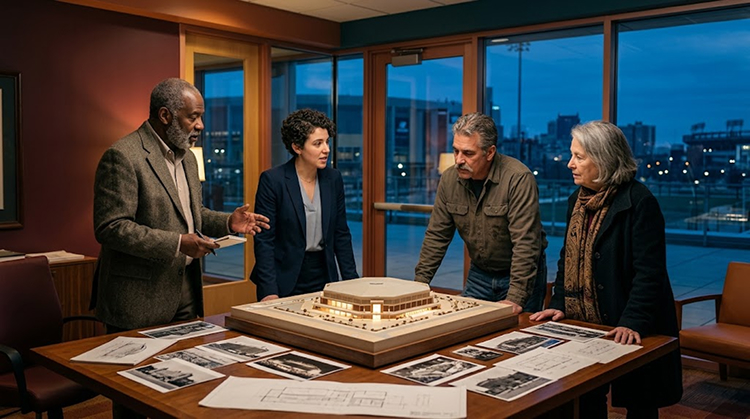
The new design intentionally references that history.
The exterior unveiled September 8 features stacked, cantilevered layers intended to break down the scale of the building, while the entrance includes a large staircase inspired in part by the Philadelphia Museum of Art. The plans also include more than half an acre of outdoor space, including public gathering areas, food and beverage spaces and fan plazas.
That design approach matters economically because the developers are attempting to make the arena’s exterior environment part of the destination.
A traditional arena can be active for several hours on event days and relatively quiet outside those periods. Public plazas, restaurants and outdoor gathering areas create opportunities for activity before events, after events and on days when there is no game.
The goal is similar to the broader mixed-use sports district model emerging in other American cities: make the venue a reason to visit the area rather than simply a place to enter for a ticketed event.
Private Financing Changes The Public Policy Conversation
Another defining feature is the project’s private funding structure.
The 76ers and Comcast Spectacor describe the arena as Philadelphia’s largest fully privately funded development project. The two organizations are partnering on the facility, with Comcast Spectacor representing the Flyers and Harris Blitzer Sports & Entertainment representing the 76ers.
That distinguishes the current proposal from many major American stadium projects in which local governments provide substantial direct construction subsidies or issue public debt.
Private financing does not eliminate public costs.
Philadelphia and Pennsylvania still have to address transportation, traffic management, public safety, infrastructure and surrounding development. Those investments can be justified when they support a larger economic district, but they should be measured against actual outcomes.
For Philadelphia, the most useful question is therefore whether public infrastructure spending helps unlock private investment and visitor spending that would otherwise not occur.
That creates a potentially stronger economic-development model than simply asking taxpayers to finance a new building.
Small Businesses Could Capture Part Of The Arena’s Growth
The arena’s economic value will ultimately depend on how broadly its spending circulates.
The project developers have emphasized opportunities for small and neighborhood businesses, while the surrounding district already contains restaurants, hotels, entertainment venues and retail operations. The teams specifically describe the arena as an economic catalyst intended to attract visitors and drive activity for small and neighborhood businesses.
That creates an opportunity for Philadelphia’s business community.
A visitor who spends $100 on a ticket is generating revenue for the venue and its operators. But a visitor who also spends $80 at a restaurant, $40 on transportation, $200 at a hotel and additional money at nearby stores creates a much wider economic footprint.
This is where chambers of commerce and local business organizations can play an important role in connecting independent businesses to major-event activity. For organizations following the economic-development side of sports, Richland Chamber’s business network offers a useful example of how business connections can support broader community participation.
Philadelphia could similarly benefit if local companies have clear opportunities to provide food, transportation, hospitality, construction, professional services and other products connected to the arena’s growing visitor economy.
The WNBA Could Expand Philadelphia’s Sports Calendar
The arrival of a WNBA franchise could also create a new economic opportunity that extends beyond the arena itself.
Philadelphia’s professional sports economy has traditionally been dominated by men’s leagues, with the Eagles, Phillies, Flyers and 76ers forming the city’s major professional sports core.
A WNBA team changes the seasonal mix.
The league’s summer schedule can bring professional basketball events into a period when the NBA is in its offseason. That creates additional opportunities for hotels, restaurants, retailers and entertainment businesses during a different portion of the year.
Philadelphia Mayor Cherelle Parker has already highlighted the potential of women’s professional basketball as part of the city’s broader sports strategy. Her March 2026 budget address referenced the future WNBA team and the potential to develop the Sports Complex into an entertainment destination capable of attracting visitors beyond individual games.
The economic importance of that strategy is straightforward: more event dates create more opportunities for visitor spending.
The larger question is whether Philadelphia can turn those events into repeat visitation and broader tourism activity.
The Arena Could Help Philadelphia Build A Year-Round Destination
The strongest case for the project is therefore broader than basketball or hockey.
Philadelphia already has the ingredients of a major sports-tourism destination. The Sports Complex attracts more than eight million visitors annually, while the city continues to host major international sporting events, concerts, conventions and cultural celebrations.
The new arena adds another venue to that ecosystem.
Its projected economic impact will be strongest if it increases the number of reasons visitors have to spend time in South Philadelphia rather than simply replacing an existing venue.
That means public spaces, restaurants, entertainment, transportation, hotels and complementary development become just as important as the arena bowl itself.
The strategy also fits a broader shift in American sports development. Cities are increasingly looking at professional sports facilities as anchors for mixed-use districts and visitor economies rather than isolated buildings.
Philadelphia has an opportunity to apply that model at a site with an established sports identity, existing transportation infrastructure and millions of annual visitors.
Philadelphia’s Arena Will Be Measured By What Happens Around It
The new arena’s headline numbers are impressive: an earlier $1.3 billion estimate, nearly 15,000 projected jobs, nearly $6 billion in projected economic activity over a decade, three professional sports tenants and a 2030 opening target.
But the more important story will be what happens outside the arena.
Philadelphia already has a sports district generating approximately $2.3 billion in annual city economic impact. The challenge is determining how much additional value a new venue can create on top of that existing base.
The answer will depend on whether the arena attracts new visitors, expands the city’s event calendar, supports surrounding businesses, creates additional employment, strengthens tourism and encourages further investment throughout Lower South Philadelphia.
The project also arrives at an important moment for Philadelphia’s approach to major events. The city’s decision to commission independent analysis of its 2026 event economy shows a growing willingness to examine the difference between projected impact and measurable results.
That same standard should eventually be applied to the new arena.
If the facility becomes a year-round destination that supports local businesses, attracts visitors and generates sustained tax revenue while expanding the economic role of South Philadelphia, the project could become a powerful example of privately funded sports infrastructure supporting public economic goals.
The real measure of the arena will not be the number of seats or the size of its opening-night crowd. It will be whether the development turns one historic sports site into a stronger economic district for Philadelphia throughout the 2030s.
