
The FIFA World Cup 2026 delivered a historic commercial opportunity for the United States, Canada, and Mexico, but the tournament’s long-term value will ultimately be judged by what remains after the matches are over.
For the 11 U.S. host cities, that question has become particularly important as local organizing committees begin transitioning from tournament operations toward legacy work. FIFA had promised $1 million in legacy funding for each host city, with the money intended to support community-oriented projects such as soccer facilities and mini-pitches.
As of August 2026, however, several U.S. host-city organizations have been seeking clarity over when those contributions will be delivered.
The dispute matters because $1 million may be relatively small compared with the billions of dollars associated with a global sporting event, but its significance is much larger at the neighborhood level. A million dollars can finance community sports infrastructure, upgrade public recreation spaces, support youth programming, or create facilities that remain available long after international fans have returned home.
The issue therefore raises a broader question about how America should evaluate the legacy promises attached to mega-events.
If host cities are expected to invest public money, personnel, transportation capacity, security resources, and infrastructure to stage global competitions, should event organizers be held to equally clear standards when they promise permanent community benefits?
The $1 Million Promise Has A Bigger Meaning Than Its Size
The reported legacy contribution was designed to leave something tangible behind in each host community.
That distinction is important because the economic impact of the World Cup was measured on a completely different scale.
The White House estimated that the 2026 FIFA World Cup could generate approximately $40.9 billion in gross output, $17.2 billion in U.S. GDP, and more than 185,000 jobs across the United States.
Against those numbers, $1 million per city can appear insignificant.
But comparing the figures misses the purpose of legacy investment.
A $1 million contribution does not need to compete with the overall economic impact of the tournament. It needs to produce a visible, lasting benefit in a community.
A new soccer mini-pitch in an underserved neighborhood can have value far beyond its construction cost. It can provide free recreational space, support youth programming, create a location for community events, and increase access to organized sports.
That is why the promised money has attracted attention from host-city organizations.
The White House FIFA 2026 overview provides the broader federal economic context for the tournament, including the scale of expected national investment and employment.
The legacy question operates at a much smaller level, but it is precisely where residents can see whether a global event translated into a permanent local asset.
Host Cities Already Carried Significant Costs
The legacy-funding dispute cannot be separated from the investments made by host cities themselves.
Cities spent years preparing for the tournament.
They expanded transportation operations, increased public-safety coordination, upgraded infrastructure, prepared fan zones, promoted tourism, and deployed city employees to accommodate an unprecedented number of international visitors.
Those investments were justified partly because of the expected economic benefits.
But host-city officials also had to manage the practical costs of bringing hundreds of thousands of additional people into their communities.
This creates an important distinction between economic impact and fiscal return.
A tournament can generate billions of dollars in economic activity while still requiring local governments to absorb substantial costs.
| World Cup Investment Area | Long-Term Relevance |
|---|---|
| Transportation | Greater capacity and event mobility |
| Public Safety | Emergency and crowd-management capabilities |
| Public Spaces | Fan zones and community gathering areas |
| Tourism Promotion | International destination exposure |
| Sports Facilities | Youth and community recreation |
| Small Business Support | Stronger local visitor economy |
Legacy funding therefore becomes one component of a much larger economic-development equation.
The question is not whether $1 million can compensate a city for everything it spent.
It cannot.
The question is whether FIFA’s promised contribution can help ensure that some of the tournament’s benefits remain visible at the community level.
Community Soccer Facilities Were Central To The Legacy Concept
The proposed legacy funding is particularly relevant because soccer infrastructure remains unevenly distributed across American communities.
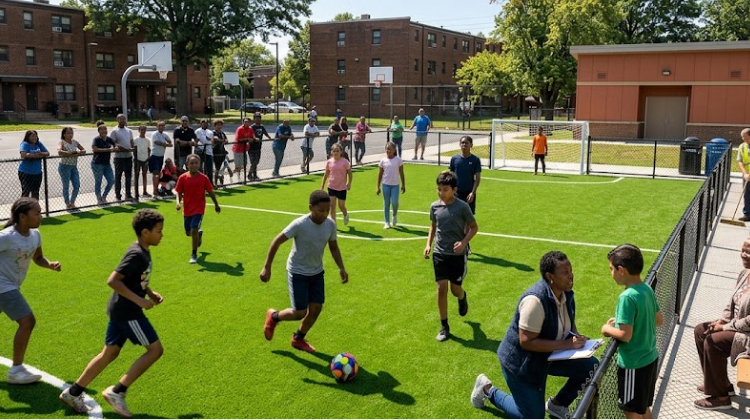
The World Cup generated enormous interest in the sport, but access to quality playing surfaces, youth programs, and neighborhood facilities varies considerably from one city to another.
Mini-pitches can address part of that problem.
Unlike large stadiums, they require comparatively limited land and can be integrated into parks, schools, recreation centers, and dense urban neighborhoods.
That makes them particularly useful as a legacy project.
A professional stadium may host tens of thousands of fans during an international tournament, but a community pitch can serve children and families throughout the year.
That difference captures the central argument for legacy spending.
The purpose is not to recreate the World Cup at neighborhood scale. It is to transform temporary enthusiasm into permanent participation.
For cities such as Los Angeles, Miami, and New York/New Jersey, which have been among those seeking clarity over the promised contributions, the projects could also reinforce existing youth-sports strategies.
The FIFA Foundation has previously emphasized the role of football-related community programs around the world, making the legacy discussion consistent with the broader principle that major football events can support grassroots participation.
Why Timing Matters After The Final Match
The timing of legacy funding is important because the window immediately following a mega-event is when public attention begins shifting elsewhere.
During the World Cup, businesses, residents, tourists, elected officials, and international media were focused on the tournament.
Once the event ends, the responsibility for maintaining momentum moves to local governments and community organizations.
That is when promised investments become especially important.
A completed mini-pitch, renovated recreation facility, or youth-sports program provides a physical reminder that the tournament produced something more permanent than temporary crowds.
Without those projects, the concept of legacy becomes harder for residents to see.
This is particularly relevant for communities that did not necessarily experience the economic benefits equally.
A hotel district may experience record occupancy.
Restaurants may generate extraordinary revenue.
Airports may handle unprecedented passenger volumes.
But residents in a neighborhood far from the official stadium may reasonably ask what the tournament changed for them.
A community facility provides a much more direct answer.
The Legacy Debate Is Really About Accountability
The most important issue surrounding the unpaid contributions is therefore not the $1 million itself.
It is accountability.
When global sporting organizations negotiate with host cities, the agreements typically involve complex arrangements covering stadiums, transportation, security, commercial operations, branding, taxation, and public services.
Legacy commitments are part of that relationship.
If a contribution is publicly presented as part of the host-city benefit package, local officials and residents have a reasonable interest in knowing when the money will arrive, how it can be spent, and which projects will receive it.
That transparency becomes especially important because the World Cup was marketed as a transformative event.
FIFA President Gianni Infantino and other tournament leaders repeatedly emphasized the potential for football to create lasting benefits across North America.
The credibility of that message will depend partly on what happens after the tournament.
The Legacy Question Could Influence Future Host-City Agreements
The dispute over the promised $1 million contributions matters beyond the 2026 tournament because American cities are already competing for future international sporting events.
Los Angeles will host the 2028 Summer Olympics, while the United States will remain a major market for international football, basketball, motorsports, tennis, and other global competitions.
That means the relationship between event organizers and local governments will continue evolving.
Future host cities are likely to pay closer attention to the details of legacy commitments, particularly when those commitments are presented as part of the justification for hosting an event.
A city considering a future mega-event could reasonably ask several questions before agreeing to participate:
- Who is legally responsible for the promised legacy funding?
- When will the money be transferred?
- Which projects qualify?
- Who controls project selection?
- What happens if the contribution is delayed?
- How will residents measure the benefit?
Those questions may eventually become standard components of host-city negotiations.
The International Olympic Committee’s Olympic Legacy approach demonstrates why the concept has become increasingly important across major sporting events. Legacy is no longer simply about constructing a venue or celebrating a successful tournament. It increasingly involves measuring how an event changes communities over time.
For American cities, that distinction could become particularly important as public scrutiny of mega-event spending increases.
A Stadium Is Temporary Infrastructure; A Community Facility Can Be Permanent
The contrast between World Cup stadiums and neighborhood sports facilities illustrates the larger legacy debate.
NRG Stadium in Houston, SoFi Stadium in Los Angeles, MetLife Stadium in New Jersey, and other major venues were essential to staging the tournament.
But they were not created specifically for the 2026 World Cup.
Most host cities instead relied on existing stadium infrastructure while investing heavily in surrounding transportation, security, operations, and public-space management.
That makes smaller legacy projects potentially more meaningful from a community-development perspective.
A mini-pitch can be used every day.
A recreation center can host youth programs throughout the year.
A renovated park can serve residents regardless of whether another international tournament arrives.
This is why the $1 million figure deserves attention even when compared with the enormous financial scale of the World Cup.
The best legacy projects are not necessarily the most expensive.
They are the ones that remain useful.
Local Governments Need A Clearer Definition Of Sports Legacy
The World Cup has also exposed the need for cities to define what they actually mean when they use the word “legacy.”

A successful sporting event can leave several different types of legacy.
There can be an economic legacy, measured through jobs, visitor spending, business investment, and tax activity.
There can be an infrastructure legacy, involving transportation, public spaces, facilities, and technology.
There can be a tourism legacy, measured through international awareness and repeat visitation.
And there can be a community legacy, involving youth participation, recreation, neighborhood improvements, and access to sport.
These categories overlap, but they should not be treated as interchangeable.
A city can experience record hotel occupancy without improving youth sports.
It can build transportation capacity without increasing access to recreation.
It can attract international visitors without producing meaningful neighborhood investment.
That is why legacy commitments should be evaluated against specific outcomes rather than broad promises.
| Legacy Type | Example Measurement |
|---|---|
| Economic | Jobs, visitor spending, business revenue |
| Tourism | International arrivals and repeat visitation |
| Infrastructure | Transit, roads, public spaces and facilities |
| Community | Youth participation and recreation access |
| Sports | New pitches, programs and registered players |
The $1 million contributions fall primarily into the community and sports categories.
Their success should therefore be measured differently from the tournament’s overall economic impact.
Why Small Projects Can Produce Large Social Returns
There is also a practical reason for focusing on community-level investment.
Large infrastructure projects often require years of planning, environmental review, financing, construction, and maintenance.
Smaller recreational projects can move more quickly.
A properly designed mini-pitch can potentially turn an underused parcel of land into an active community space without requiring the scale of investment associated with a major stadium or transportation project.
That makes the promised FIFA contribution potentially useful as seed funding.
The money could be combined with municipal budgets, nonprofit funding, private donations, and youth-sports organizations to produce projects larger than the original contribution.
This model would allow cities to use the World Cup as a catalyst rather than treating FIFA’s contribution as a standalone funding source.
The challenge is making sure the money actually arrives and that communities have a transparent process for deciding where it goes.
The 2026 Tournament Also Changed The Standard For Measuring Success
The United States hosted a tournament unlike previous World Cups because the competition was distributed across a huge geographic area.
Eleven U.S. cities hosted matches, while Canada and Mexico added additional host locations.
That geographic scale created a new model for sports tourism.
Fans could move between cities, airlines handled massive increases in demand, hotels benefited from international travelers, and local businesses participated in a tourism economy that extended far beyond stadium boundaries.
The scale makes the legacy question more complicated.
A city can claim success because its hotels performed well, while another may emphasize transportation improvements or increased international recognition.
The strongest evaluation will likely combine all of these factors.
This is where the $1 million contributions become symbolically important.
They provide an opportunity to attach a tangible community outcome to an event whose economic benefits are otherwise difficult for individual residents to see.
Host Cities Could Demand Stronger Legacy Guarantees In The Future
The experience could influence how American cities approach future sporting-event bids.
Instead of accepting broad statements about community benefits, future host committees could negotiate specific legacy agreements with clear deadlines, project lists, funding mechanisms, and accountability requirements.
That would represent a shift from promised legacy to measurable legacy.
For example, a future agreement could establish that a certain number of community facilities must be completed within a defined period after the tournament.
It could require public reporting of funding transfers.
It could establish independent oversight.
It could also define what happens when promised funds are delayed.
Such provisions would make legacy commitments more meaningful because residents could evaluate them using concrete benchmarks.
The broader lesson is that sports tourism works best when the benefits continue after the visitors leave.
America’s Next Mega-Events Will Face The Same Question
The issue will not disappear with the World Cup.
Los Angeles is already preparing for the 2028 Olympics, and other American cities will continue pursuing major international sporting events.
Each new event will raise similar questions.
How much should taxpayers contribute?
How much infrastructure should governments build?
Who receives the economic benefits?
What happens to temporary facilities?
And what remains for residents?
The answer cannot simply be that a city hosted a successful event.
Success needs to include what happened afterward.
The U.S. Olympic & Paralympic Committee and local organizing structures will face an increasingly sophisticated public audience that wants to understand the relationship between sporting events and long-term community development.
The 2026 World Cup offers an immediate case study.
The $1 Million Could Become A Test Of The World Cup’s Legacy
The financial dispute surrounding FIFA’s promised legacy contributions is ultimately about more than one payment.
It is about whether a global sporting organization can translate the language of community benefit into tangible investment.
The United States received enormous economic activity from the 2026 World Cup. Hotels, restaurants, airports, retailers, transportation companies, entertainment venues, and tourism organizations all participated in an unprecedented visitor economy.
But economic activity is temporary.
Legacy is measured by what remains.
A community sports facility, youth program, renovated park, or accessible mini-pitch can continue serving residents long after the tournament’s economic statistics become historical data.
That is why the promised $1 million per U.S. host city carries significance disproportionate to its size.
If the money reaches communities and produces visible projects, it can become a small but concrete example of how international sports can support local development.
If the commitments remain unresolved, however, future host cities may become more skeptical of broad legacy promises.
For America’s next generation of sporting events, that distinction could shape the negotiating table as much as stadium capacity, hotel rooms, transportation networks, and tourism projections.
The ultimate measure of a World Cup legacy is not how loudly the tournament ended. It is whether residents can still point to something useful that exists because the tournament came to town.
