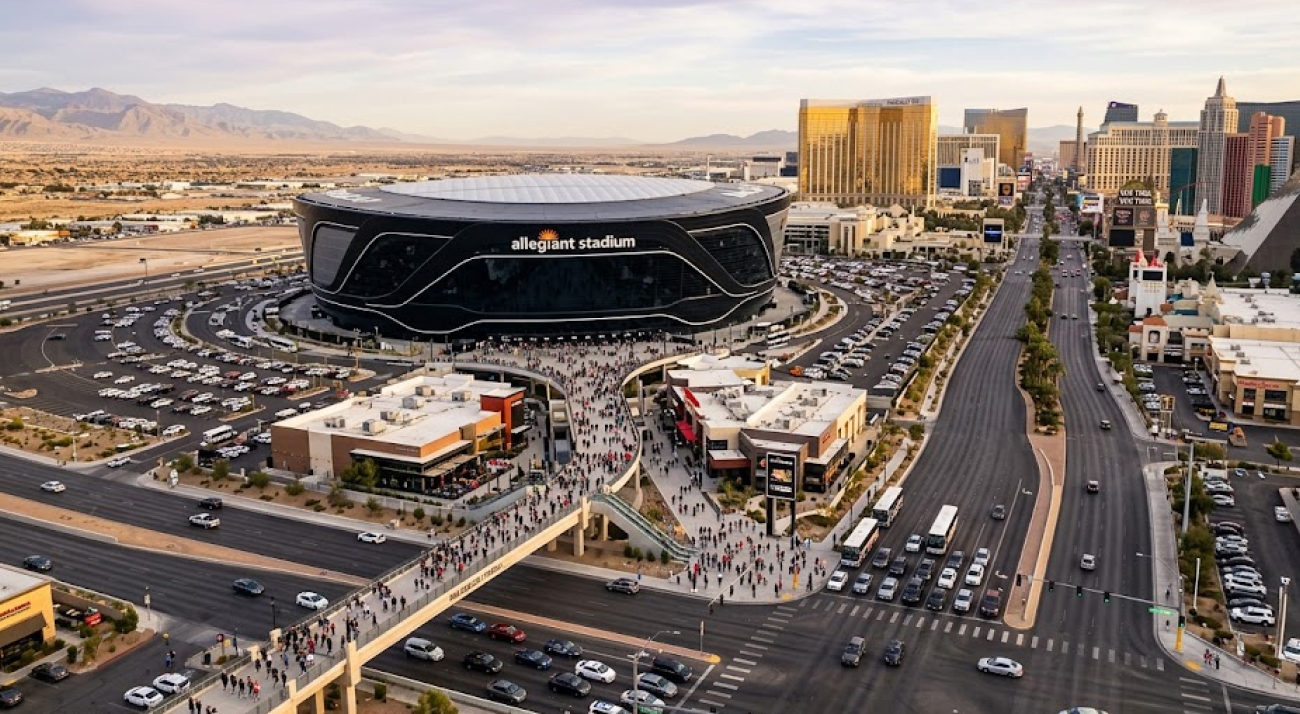
Las Vegas is preparing to make another major public investment in Allegiant Stadium, just six years after the $2 billion venue opened its doors. On September 2, 2026, the Las Vegas Stadium Authority unanimously approved up to $75 million in public funding for a $158 million expansion of the stadium’s north entrance and outdoor event area. The Las Vegas Raiders will finance the remaining portion of the project.
The decision presents an unusual question for cities that use sports facilities as economic-development tools: when a stadium is already outperforming its original economic projections, does additional public investment become easier to justify?
According to an economic analysis presented to the Stadium Authority, Allegiant Stadium generated approximately $2.6 billion in economic impact from 30 events and 1.5 million visitors during 2025, significantly exceeding an inflation-adjusted original projection of $890 million. The stadium’s performance has also been associated with substantial employment and tax generation since opening.
That performance gives Las Vegas a powerful argument for continuing to invest in the venue. It also creates a more complicated debate about public financing because the new expenditure is occurring after the stadium has already demonstrated that it can attract visitors, major sporting events, concerts, and entertainment activity.
For cities studying the economics of sports tourism, the Las Vegas case could become an important example of a second stage of stadium financing: public investment after the original construction has already proven commercially successful.
Allegiant Stadium Has Become More Than An NFL Venue
When Allegiant Stadium opened in 2020, its primary identity was straightforward: it was the new home of the Las Vegas Raiders.
That role remains important, but the venue has developed into something considerably broader.
The stadium has hosted NFL games alongside concerts, championship boxing, college football, international soccer, rugby, wrestling, and other major events. In 2025, the facility hosted events including WrestleMania 41 and the Canelo Alvarez-Terence Crawford boxing match, while major music acts also contributed to the venue’s entertainment calendar.
The diversity of events matters because sports tourism economics depend heavily on how frequently a facility can attract visitors from outside the local market.
A football stadium that generates economic activity only during home games has a fundamentally different business model from a multipurpose entertainment facility that can attract tourists throughout the year.
The Raiders’ 2025 impact reporting found that 62% of visitors came to Las Vegas specifically for a live sporting, music, or entertainment event at Allegiant Stadium, producing an estimated $1.1 billion in economic impact. The stadium also generated more than $281 million in gross revenue from live music and entertainment events during the relevant 2025 reporting period.
This helps explain why Las Vegas officials view the stadium as part of the city’s tourism infrastructure rather than simply as a football facility.
The Las Vegas Convention and Visitors Authority operates within an economy where attracting visitors is central to public policy. From that perspective, maintaining a globally competitive entertainment venue can be viewed as an investment in the city’s visitor infrastructure.
The distinction is important for other communities considering public participation in sports facilities. The strongest economic case may come when a stadium is capable of attracting tourists who would otherwise have no reason to visit.
The $75 Million Upgrade Is About More Than A New Entrance
The immediate project involves a $158 million expansion of Allegiant Stadium’s north entry area, with the public contribution capped at $75 million and the Raiders covering the balance. The proposed development includes a second-story entrance and outdoor event space intended to improve the visitor experience and increase the functionality of the stadium’s northern approach.
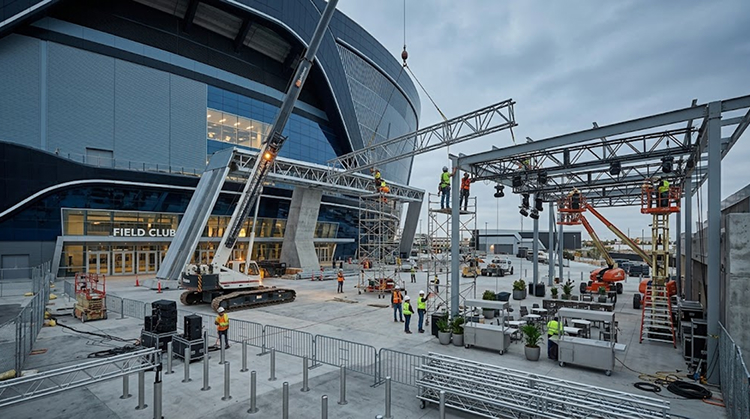
That may sound like a relatively modest infrastructure improvement compared with the original $2 billion stadium.
Economically, however, the distinction between a cosmetic renovation and an operational improvement is significant.
A more efficient entrance can influence crowd movement, event capacity, hospitality operations, premium experiences, security procedures, and the ability to use surrounding areas for additional programming.
The Stadium Authority’s argument is also based on the broader economic performance of the facility. Its economic analyst reported that Allegiant Stadium generated approximately $10.6 billion in cumulative economic impact from its opening through the latest reporting period, alongside approximately $487.3 million in tax revenue and 62,215 person-years of employment.
| Allegiant Stadium Economic Indicator | Reported Figure |
|---|---|
| 2025 Economic Impact | Approximately $2.6 billion |
| 2025 Visitors | Approximately 1.5 million |
| 2025 Events | 30 |
| Cumulative Economic Impact | Approximately $10.6 billion |
| Cumulative Tax Revenue | Approximately $487.3 million |
| Employment Supported | 62,215 person-years |
These figures change the public-financing discussion.
Instead of asking whether Las Vegas should continue supporting a stadium that has failed to produce economic activity, policymakers are evaluating whether additional investment can protect and expand an asset that is already producing substantial tourism-related activity.
That is a very different proposition.
The Original Stadium Investment Is Already Outperforming Expectations
The strongest argument supporting the new investment is the stadium’s performance against its original projections.
A Nevada legislative analysis comparing projected and actual economic performance found that 2025 total output reached approximately $2.4 billion, compared with a 2016 projection of $620 million. Wages and salaries reached $587 million compared with a projected $230 million, while employment reached approximately 10,600 compared with a projection of 5,980.
The comparison is significant because it gives policymakers measurable benchmarks.
| Measure | 2016 Projection | 2025 Actual | Change |
|---|---|---|---|
| Total Output | $620 million | $2.4 billion | +291% |
| Wages & Salaries | $230 million | $587 million | +154% |
| Employment | 5,980 | 10,600 | +77% |
These results do not automatically prove that every dollar of public investment produces an equivalent return.
Economic-impact measurements can include spending that moves through multiple sectors, and the performance of a stadium can be influenced by the broader strength of the Las Vegas tourism economy.
Still, the gap between projections and actual performance is substantial.
For Las Vegas, that creates a case that the stadium is functioning as a tourism asset rather than simply as a subsidized sports venue.
The Nevada Legislature’s economic analysis provides a useful benchmark because it compares the stadium’s performance against projections established before construction.
For other cities, that type of comparison may become increasingly important. Public officials can establish performance benchmarks before construction and then evaluate the facility against those benchmarks several years later.
That creates a more measurable approach to sports infrastructure policy.
Public Financing Still Creates A Difficult Question
The economic success of Allegiant Stadium does not eliminate the central issue surrounding the new $75 million commitment.
The question is whether public money should be used to finance improvements to a facility operated by a professional sports organization whose franchise has become substantially more valuable since relocating to Las Vegas.
Critics of the agreement have questioned why taxpayers should contribute to an expansion when the Raiders could potentially finance the entire project themselves. Nevada Current reported that the Stadium Authority approved the funding without board members raising questions during the September 2 meeting, while critics argued that public resources should face greater scrutiny.
The Raiders, however, argue that continued investment in the stadium supports the broader tourism economy and allows the facility to remain competitive as an event destination.
That argument reflects the fundamental tension in modern stadium financing.
A professional sports franchise can benefit directly from improved facilities through ticket sales, premium seating, sponsorships, concessions, naming rights, and event revenue.
At the same time, the surrounding community can benefit through hotels, restaurants, transportation, retail activity, employment, tourism spending, and tax revenue.
The challenge for policymakers is determining how those benefits should be divided between private and public participants.
Las Vegas’ agreement attempts to address that tension by having the Raiders pay approximately half of the expansion cost rather than placing the entire burden on the public sector.
That cost-sharing structure could become increasingly relevant as other cities consider upgrades to recently constructed stadiums.
Sports Tourism Is Becoming A Stadium Lifecycle Business
The Las Vegas project suggests that the economics of sports tourism cannot be evaluated only at the moment a stadium opens.
A stadium has a lifecycle.

The first stage involves land acquisition, construction, infrastructure, financing, and opening.
The second stage involves attracting events and building an audience.
The third stage involves maintaining the facility, improving visitor experiences, competing for major events, and adapting the venue to changes in entertainment and technology.
Las Vegas is now entering that third stage.
The $75 million public contribution effectively asks whether maintaining the competitiveness of an established sports-tourism asset deserves the same level of economic-development attention as building a new facility.
That distinction could influence future municipal decisions.
A city may hesitate to approve hundreds of millions of dollars for an entirely new stadium because the economic outcome is uncertain. A smaller investment into an existing venue with several years of documented tourism performance may present a different risk profile.
This does not mean existing stadiums should automatically receive public funding.
Instead, it suggests that performance data could become a prerequisite for future public capital improvements.
A venue that consistently misses attendance, tourism, employment, and tax-revenue targets would have a weaker case for additional public money.
A venue that dramatically exceeds those benchmarks could make a stronger argument for strategic reinvestment.
Las Vegas Has A Unique Advantage: Multiple Tourism Engines
The economics of Allegiant Stadium cannot be separated from Las Vegas’ broader tourism ecosystem.
The city already attracts visitors for conventions, casinos, restaurants, entertainment, nightlife, concerts, and major sporting events.
That means a stadium event can interact with an existing visitor economy rather than creating tourism demand from scratch.
A visitor traveling to Las Vegas for a football game may also stay in a hotel, eat at restaurants, visit attractions, use transportation services, attend another show, and spend money elsewhere in the city.
The same applies to visitors attending concerts or championship sporting events.
The economic value therefore extends beyond the stadium property.
The 2025 Canelo Alvarez-Terence Crawford fight illustrates this effect. The event generated an estimated $303.9 million in economic impact, supported 1,335 local jobs, and drew 70,482 attendees. Approximately 94.8% of attendees reportedly traveled to Las Vegas specifically for the fight, while 95.6% were non-local.
WrestleMania 41 produced another significant result, with an estimated $322.2 million economic impact and 124,693 fans attending across two nights.
These events demonstrate why stadium infrastructure can have value beyond its primary tenant.
A venue capable of attracting tens of thousands of visitors for events unrelated to its home team effectively becomes part of a city’s tourism portfolio.
The New Upgrade Could Protect Las Vegas’ Competitive Position
Las Vegas competes aggressively with other American cities for major sporting events and entertainment productions.
That competition is increasingly global.
Major events can choose among stadiums in Los Angeles, Miami, Dallas, Atlanta, New York, Phoenix, Nashville, and other major markets. Venue operators therefore have incentives to maintain modern facilities that can accommodate changing expectations from fans, performers, sponsors, broadcasters, and event organizers.
Allegiant Stadium already has several major events scheduled for the coming years, including the 2027 College Football Playoff National Championship, 2028 NCAA Men’s Final Four, and Super Bowl LXIII.
Those events represent substantial opportunities for Las Vegas businesses.
Hotels can benefit from visitor demand. Restaurants can experience higher traffic. Transportation companies can increase activity. Retailers and entertainment businesses can benefit from visitors who spend money before and after events.
The stadium therefore operates as part of a larger economic network.
For a city like Las Vegas, maintaining the quality of that network can be viewed as a competitive strategy.
The Las Vegas Stadium Authority explicitly has responsibility for stadium ownership, oversight, revenue distributions, and capital-improvement expenditures, making the authority an important part of the public-private structure behind Allegiant Stadium.
The Real Test Will Be The Return On The Second Investment
The original public investment in Allegiant Stadium was capped at $750 million, funded through hotel-room tax revenue and bonds issued through Clark County. The current stadium development budget is approximately $1.97 billion, with private investment accounting for the remainder.
The new $75 million commitment therefore adds another layer to an already complex public-private financing structure.
That makes measurement particularly important.
The relevant question after completion should not simply be whether the north entrance looks better.
Las Vegas should be able to measure whether the improvement contributes to additional event activity, higher visitor spending, greater stadium utilization, improved operational efficiency, additional employment, or increased tax generation.
Those measurements can then be compared with the public cost of the project.
This is where sports tourism policy can become more sophisticated.
Rather than treating stadiums as one-time infrastructure projects, cities can evaluate them as long-term assets requiring periodic investment. Public funding can then be connected to documented performance, specific economic objectives, and clearly defined community benefits.
That framework could help reduce the political divide between supporters and critics of sports subsidies.
What Other Cities Can Learn From Las Vegas
The Las Vegas decision offers several lessons for municipalities evaluating major sports venues.
First, event diversity matters. A stadium that hosts football, concerts, wrestling, boxing, international sports, and championship events has more opportunities to generate tourism activity than a facility dependent on one team.
Second, visitor origin matters as much as attendance. A stadium filled with local residents produces a different economic effect from a stadium that attracts thousands of visitors who book hotel rooms and spend money throughout the region.
Third, performance should influence future public investment. A city should be able to compare actual economic results with the assumptions that supported the original public commitment.
Finally, capital improvements should have measurable objectives. Public funding for a stadium upgrade becomes easier to evaluate when officials can identify the expected effect on tourism, events, employment, infrastructure, and tax revenue.
Las Vegas is effectively testing that model now.
The Next Generation Of Stadium Deals May Begin After Opening Day
The $75 million Allegiant Stadium project could ultimately influence stadium financing discussions far beyond Nevada.
For decades, debates about sports subsidies have focused primarily on whether governments should help build new stadiums.
Las Vegas introduces a different question: what happens after the stadium succeeds?
If a facility becomes a major tourism generator, should governments continue investing in it to protect that economic contribution?
The answer will depend on the structure of the agreement, the division of financial responsibility, and the measurable benefits created for the community.
In Las Vegas, the Raiders are covering the balance of a $158 million project while public funding provides up to $75 million. The stadium has already exceeded several original economic projections, and its event calendar has transformed it into a major component of Southern Nevada’s tourism infrastructure.
That combination creates a compelling case study.
The most important outcome will not be the completion of the new entrance itself. It will be whether the additional investment produces another measurable increase in the economic activity that justified the stadium in the first place.
If it does, Las Vegas could help establish a new model in which public stadium financing is treated as an ongoing economic-development strategy tied to performance.
If it does not, the $75 million commitment could become another example of why successful stadiums still require careful scrutiny after the ribbon-cutting ceremony.
Either way, the economics of sports tourism are becoming less about building a stadium once and more about determining how long a venue can remain competitive, how much reinvestment it requires, and who should pay for keeping it economically productive.
