
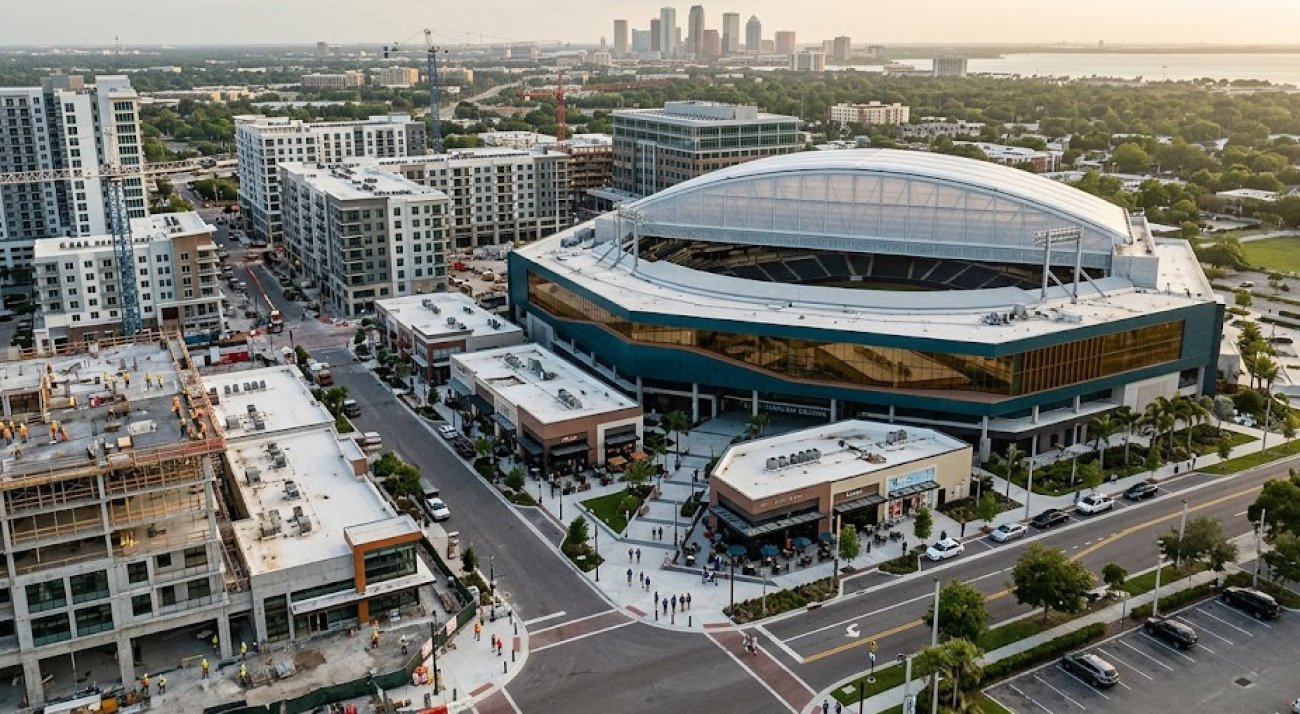
The Tampa Bay Rays have reached one of the most significant stadium agreements in American professional sports in recent years, and the structure could become a reference point for how cities negotiate public-private partnerships around major sports venues. On August 28, 2026, the Hillsborough County Board of County Commissioners approved a $2.36 billion “Forever Home” project for the Rays, one day after the Tampa City Council approved the agreement by a 4-3 vote. The project will place a new fixed-roof ballpark on the Dale Mabry campus of Hillsborough College and combine the stadium with a larger mixed-use development.
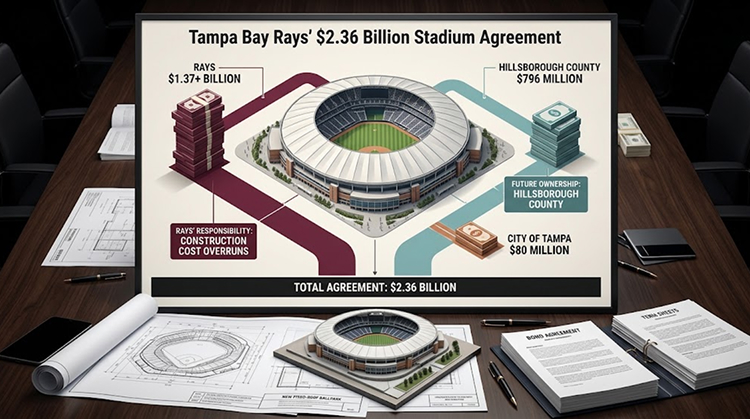
The financing structure is particularly significant because the Rays are committing approximately $1.37 billion and accepting responsibility for cost overruns, while Hillsborough County is contributing $796 million and the City of Tampa $80 million. The county will own the stadium, while the Rays will operate it under a 35-year agreement and pay $4 million in annual rent.
That arrangement differs from the traditional stadium model in which public agencies absorb a large share of construction costs while teams retain substantial control over the venue’s long-term commercial value. Tampa’s agreement places more financial responsibility on the franchise while tying public investment to a broader redevelopment strategy.
For chambers of commerce, municipalities, developers, and business organizations watching the economics of major sporting facilities, the Rays deal offers a useful case study in how stadium financing may evolve from a simple venue subsidy into a broader economic-development partnership.
The Rays Deal Changes The Public-Private Equation
The headline figure is $2.36 billion, but the more important number may be the approximately $1.37 billion being committed by the Rays.
Under the final agreement, the team is responsible for roughly 58% of the projected stadium cost before accounting for overruns. Hillsborough County contributes $796 million, while Tampa contributes $80 million. The Rays will also privately finance the surrounding mixed-use district.
| Funding Partner | Approximate Commitment | Primary Role |
|---|---|---|
| Tampa Bay Rays | $1.37 billion+ | Stadium construction and cost overruns |
| Hillsborough County | $796 million | Public stadium financing |
| City of Tampa | $80 million | Public infrastructure and project participation |
| Total Stadium Project | $2.36 billion | Ballpark and related development |
The difference is important because the public sector is not simply financing a private team’s building. The county will own the ballpark, while the Rays assume the risk of cost overruns and privately finance the surrounding development.
That allocation creates a different incentive structure. If construction costs increase, the team—not taxpayers—is responsible for covering those overruns under the agreement. At the same time, the public sector receives ownership of the facility and a long-term commitment from the franchise to remain in the market.
The financing model is also the product of negotiations that materially changed between the preliminary memorandum of understanding and the definitive agreements. The city’s contribution was reduced from the $180 million contemplated in the May framework to $80 million in the final structure. The final documents also replaced the proposed $100 million Community Redevelopment Agency contribution with a privately financed Community Development District.
For communities evaluating similar projects, that negotiation process may be as important as the final dollar figures. A stadium agreement can evolve substantially when elected officials challenge the distribution of financial risk.
Public Money Is Being Connected To A Larger Development Strategy
The most distinctive element of Tampa’s agreement is that the stadium is being presented as one component of a much larger redevelopment project.
The new ballpark will be built on the site of Hillsborough College’s Dale Mabry campus, with the project also including a modernized college campus and a privately financed mixed-use neighborhood. The Rays have described the development as a destination for businesses, hospitality, entertainment, and other activities rather than a facility used exclusively for baseball.
This distinction matters because stadium economics become much stronger when the surrounding development generates activity throughout the year.
A baseball stadium may host roughly 81 regular-season home games, along with potential postseason contests and other events. A mixed-use district, by comparison, can produce economic activity on days when no game is scheduled.
That broader approach is consistent with the growing emphasis on sports-led development in American cities. Instead of measuring a stadium primarily through attendance, communities can evaluate its relationship with hotels, restaurants, retail, office space, residential development, education, transportation, and public spaces.
The Tampa Bay economic development strategy provides a useful example of the broader municipal environment in which major development projects are evaluated, particularly around business growth, infrastructure, and redevelopment.
The Rays project therefore raises a more useful question than whether the stadium itself generates enough revenue to justify its cost.
The question is whether the entire district creates enough new economic activity to justify the public investment.
That is a much higher standard, but it also creates a clearer framework for measuring performance.
Why The County’s $796 Million Matters
Hillsborough County’s $796 million commitment remains the most significant public component of the agreement.
According to the final financing structure, roughly $360 million is expected to come from the Community Investment Tax and approximately $303 million from Tourist Development Tax resources.
These funding mechanisms are important because they connect the project to existing economic activity rather than introducing a new broad-based tax specifically for the stadium.
That does not eliminate the opportunity cost of the investment. Public resources directed toward a stadium cannot simultaneously be used for every other infrastructure or community priority.
However, it changes the political and financial argument. Instead of asking residents to approve a new tax specifically to build a baseball stadium, officials can frame the investment around existing tourism and economic-development revenue streams.
This is one reason stadium financing agreements increasingly involve detailed revenue projections, development districts, tax allocations, infrastructure commitments, and long-term lease structures.
The Hillsborough County government will ultimately have to demonstrate that the public investment produces sufficient long-term value through the stadium, surrounding development, tourism, employment, and property activity.
That creates an important performance question: what measurable economic return should taxpayers expect from $796 million of public capital?
A credible answer should extend beyond ticket sales.
It should include property-value growth, new businesses, employment, visitor spending, tax generation, infrastructure improvements, college investment, and the amount of private capital attracted to the surrounding district.
The $80 Million City Contribution Shows How Negotiations Can Shift
The City of Tampa’s final $80 million contribution is another important feature of the agreement because it demonstrates how local governments can change their exposure during negotiations.
The preliminary May agreement contemplated a substantially larger city commitment. By August, that contribution had been reduced to $80 million after negotiations over the structure of the development. Tampa City Council member Bill Carlson publicly emphasized that his position changed because the deal itself changed.
That is an important lesson for other municipalities.
Major sports projects frequently begin with preliminary agreements that are later revised as financing, infrastructure responsibilities, development rights, ownership structures, and risk-sharing provisions are examined in greater detail.
A preliminary memorandum should therefore be viewed as a negotiating framework rather than the final economic arrangement.
For local business communities, that process can be valuable. It creates an opportunity for chambers of commerce, neighborhood organizations, educational institutions, developers, and transportation agencies to assess whether the project serves broader economic priorities.
The Richland Chamber business resources model similarly reflects the importance of connecting business development with broader community priorities rather than treating economic growth as an isolated objective.
In Tampa, the final structure appears to place greater responsibility on the private sector while reducing the city’s direct contribution.
That does not eliminate public risk, but it demonstrates how negotiating leverage can change the balance between government and a professional sports franchise.
The Stadium’s Ownership Structure Could Become A Model
One of the most consequential provisions is that Hillsborough County will own the new ballpark.
The Rays will lease and operate the facility under an initial 35-year agreement that includes a non-relocation commitment. The team will pay $4 million in annual rent.
This creates a fundamentally different relationship from outright private ownership.
The county receives a long-term public asset, while the Rays receive the operating rights necessary to generate revenue from baseball and other events.
The arrangement also provides the public sector with a tangible asset that can potentially support future events beyond MLB games.
The planned fixed-roof stadium will have at least 28,000 seats, and the Rays have emphasized its ability to host non-baseball events.
That flexibility could influence the economic performance of the venue.
Concerts, exhibitions, corporate events, community programs, college competitions, and other sports can help increase utilization and spread the economic benefits across more calendar days.
However, utilization should be measured carefully. A facility hosting additional events is valuable only if those events generate enough incremental spending to justify operating and maintenance costs.
That means future stadium evaluations will likely place greater emphasis on annual utilization, private investment, tax generation, and surrounding development rather than attendance alone.
Tampa’s Mixed-Use District Is The Bigger Economic Experiment
The surrounding development may ultimately determine whether Tampa’s stadium model succeeds.
The Rays are expected to privately finance the mixed-use district, while a portion of tax revenue generated by the development will support public infrastructure, public-use areas, and debt service associated with the privately placed financing. The project also calls for property tax revenues to be shared with the city and county.
This creates a potentially powerful economic-development cycle.
Private development creates new property and economic activity. That activity produces additional tax revenue. Some of that revenue can support infrastructure and district costs, while the city and county can also receive a share of the increased tax base.
The model depends on one central assumption: the development must create new economic value before the resulting revenue can support reinvestment.
That is considerably different from simply borrowing public money to construct a stadium.
The Major League Baseball coverage of the agreement provides additional detail on the financing structure, ownership arrangement, college redevelopment, and surrounding mixed-use district.
If the district succeeds, Tampa could demonstrate that a professional sports facility can serve as an anchor for a broader development ecosystem.
If surrounding development underperforms, however, the public sector could face a very different economic reality.
That makes the district’s performance one of the most important long-term indicators to monitor.
Hillsborough College Adds A Different Dimension
The inclusion of Hillsborough College makes the project more unusual than a conventional stadium development.
The ballpark will be part of a redevelopment that includes a modernized college campus. During construction, the college will use a temporary on-site facility known as “The Nest.”
This gives the project an educational component that extends beyond professional sports.
A college campus can contribute students, employees, educational programs, community services, and daily foot traffic to an area. Integrating the campus into the redevelopment could therefore help produce activity independent of baseball.
For economic-development planners, that is significant.
The strongest sports districts tend to have multiple sources of activity rather than depending on one anchor. A professional team can generate large crowds on game days, while universities, offices, housing, retail, restaurants, and entertainment can provide a steady customer base throughout the year.
Tampa’s project attempts to combine several of those components within a single development strategy.
That creates the possibility of a more resilient district, although the results will depend on how effectively the different uses connect with one another.
The 35-Year Commitment Changes The Economic Horizon
The Rays’ 35-year non-relocation commitment is another critical element.
Professional sports franchises often negotiate stadium agreements around long-term lease periods because governments need sufficient time to recover the value of infrastructure investments and teams need stability to plan operations, sponsorships, hospitality, and surrounding development.
The Tampa agreement provides that stability.
The franchise receives a long-term home while the county gains a defined operating relationship and ownership of the facility.
For businesses, long-term sports commitments can also create greater confidence.
Restaurants can plan around predictable event traffic. Hotels can develop sports-related marketing strategies. Developers can consider nearby projects with greater certainty. Local employers can evaluate workforce and transportation needs over a longer horizon.
The economic value of certainty is difficult to capture in a single stadium impact study, but it can influence investment decisions across an entire metropolitan area.
That may become one of the strongest arguments for public participation in professional sports facilities: not simply the economic activity generated by games, but the stability created by securing a major franchise for several decades.
Tampa Could Influence Future Stadium Negotiations Across The United States
The Rays agreement arrives at a time when cities across the country are increasingly scrutinizing the economics of professional sports facilities.
The traditional model often asks governments to provide land, infrastructure, tax incentives, bonds, or direct financial support while teams contribute a smaller share of construction costs.
Tampa’s structure presents a different proposition.
The franchise is contributing more than half of the stadium’s projected cost, accepting responsibility for overruns, privately financing the surrounding district, and committing to a 35-year non-relocation agreement.
The public sector, meanwhile, receives ownership of the stadium and participates in a broader redevelopment that includes education and infrastructure.
That does not automatically make the project a better deal. The public contribution remains substantial, and the ultimate return will depend on future development, attendance, event activity, property values, tax revenue, and operating performance.
But it does create a more clearly defined exchange.
The city and county are contributing capital and development support. The team is contributing substantial private capital and accepting construction risk. The public receives ownership and a long-term franchise commitment.
Future stadium negotiations could increasingly adopt this type of risk-sharing structure.
What Businesses Should Watch As The Project Moves Forward
The approval of the Rays stadium deal is the beginning of the economic experiment rather than its endpoint.
Construction must begin in fall 2026 to maintain the goal of opening before the 2029 MLB season.
That means the next stage will involve contracts, construction activity, campus redevelopment, infrastructure investment, private development, hiring, and business opportunities.
For local businesses, several indicators will be particularly important:
- The amount of private capital committed to the surrounding district.
- Construction and permanent employment created by the project.
- New hotel, restaurant, retail, and entertainment development.
- Property-value and tax-base growth around the site.
- Annual stadium utilization beyond baseball.
- Infrastructure improvements that remain valuable to residents.
- The performance of Hillsborough College’s redesigned campus.
These indicators can provide a more complete picture than stadium attendance alone.
A successful sports-led development should eventually become part of the normal economic life of a city rather than functioning as an isolated destination used primarily on game days.
A New Standard For Sports Infrastructure Financing
Tampa’s $2.36 billion Rays agreement may ultimately be remembered less for the size of the stadium than for the financing structure surrounding it.

The project combines significant private team investment, capped municipal participation, county financing, public ownership, a long-term non-relocation commitment, private mixed-use development, and educational redevelopment.
That combination represents a more complicated but potentially more accountable model for sports infrastructure.
The key test will come after the construction headlines disappear.
If the stadium generates sustained event activity, the mixed-use district attracts private investment, Hillsborough College benefits from its new campus, and the surrounding area experiences measurable business and tax-base growth, Tampa could provide a powerful example of how public money can support a professional sports franchise while also pursuing broader community development.
If those outcomes fail to materialize, the $796 million county commitment will face much greater scrutiny.
For cities considering their own stadium proposals, that is perhaps the most valuable lesson from Tampa. The central question should no longer be simply who pays for the stadium.
It should be who assumes the risk, who owns the asset, what economic activity is created around it, and what measurable benefits remain after the opening ceremony is over.
That framework could become increasingly important as American cities negotiate the next generation of professional sports facilities.
