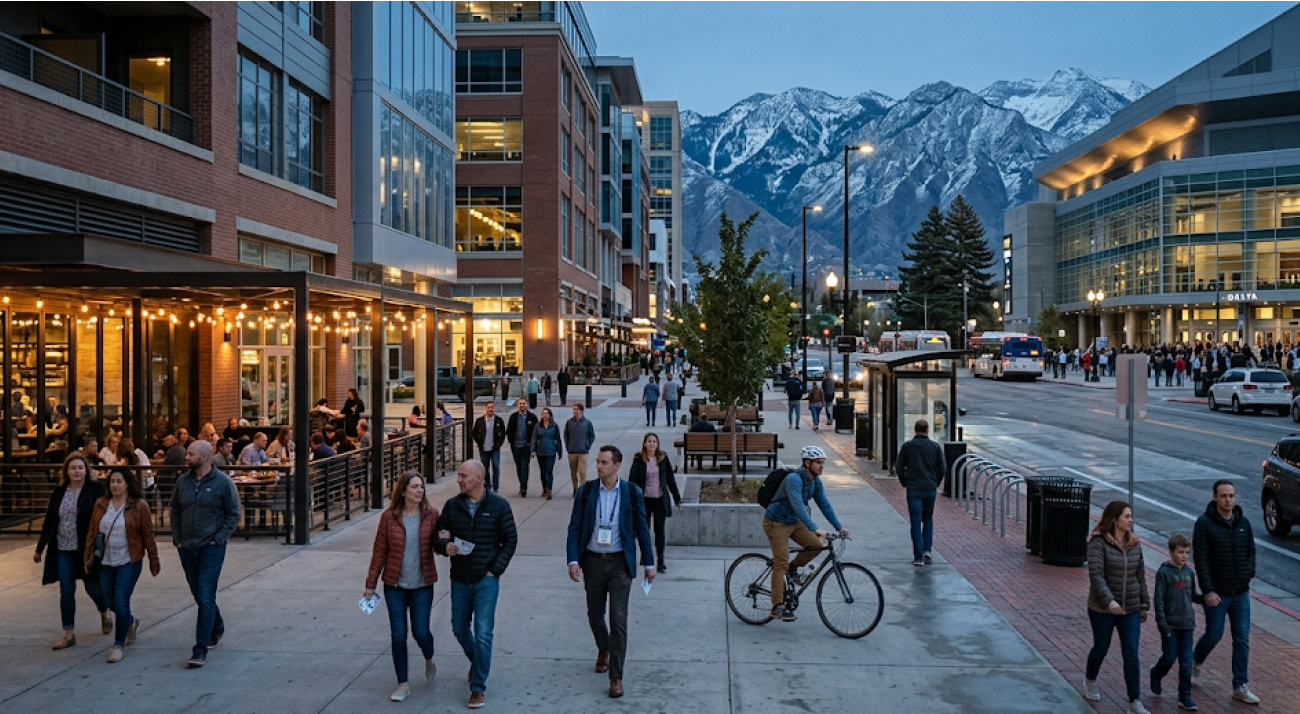
Salt Lake City is moving toward a major transformation of its downtown core, with a proposed sports, entertainment, culture, and convention district that could reshape how the city attracts visitors and supports local businesses. On October 14, 2026, Smith Entertainment Group (SEG), led by Ryan Smith, released new renderings showing a connected district between the Delta Center and the Calvin L. Rampton Salt Palace Convention Center. The plans include new retail spaces, offices, residences, a hotel, public gathering areas, and a 6,000-seat music venue.
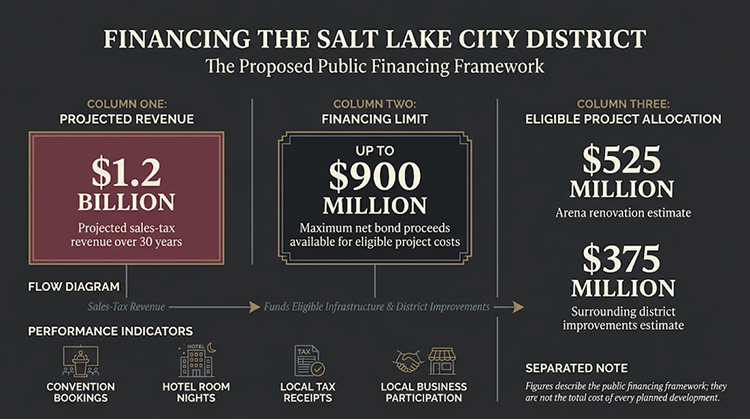
The proposal builds on a public financing agreement approved in 2024. A 0.5% citywide sales tax increase is projected to generate approximately $1.2 billion over 30 years, with up to $900 million available for eligible arena renovations and improvements to the surrounding district. SEG has separately described a multibillion-dollar investment program, placing the public contribution within a much larger development strategy.
The timing is significant. Utah will host the 2034 Olympic and Paralympic Winter Games, giving Salt Lake City a major deadline for improving its visitor infrastructure. However, the district’s long-term value will depend on what happens during the years before and after the Olympics: whether conventions grow, businesses attract more customers, residents use the public spaces, and downtown activity remains strong throughout the calendar.
The $1.2 Billion Figure Is A Long-Term Funding Projection
The sales-tax estimate is central to the project, but it requires careful interpretation. Salt Lake City approved the 0.5% increase in October 2024 under the state’s Capital City Revitalization Zone framework. The agreement anticipates approximately $1.2 billion in revenue over 30 years, with a maximum of $900 million in net bond proceeds available to SEG for approved project costs.
According to the Salt Lake City Council’s project agreement summary, the eligible program includes the Delta Center renovation and surrounding district improvements. The agreement originally allocated estimated costs of $525 million for the arena remodel and $375 million for other district improvements.
Those figures describe the eligible public financing framework, rather than the full cost of every development announced in the October 2026 renderings. The district also includes privately financed and separately planned components, while the convention center reconstruction follows its own county-led process.
The distinction matters for economic development. Projected tax collections over three decades cannot be treated as cash already available, and they should not be confused with the district’s total construction budget or its future economic impact. Actual collections will depend on taxable sales and economic conditions over time.
For residents and businesses, the central question is whether the investment produces enough additional economic activity and public benefit to justify the financing commitment. That requires a long-term assessment of tax receipts, construction costs, maintenance, business growth, and the distribution of benefits across downtown.
The New District Connects Sports, Retail, Culture, And Housing
The October 14 plans show a more integrated downtown environment than a traditional arena-centered development. SEG’s vision links the Delta Center to the Salt Palace Convention Center through pedestrian routes, retail spaces, public gathering areas, and new destinations.
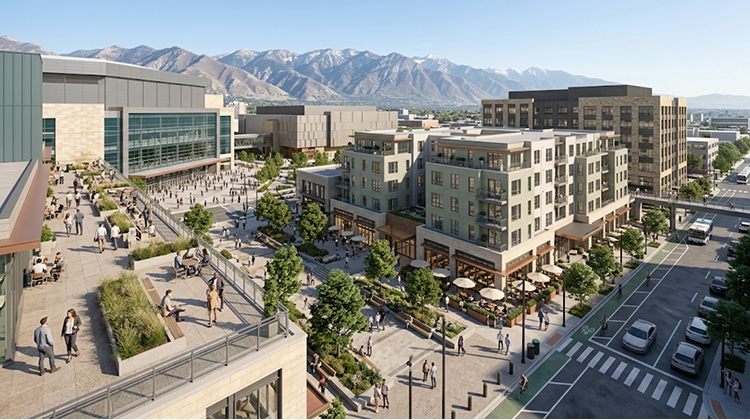
The proposal includes a new east-facing entrance for the Delta Center, restaurants and shops, office space, residential development, a hotel, and a 6,000-seat concert venue. The new music venue is expected to host approximately 80 to 120 concerts annually, according to reporting by the Salt Lake Tribune and Deseret News.
That concert schedule could provide a meaningful source of visitor activity between professional basketball and hockey games. The Utah Jazz and Utah Mammoth already give the arena a dual-sport calendar, while concerts and other entertainment events bring different audiences into downtown.
A mixed-use district can also extend visitor spending beyond the event itself. Attendees may arrive early for dinner, stay overnight, shop before a concert, or return for other activities. Residents may use public plazas and restaurants even when no major event is taking place.
The proposed pedestrian connection is particularly important because it seeks to link destinations that have historically felt separated by large buildings and service areas. Salt Lake City Mayor Erin Mendenhall has described the plan as an opportunity to reconnect downtown and improve walkability.
The October 2026 district plans offer an early view of that ambition, although the final design, construction schedule, and business mix may change as planning advances.
The Salt Palace Could Become A Stronger Convention Competitor
The district’s convention component is just as important as its arena and concert plans. The Salt Palace Convention Center supports a substantial visitor economy, bringing meeting attendees into hotels, restaurants, transportation services, and downtown attractions.
Salt Lake County has been advancing a comprehensive reconstruction program for the facility. Its planning team is working toward completion by January 2031, ahead of the 2034 Winter Games. A central objective is to improve the building’s ability to host multiple major conventions at the same time.
County officials have identified a second full-service ballroom as a key component. The addition would give event organizers greater flexibility and help reduce scheduling constraints that can prevent a convention center from accepting overlapping bookings.
According to Salt Lake County’s April 2026 project update, the planned improvements could generate an estimated $105 million in additional annual economic impact on top of approximately $300 million per year attributed to the center in its current form.
Those are projections, rather than guaranteed future results. Their value will depend on the facility’s ability to attract additional events and increase attendance without incurring costs that outweigh the added benefits.
A stronger convention center can also help hotels and restaurants plan for demand outside the busiest sports seasons. Large meetings often bring visitors on weekdays, while games and concerts can create evening and weekend traffic. Combining these uses could produce a more balanced calendar for downtown businesses.
The 2034 Winter Olympics Create A Deadline And A Long-Term Opportunity
The 2034 Olympic and Paralympic Winter Games give Salt Lake City a major reason to accelerate improvements to downtown infrastructure. The city’s Olympic plans identify the Salt Palace as a potential curling venue and a location for international broadcast and press operations. Downtown is also expected to host major public-facing Olympic activities.
The Games will attract athletes, media organizations, sponsors, officials, and visitors from around the world. That creates opportunities for hotels, restaurants, transportation providers, event contractors, and cultural attractions. It also places pressure on the city to deliver reliable transport, safe public spaces, accommodation capacity, and event facilities.
Salt Lake City already has experience hosting the Winter Olympics, having staged the Games in 2002. The 2034 event gives officials an opportunity to build on that experience while preparing for a different visitor market and a substantially updated downtown.
The city’s official Olympic planning information outlines the venues and locations expected to play a role in the Games. The district could help connect some of these activities to a wider downtown visitor experience.
However, the Olympics should be treated as a milestone rather than the sole justification for the project. Major international events create a temporary surge in demand, but the facilities remain in place for decades. A district that performs well in 2034 must also work in 2035, 2040, and beyond.
That means the long-term economic case should rest on repeat conventions, regular concerts, sports attendance, private investment, and public use—not just a short period of heightened international attention.
Local Businesses Need A Clear Path To Participate
The economic benefits of a large sports district will depend partly on how much spending reaches existing businesses. New restaurants and retail stores can create jobs and attract visitors, but construction and development can also shift customers away from nearby businesses or raise property costs.
For independent operators, the opportunity may include catering contracts, food and beverage sales, retail partnerships, event services, temporary staffing, transportation, and visitor experiences. Businesses that already serve downtown customers could gain from stronger foot traffic if the district’s pedestrian routes connect them to new destinations.
The public agreement also includes commitments associated with workforce development, public art, affordable housing, and revitalization of historic Japantown. These commitments matter because the value of a downtown investment cannot be measured entirely by visitor spending or property development.
The district’s success should also be judged by whether local residents can access its public spaces, whether small businesses can compete for commercial opportunities, and whether surrounding neighborhoods benefit from improved connections.
Richland Chamber’s work on local economic development reflects the broader role that business organizations can play in connecting investment with community participation. In Salt Lake City, comparable coordination among city officials, county leaders, property owners, event organizers, and business groups could help make the new district more inclusive and commercially productive.
A practical next step would be to track local procurement, small-business participation, workforce training, employment, and the geographic distribution of visitor spending. These measures would give the public a clearer picture of who benefits from the project.
Public Financing Requires Transparent Performance Measures
The project’s financing structure makes accountability particularly important. The projected $1.2 billion in sales-tax revenue will be collected over 30 years, while the maximum $900 million in net bond proceeds represents a defined public funding limit for eligible project costs under the agreement.
The city also approved a Convention Center Public Infrastructure District in April 2025, a separate financing mechanism associated with an estimated $1.8 billion in upgrades to major downtown venues, including the Salt Palace and Delta Center. This funding structure should be evaluated separately from the sales-tax arrangement to avoid treating distinct financing commitments as a single pool of money.
The Salt Lake City Council’s statement on the infrastructure district also raised questions about public transparency and the city’s limited role in the state-mandated process.
For taxpayers, the most useful reporting will show what the city and county spend, which improvements are completed, how much revenue is collected, and whether the district attracts new business activity. Construction milestones and economic results should be reported separately, since completing a project does not automatically demonstrate that it has achieved its financial objectives.
A credible performance framework would track convention bookings, hotel room nights, event attendance, local tax receipts, employment, public-space usage, and business openings and closures. Officials should also distinguish new spending from activity displaced from other parts of the region.
These measures would help residents assess the project over time instead of relying on a single headline estimate of future economic impact.
The District Must Work Beyond Game Nights
The most ambitious aspect of the proposal is its goal of creating a destination that remains active when the Jazz and Mammoth are not playing. A concert venue, convention center, hotel, housing, restaurants, shops, and cultural facilities could attract different audiences throughout the year.
The Delta Center already provides a substantial foundation. According to its official venue information, the arena hosts more than 320 events annually and welcomes approximately 1.8 million guests. Its calendar spans professional basketball, hockey, concerts, and other entertainment.
That existing activity offers a base of potential customers for the surrounding district. Yet visitors attending an arena event will not automatically spend money elsewhere. The design must make surrounding businesses easy to reach, while the event calendar and commercial mix must provide reasons to arrive early, remain after an event, or return on another day.
The Delta Center’s venue information outlines its existing event volume and ongoing transformation into a dual-sport facility. The next phase of development will determine how effectively that arena activity connects with conventions, culture, and neighborhood businesses.
Year-round performance also depends on affordability and accessibility. Residents need reasons to use the public spaces without purchasing premium event tickets, and businesses need a mix of customers beyond major sports audiences. Free public gathering areas, local cultural programming, and accessible pedestrian routes can help make the district part of everyday downtown life.
Salt Lake City’s Economic Test Will Continue After 2034
The October 2026 renderings mark a new stage in Salt Lake City’s downtown development strategy. They make the proposed district easier to visualize and clarify how the arena, convention center, concert venue, housing, retail, and public spaces could fit together.
The investment also carries substantial obligations. Sales-tax revenue is expected to support eligible project costs over decades, the convention center reconstruction requires careful coordination, and the 2034 Olympics impose a major deadline for facilities and public infrastructure.
The most meaningful outcome will be a downtown that attracts visitors throughout the year, creates opportunities for local businesses, supports cultural institutions, and remains useful to residents after the Olympics have ended.
Salt Lake City has a strong starting point in its existing sports calendar, convention business, and Olympic experience. Whether the new district becomes a durable economic asset will depend on execution, financial transparency, and the ability to turn event attendance into broader local spending.
For cities considering similar investments, the central lesson is that a successful sports district must operate as more than a collection of venues. It must connect events to hotels, restaurants, cultural destinations, public spaces, and businesses—and demonstrate over time that the benefits justify the public commitment.
