

For decades, the architectural ceiling of the modern sports stadium seemed firmly capped. The “Big House” at the University of Michigan comfortably holds just over 107,000 screaming fans. North Korea’s Rungrado 1st of May Stadium claims a capacity of 114,000. Beyond that threshold, architects and urban planners have long argued that the logistics of sightlines, crowd control, and structural physics become unmanageable.
But in 2026, the global sports economy operates on an entirely different scale. Fueled by exponential broadcast revenues, the integration of legalized gambling, and the insatiable demand for live, experiential entertainment, the architectural whispers have turned into legitimate boardroom blueprints. Several elite international design firms are currently modeling the ultimate modern colosseum: a fully enclosed, climate-controlled stadium with a staggering capacity of 200,000 seats.
A project of this magnitude is no longer a question of if, but when, where, and for whom.
The $12 Billion Price Tag
To understand the scope of a 200,000-seat mega-stadium, you have to throw out every existing financial metric in sports infrastructure. The most expensive stadium currently on earth is SoFi Stadium in Los Angeles, which cost an estimated $5.5 billion for 70,000 seats.
Industry insiders speculate that a 200,000-seat venue would command a price tag between $10 billion and $12 billion. Why the exponential leap in cost? A venue of this size cannot simply be a larger bowl of concrete; it must operate as a hyper-connected smart city. To sustain 200,000 people simultaneously, the stadium would require dedicated, on-site sustainable energy grids capable of powering the equivalent of a mid-sized American municipality for four hours straight.
Furthermore, the sheer volume of high-strength steel, advanced polymers for a transparent climate-controlled roof, and the labor required to assemble it would necessitate massive global talent acquisition campaigns just to staff the decade-long construction phase.

The Technological and Logistical Marvel
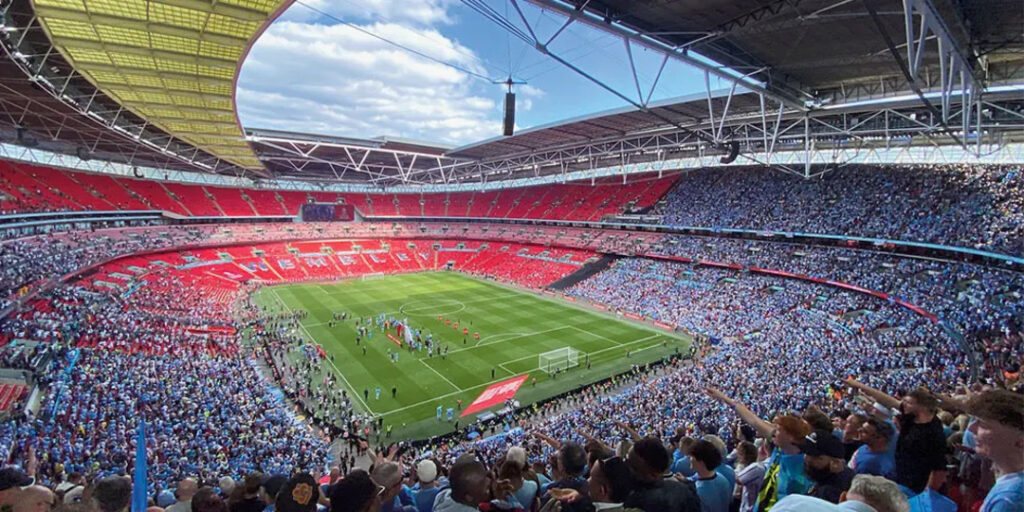
The primary hurdle of a 200,000-seat stadium is the viewing experience. At the highest tiers of a stadium this large, the players on the field would look like ants. To solve this, the stadium of the future will rely on vertical, tiered “opera house” seating that stacks fans higher rather than further away, pushing the limits of cantilevered engineering.
To bridge the visual gap, every seat will be a technological hub. We are looking at personalized, high-definition augmented reality visors built into the seating, powered by massive cloud gaming infrastructure that guarantees zero latency for 200,000 simultaneous users. This will allow fans in the upper decks to zoom in on the line of scrimmage, pull up real-time player speeds, and view holographic replays right in front of their eyes, utilizing the latest advanced broadcasting technology.
Speculation: Who Gets the Mega-Stadium?
You do not build a $12 billion stadium for an expansion franchise. You build it for a global brand with a fanatical, deeply entrenched culture. While international soccer giants like Real Madrid or Manchester United are candidates, the financial gravity of American football makes the United States the most likely host.
If we are looking at the map, Texas is the undisputed frontrunner. The state has the land, the decentralized regulatory environment, and a cultural obsession with football that borders on religious.
Specifically, Austin or Dallas are the prime targets. With the recent seismic shifts in college athletics and the formation of modern super-conferences, the SEC has become a financial juggernaut capable of rivaling the NFL. Imagine a 200,000-seat fortress serving as the ultimate crown jewel for elite Texas football programs. The sheer scale of the Texas Longhorns’ brand, backed by tech-sector billionaires and an alumni base desperate for total national dominance, could absolutely fill 200,000 seats for a prime-time Saturday night kickoff.
Alternatively, this venue could be built as a dedicated, neutral-site SEC super-hub. Instead of a home team, it would serve as the permanent host for colossal, high-stakes Florida SEC matchups, the SEC Championship game, and the expanded College Football Playoff. The demand for a Florida Gators versus Texas Longhorns matchup in a 200,000-seat venue would crash ticketing servers worldwide and generate a localized economic impact rivaling a Super Bowl every single weekend.
The Sports Betting Integration
How do you pay off a $12 billion architectural wonder? Ticketing and traditional concessions will only cover a fraction of the debt service. The true revenue engine of the 200,000-seat stadium will be its seamless integration with legalized sports gambling.
This stadium will not just host games; it will be the world’s largest casino. Expect massive, high-roller VIP betting lounges seamlessly woven into the luxury suites, operated by top-tier sportsbooks. But the real revenue will come from micro-betting.
With 200,000 fans connected to the stadium’s zero-latency cloud network, attendees will be able to place real-time prop bets from their digital armrests. Will the next play be a run or a pass? Will the quarterback scramble for more than five yards? Will this field goal attempt hit the left upright? By turning the entire spectator base into active, real-time participants, the stadium creates a continuous, billion-dollar revenue stream every single game day.
The Broader Economic Horizon
For a local Chamber of Commerce, the announcement of a 200,000-seat stadium would fundamentally alter the region’s economic destiny. The surrounding infrastructure required to move that many people—hyperloop transit stations, expanded airport terminals, and automated traffic corridors—would trigger a massive influx of federal and private capital.
According to recent national economic reports, mega-infrastructure projects of this scale create a localized “halo effect.” Hotels, entertainment districts, and corporate headquarters inevitably cluster around the venue, creating a self-sustaining micro-economy that generates jobs and tax revenue long after the final whistle blows.
The Colosseum of the Future
The 200,000-seat stadium is no longer a pipe dream reserved for science fiction. The technology exists, the broadcast money is clearing the bank, and the cultural appetite for massive, shared spectacles has never been higher. Whether it rises in the plains of Texas or the outskirts of an international metropolis, the colosseum of the future is coming and it will change the business of sports forever.
