Washington, D.C. is moving forward with one of the most ambitious sports-led redevelopment projects in the United States, but the scale of the proposal extends far beyond a new football stadium.
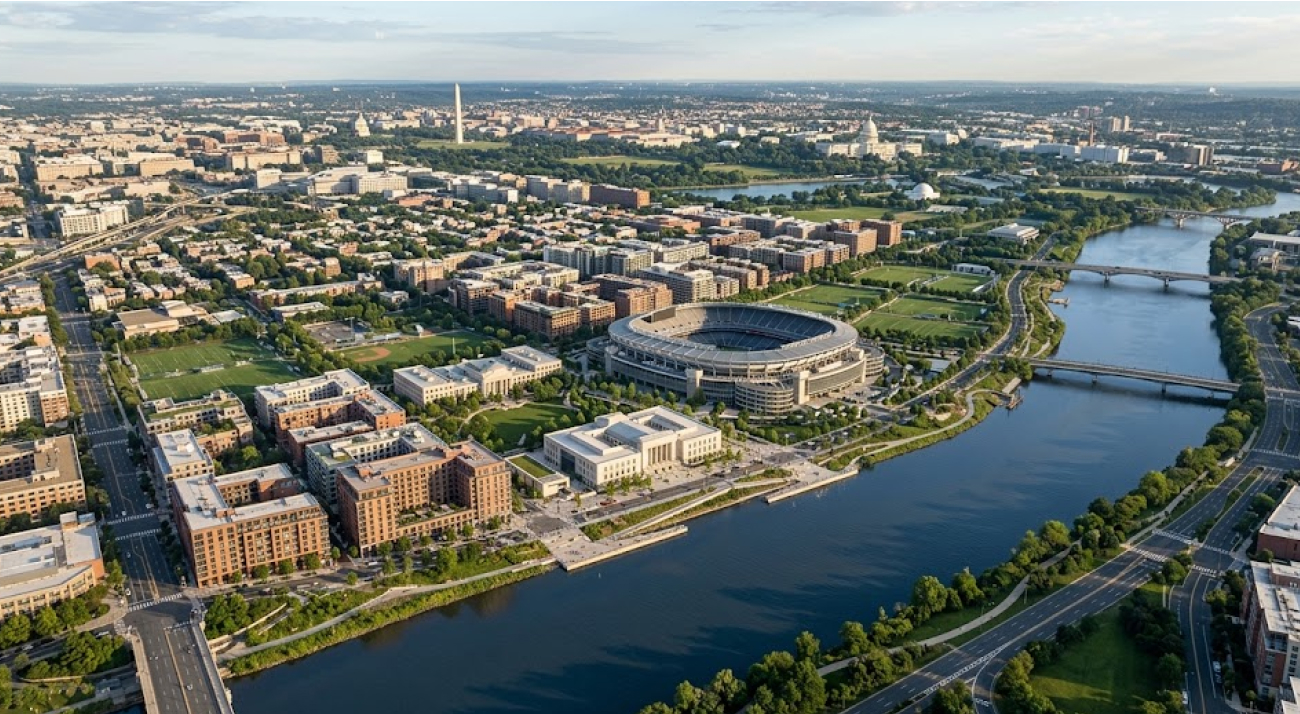
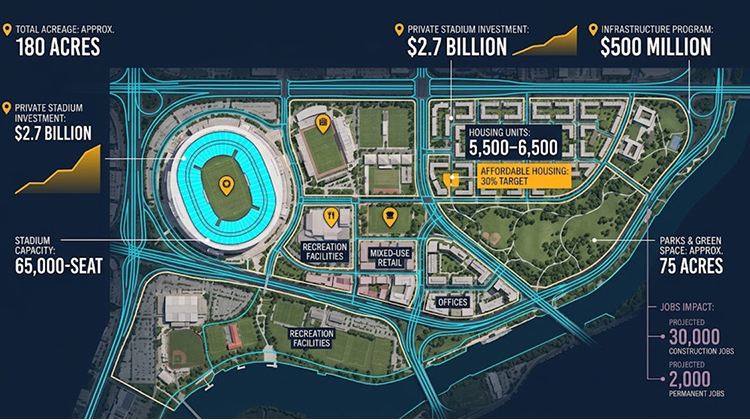
On September 24, 2026, Mayor Muriel Bowser and the D.C. Office of Planning transmitted the RFK Campus Master Plan to the D.C. Council, establishing a framework for transforming approximately 180 acres along the Anacostia River into a mixed-use waterfront district built around sports, housing, recreation, entertainment, retail and public space.
The plan is significant because it treats the former RFK Stadium site as a piece of city infrastructure rather than simply a location for an NFL venue. The Washington Commanders’ proposed return to the District is the central catalyst, but the surrounding development is intended to operate throughout the year.
According to the D.C. Office of Planning, the campus would include new land-use and design guidelines, recreational facilities, housing, businesses, parks and improved connections to the Anacostia River. The D.C. Council is scheduled to hold a public hearing on September 30 and vote on adoption of the plan by the end of 2026.
That approach creates a larger question for cities across the country: Can a major sports facility become the anchor for an entire urban district instead of functioning as a destination that comes alive primarily on game days?
The RFK Campus Is Much Larger Than A Stadium Project
The scale of the RFK redevelopment is one of the most important aspects of the proposal.
The 180-acre campus sits between the Anacostia River and the Kingman Park and Hill East neighborhoods. The site is also connected to Metrorail, bus routes, major roads, trails and nearby recreational areas.
That location gives the project characteristics that many stadium developments do not have. Rather than starting with a stadium surrounded by disconnected parking, the District is planning an interconnected collection of neighborhoods, parks, public spaces and commercial areas.
The proposed Washington Commanders stadium would contain approximately 1.8 million square feet and seat roughly 65,000 people. The team selected a joint venture of Clark Construction Group, Mortenson and Smoot Construction Company of Washington, D.C., in August to lead construction of the new facility.
The Washington Commanders stadium plans describe the venue as a year-round sports and entertainment facility capable of hosting more than 200 events annually, including sporting events, concerts, festivals and other large gatherings.
The stadium itself, however, represents only one part of the larger land strategy.
The September master plan divides the campus into four development districts and two additional districts dedicated to parks and recreation. Flexible open spaces are intended to accommodate everyday community use while also functioning as gathering areas before major events.
That distinction could become increasingly important for cities considering large sports investments. A stadium that sits empty most of the week creates a very different economic pattern from a district containing housing, restaurants, offices, parks, recreation facilities and entertainment venues.
Housing Could Make The Project A Different Kind Of Sports District
One of the clearest differences between the RFK proposal and a traditional stadium development is the role of housing.
The June draft master plan called for approximately 5,500 to 6,500 new housing units, with at least 30% designated as affordable housing.
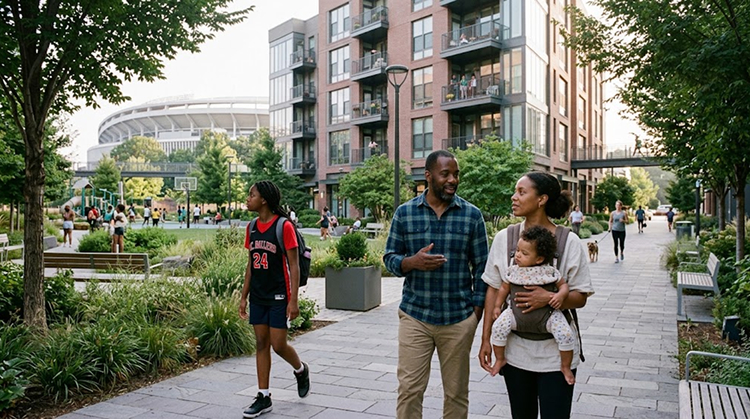
That means the development is being planned around permanent residents as well as visitors.
Housing changes the economics of a sports district because residents create demand during periods when there are no games or major events. Restaurants, retail businesses, public spaces and transportation infrastructure can therefore serve a local population throughout the week instead of depending entirely on event attendance.
The District has also emphasized connections between the new development and surrounding neighborhoods. The plan includes a new roadway network intended to support game-day traffic while creating walkable connections and access to parks and community spaces.
This is where sports-led development intersects with broader business development strategy. For regional organizations and chambers of commerce, major developments can create opportunities for local businesses when the surrounding infrastructure allows them to participate in the visitor economy rather than leaving most spending concentrated inside a stadium or large entertainment complex.
The Richland Chamber business development resources offer a useful parallel for communities examining how investment, business participation and local economic activity can reinforce one another.
The RFK proposal also includes commercial space, hotels, restaurants and retail, creating multiple potential sources of activity beyond ticket sales.
Parks And The Anacostia River Are Central To The Plan
Another defining feature is the amount of land devoted to public and recreational uses.
Earlier planning materials established a goal of reserving at least 30% of the campus, excluding the riparian area, for parks and open space. The broader concept includes approximately 75 acres of parks and green space, including about 30 acres of natural riparian area.
The strategy connects the sports campus to the Anacostia waterfront and nearby Kingman and Heritage Islands.
This matters because waterfront redevelopment can change the way residents experience a major event district. Instead of treating the river as a boundary around a stadium, the plan positions it as part of the public realm.
The National Park Service’s RFK planning materials describe improvements to the street network, transit services and utilities intended to connect new residential and commercial development with the Anacostia River waterfront.
For sports tourism, this creates another potential benefit. Visitors attending a football game or concert could have access to parks, trails, restaurants and waterfront destinations before or after an event.
That expands the potential visitor experience beyond the ticketed event itself.
It also gives residents reasons to use the area when there is no major sporting event scheduled.
The Economic Numbers Show Why The Project Matters
The financial scale of the RFK project is substantial.
The Washington Commanders have committed at least $2.7 billion toward construction of the new stadium, which District officials describe as the largest private investment in Washington, D.C. history.
The District has also committed significant resources to infrastructure associated with the project.
The D.C. Office of the Chief Financial Officer identifies a $500 million RFK Campus Infrastructure Project for horizontal improvements and eligible capital costs associated with redevelopment.
Earlier District agreements also outlined additional infrastructure and transportation-related investments, including utilities, roadways and a WMATA transit study.
The distinction between vertical construction and horizontal infrastructure is particularly important. A stadium may receive the majority of public attention, but roads, utilities, transit connections, sidewalks, drainage, public spaces and other infrastructure determine whether the surrounding district can actually function as a neighborhood.
The D.C. Office of the Chief Financial Officer reported that the District’s budget included $733 million associated with RFK redevelopment, including $500 million for horizontal infrastructure, $156 million for campus redevelopment and $77 million for a sports complex intended to serve youth.
Those numbers illustrate why the project should be analyzed as an urban-development program rather than simply a stadium financing package.
The Youth Sports Component Could Broaden The Campus’ Economic Role
Professional sports may provide the most visible reason for the RFK redevelopment, but youth sports could become an important part of the campus’s long-term community function.
The District has planned a new sportsplex near the existing Fields at RFK. The facility is intended to support year-round sporting activities and tournaments for young athletes.
That creates a different type of sports tourism opportunity.
Youth tournaments can generate repeated travel from families, coaches and teams. Unlike a single professional game, tournament activity can involve multiple days of competition and create demand for hotels, restaurants, transportation and recreational attractions.
The District previously proposed $89 million for the sportsplex, while planning materials have described it as a facility capable of hosting youth tournaments and community sports programs.
This model is increasingly relevant for cities trying to build sports tourism economies because it creates a calendar of smaller events rather than relying exclusively on a limited number of major competitions.
A professional stadium can attract tens of thousands of people on a handful of days. A youth sports complex can potentially generate a much broader schedule of activity throughout the year.
The RFK campus therefore has the potential to combine both models: major-event tourism at the stadium and recurring sports activity at community and tournament facilities.
Community Participation Could Shape The Development’s Long-Term Value
The District’s planning process also provides an important lesson about large-scale redevelopment.
From February 2025 through August 2026, the city conducted more than 30 community engagement events and received more than 3,000 written comments during the summer 2026 public comment period. The Office of Planning said the process engaged close to 1,800 community members.
The numbers matter because a 180-acre redevelopment affects more than sports fans.
Residents living near the campus will experience changes in traffic, housing, public space, retail activity and access to the waterfront. Local businesses will have opportunities to participate in the new commercial environment, while transportation agencies will have to accommodate both everyday movement and major event surges.
The final master plan is intended to provide development and infrastructure guidelines that can coordinate those interests as the site moves forward.
That makes the project different from a conventional stadium proposal in which the central question is often whether the venue itself can generate sufficient attendance and revenue.
At RFK, the larger question is whether an entire district can function as an economically productive neighborhood.
Transportation Will Be One Of The Biggest Tests
The success of the RFK campus will also depend heavily on transportation.
A 65,000-seat stadium capable of hosting more than 200 events annually will create significant demand for roads, transit, pedestrian routes and parking. The challenge is even greater when the same site is expected to contain thousands of homes, hotels, restaurants, retail and recreational facilities.
The master plan therefore incorporates a new roadway network designed to handle both game-day and everyday traffic while promoting walkability.
The site’s existing access to Metrorail is another important advantage. The Stadium-Armory station is located close to the campus, while bus connections, trails and bicycle infrastructure provide additional options.
The transportation strategy will determine whether the development behaves like a connected urban district or a conventional event complex surrounded by traffic.
That issue has become increasingly important as cities evaluate major sports developments. A venue can generate substantial visitor spending while still creating significant pressure on transportation systems if the infrastructure is built around occasional surges rather than daily mobility.
RFK’s planners are attempting to address both conditions within the same framework.
The Project Could Create A New Standard For Sports-Led Development
The most interesting part of the RFK redevelopment is the relationship between the stadium and everything around it.
The District is planning a new NFL venue, but the proposed campus also includes housing, affordable housing, parks, recreation facilities, hotels, retail, restaurants, office space, waterfront connections and public gathering areas.
The June draft plan projected approximately 30,000 construction jobs and 2,000 permanent jobs associated with the stadium and mixed-use development. It also projected roughly $24.2 billion in total economic output and approximately $5.1 billion in tax revenue for the District over the development’s projected economic life.
Those figures are projections rather than completed economic results, so they should be evaluated against actual investment, construction progress, future occupancy and event activity as the project develops.
That distinction will matter for other communities studying the project.
The real test of sports-led development is rarely whether a stadium attracts fans. The more significant test is whether the investment creates durable economic activity outside the venue.
RFK’s proposed combination of professional sports, youth athletics, housing, public space, hospitality and commercial development provides a framework for measuring that broader effect.
RFK Could Turn A Former Stadium Site Into A 365-Day District
The RFK Stadium site has already demonstrated how quickly the economic role of a major sports property can change.
The stadium officially closed in 2019. Before that, the site had been home to the Washington Commanders, Washington Senators, Washington Nationals and D.C. United at different points in its history.
Now the District is attempting to create something fundamentally different from the former stadium model.
The objective is a campus where a football game represents one activity within a much larger ecosystem.
On one day, the site could host an NFL game. On another, a youth tournament. On another, a concert, community festival, restaurant gathering or recreational activity. At the same time, thousands of residents could live nearby and use the parks, streets and waterfront regardless of the event calendar.
That model could prove significant for cities with large underused stadium sites or publicly controlled development parcels.
Instead of asking what a stadium can do for a city, planners can ask what an entire sports district can do for a neighborhood.
Washington’s RFK Campus Master Plan now provides a real-world test of that idea.
The D.C. Council’s September 30 public hearing and subsequent review will determine the next stage of the plan. If adopted, the framework will guide zoning, infrastructure and development decisions across the 180-acre campus.
The most important measure will come later: whether the promised connections between sports, housing, business, recreation and public space actually produce a district that works on ordinary days as well as major event days.
For cities examining sports-led economic development, that may ultimately be the most valuable lesson coming from Washington.
